As a data function becomes more central to the business, the conversation usually changes.
At first, the emphasis is often on possibility. Better reporting. Stronger governance. Cleaner data. More useful analytics. Maybe even AI in places where it can genuinely help.
Then the question becomes more practical.
What needs to come first?
I think that is one of the most useful, yet challenging, questions in the whole journey, because sequencing has a lot to do with whether the function becomes something the organization can build on or something it keeps trying to catch up to.
It also helps that the outside guidance is fairly consistent here. DAMA defines governance as the exercise of authority and control over data assets. McKinsey ties data and AI outcomes to structure, responsibilities, governance, risk, and talent. NIST’s AI Risk Management Framework begins with Govern and then moves through Map, Measure, and Manage. Banking guidance on model risk points to governance, roles, validation, and monitoring as core parts of responsible practice. Taken together, they point to the same idea: capability tends to grow more effectively when the operating conditions are established in the right order.
That is why proper sequencing usually starts in a more practical place than people expect.
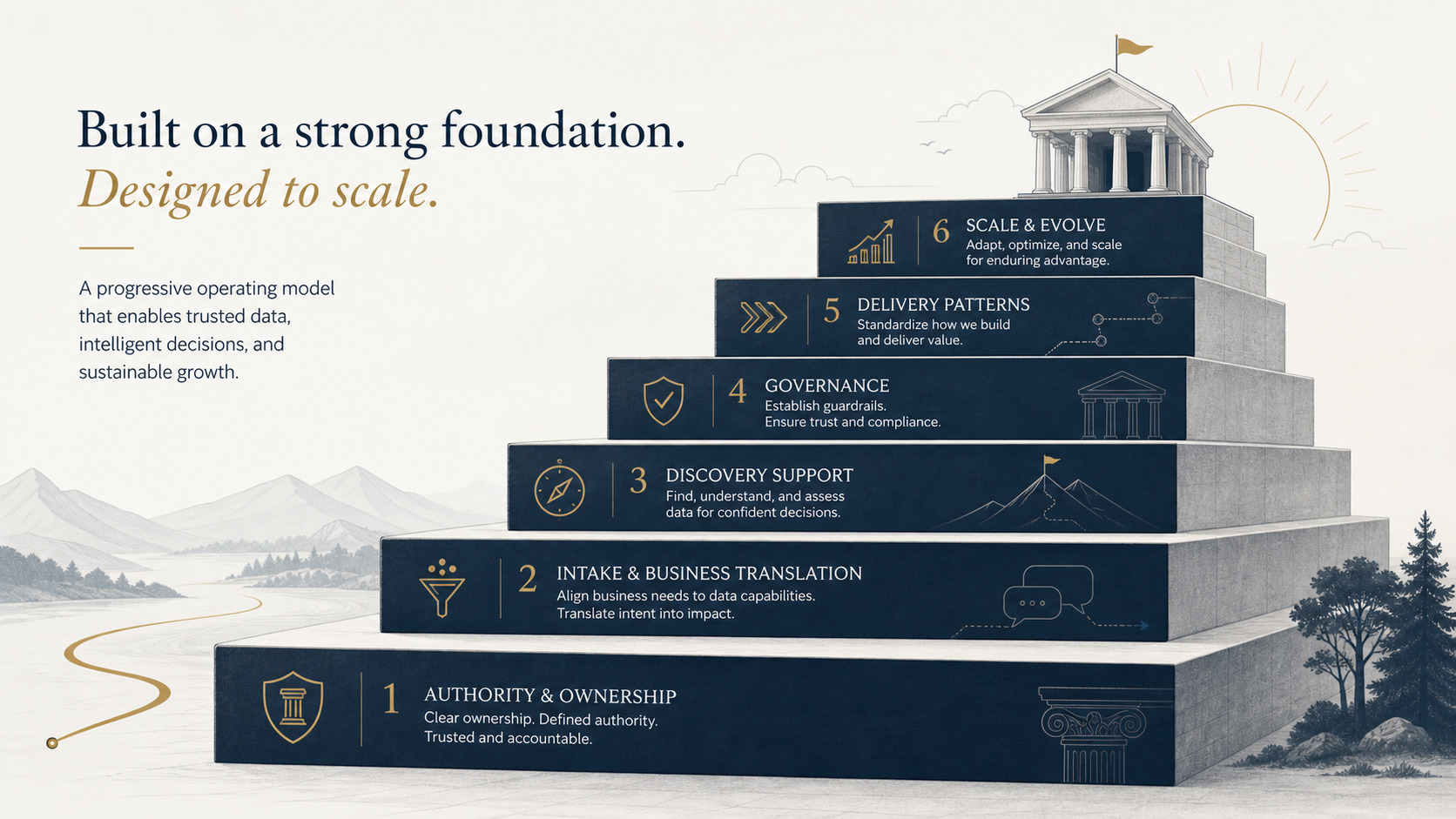
It starts with authority and ownership.
Before a data function can support the business well, there has to be clarity about who can prioritize work, who owns the business outcomes, who owns the data, and who can bring the right groups together when progress depends on multiple teams. That is part of what sits beneath A Data Function Has to Be Designed to Deliver. Commitment is not just a statement of support. It shows up in whether the function has the standing to move work forward.
From there, the next layer is intake and business translation.
This is where demand becomes more manageable. Which use cases matter most? What are they meant to improve? What dependencies do they carry? What level of oversight will they need? This is also where Why Data Transformations Stall and When Good Strategy Still Does Not Move become especially relevant. A lot of organizations do not struggle because they lack worthwhile ideas. They struggle because too many ideas are moving without enough structure around them.
The next piece is discovery support.
Before a use case becomes something the business can rely on, someone has to do the work of understanding where the data lives, what quality issues are likely to matter, how systems connect, what process constraints exist, and what the real opportunity looks like once it touches reality. That work does not always get much attention in strategy conversations, but it is often what makes the rest of the sequence credible.
After that, governance and delivery patterns start becoming more useful.
This is where the function begins to establish repeatable ways of working around a small number of real priorities. Definitions become clearer. Stewardship becomes more practical. Review paths become easier to follow. The business starts to see what good support looks like, not just what good intent sounds like. That connects naturally with What “Premier Member Service Through Responsible AI” Actually Looks Like and Before Signing an AI Vendor Contract: The Questions That Build Better AI Partnerships, because the same principle applies in both cases: trust is easier to maintain when ownership, controls, and review are built into the work from the beginning.
Only then does broader scaling start to make more sense.
At that stage, the function is not trying to support everything equally. It is building from a sequence that has already shown it can hold.
A simple example helps.
Say a credit union wants to improve indirect lending turnaround time. The instinct might be to think immediately about dashboards, automation, or AI-supported workflow improvements. Those may all have a place.
But the sequence usually starts earlier.
First, the business problem needs to be defined clearly. Is the issue intake, exception handling, document review, or decision support consistency?
Second, ownership needs to be clear. Who owns the outcome? Who owns the relevant data? Who has the authority to move the work across lending, operations, technology, and risk?
Third, the discovery work has to happen. What systems are involved? What data is available? Where are the bottlenecks? What controls matter?
Then the function is in a much better position to support the right reporting, workflow improvements, or decision support for that use case and to extend the pattern into adjacent work later.
That sequence is not about moving slowly.
It is about giving the function a chance to build in a way that is useful, trusted, and sustainable.
I think that is part of what Your Data Strategy Should Enable Your Business Strategy and AI Adoption in Practice: The Gap Between Enthusiasm and Execution are really pointing toward as well. A function becomes more valuable when its growth matches the realities of the business it is meant to support.
So when I think about proper sequencing, I do not think first about tools or even about scale.
I think first about what gives the function the best chance to support one important priority well, then a second, then a third.
That is usually where momentum becomes real.
When you look at your own institution, what part of the sequence feels strongest right now, and what part is ready for more attention?