February 27, 2026
Early in most organizations’ data journeys, data strategy lives in its own world. A separate initiative. A parallel track. The business has strategic goals, and somewhere in the IT section of the plan, there’s a bullet point about “improving data capabilities.”
That’s not wrong. It’s developmentally appropriate.
But as organizations mature, something fundamental shifts. Data and AI stop being enablers of business strategy and start becoming embedded in it. The distinction matters more than you might think.
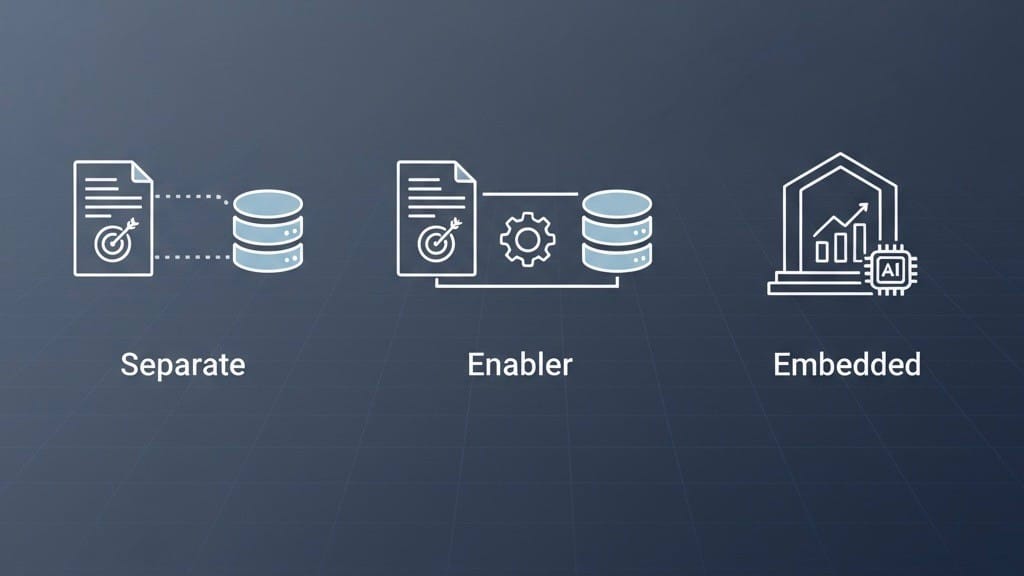
Three Stages of Integration
Stage 1: Separate
Your strategic plan mentions “modernize data infrastructure” as an IT project. Data strategy exists in its own slide deck, disconnected from business outcomes. Technology teams work on data, business teams work on strategy, and occasionally they talk.
The gap isn’t unusual. It reflects where you are in maturity. You’re building foundations while the business operates in familiar patterns.
Stage 2: Enabler
Your strategic plan says “grow loans 15%” and explicitly notes “enabled by AI-powered credit decisioning.” Data strategy directly supports business initiatives. You’re not just improving data quality; you’re improving it because marketing needs better segmentation or lending needs faster decisions.
This stage is critical. You’re proving value. Business leaders are asking for data capabilities to support their goals. The connection is explicit and tangible.
But here’s what’s changed: you can’t afford to stay here for years anymore. Five years ago, organizations could spend 3-5 years at Stage 2, gradually building credibility. Today’s competitive environment—fintechs moving at speed, megabanks deploying AI at scale—compresses that timeline dramatically.
The organizations winning right now are those that prove value at Stage 2 and quickly build momentum toward Stage 3. Not rushing foundations, but also not treating Stage 2 as a comfortable plateau. The question isn’t if you’ll embed data and AI into business strategy, but how fast you can do it responsibly.
Stage 3: Embedded
Your strategic plan assumes AI-powered personalization, predictive analytics, and data-driven decisioning as simply the way you operate. Not separate initiatives. Not IT projects. Just how business gets done.
Your member growth strategy isn’t “improve marketing and use data.” It’s “use predictive models to identify and acquire members most likely to become long-term engaged.” The data capability is the strategy.
Your lending strategy isn’t “modernize loan origination.” It’s “approve more members faster through AI-powered decisioning while maintaining credit quality.” The distinction is subtle but profound.
How Do You Know When You’re Ready to Advance?
Moving from Stage 1 to Stage 2 happens when you’ve proven data can reliably deliver on specific business problems. Your lending data is clean enough to trust. Your marketing analytics actually predict outcomes. You’ve built credibility through small wins.
Moving from Stage 2 to Stage 3 is different. It requires:
- Data quality that’s sustained, not episodic
- Analytics capabilities embedded in business processes, not bolt-on
- Business leaders who think in terms of data possibilities, not data requests
- Governance that enables speed, not just controls risk
Most importantly, it requires that data and AI capabilities have become reliable enough that the business can depend on them for core operations, not just periodic insights.
The Practical Test
Ask yourself: If your data team disappeared tomorrow, how long before critical business operations failed?
- At Stage 1, probably weeks. They’d keep running on instinct and spreadsheets.
- At Stage 2, days. Key reports would be missing. Decisions would slow.
- At Stage 3, hours. Your member engagement engine stops. Credit decisions stall. Operations grind down.
That dependency signals maturity, not fragility. It means data and AI have become fundamental to how value gets created.
Why This Evolution Matters
Industry trends reinforce this trajectory. Organizations that treat data as embedded in business strategy report measurably better outcomes: faster decision cycles, higher operational efficiency, and clearer competitive differentiation. The gap between those who’ve made this transition and those who haven’t is widening.
The goal isn’t to rush progression. Trying to operate at Stage 3 with Stage 1 foundations creates chaos. But understanding the path helps you invest appropriately. If you’re at Stage 2, you’re not building data infrastructure projects anymore. You’re building business capabilities that happen to require data and AI.
There’s a moment when “data strategy” stops being its own thing and just becomes “strategy.” That’s not a semantic shift. It’s strategic maturity. And it changes how you compete.
Where does your organization sit on this progression? And more importantly, what would need to be true to move to the next stage?