
After five articles on this Data and AI journey, I do not think the hardest questions are as mysterious as they once felt.
We have spent time on maturity, on fit-for-purpose data quality, on governance, on measurement, and on the reality that someone has to connect the work across business, data, technology, and trust. By this point, most leaders can see at least part of the landscape more clearly. The broad shape of the challenge is not hidden anymore.
That matters.
But seeing the journey clearly is not the same thing as moving through it well.
That is the tension I keep coming back to.
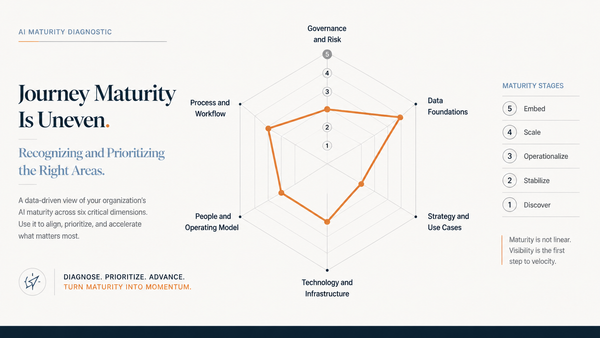
Across the earlier articles, the pattern was fairly consistent. First, the journey is real, and not every organization is in the same place. Second, maturity is uneven, which means ambition and readiness do not always travel at the same speed. Third, governance only works when it is right-sized to actual complexity, risk, and capacity. Fourth, measurement depends on context. The value is not in claiming AI progress in the abstract, but in improving decisions, strengthening trust, and delivering something that matters in the real work of the institution.
I still believe all of that.
But understanding those truths is not the same as having a practical way to move through them.
That is where many organizations seem to be now. Not asking whether this journey exists. Not debating whether AI, data quality, and governance matter. More often, they are trying to answer a more difficult question: how do we move forward in a way that is honest about where we are, realistic about what we can support, and still ambitious enough to matter?
That question is a lot less theoretical.
A credit union can understand that its data quality only needs to be fit for purpose, then still struggle to decide which data really needs attention first. It can understand that vendor AI does not remove accountability, then still lack a practical way to inventory those uses, assign owners, or decide which ones deserve tighter oversight. It can understand that AI should be measured by member impact, decision quality, and trust, then still default to softer activity metrics because those are easier to count.
This is the difference between recognizing the river and navigating it.
A map helps. It tells you the river is real. It shows you the broad direction. It may even highlight the major bends. But a white-water guide brings something different. A good guide knows where the trouble spots tend to be, which channels are safer under certain conditions, when a calm stretch is misleading, and when a team is not ready for the line it wants to take. Just as important, the guide also knows that no two runs are exactly the same. Water level changes. Weather changes. The boat changes. The people in it change.
That feels closer to the work in front of many organizations now.
The challenge is not just knowing the journey exists. It is reading the actual conditions of your own institution well enough to move through them responsibly.
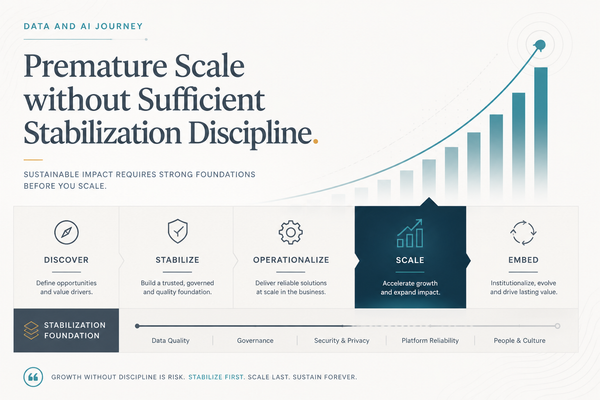
That means being honest when maturity is stronger in one area than another. It means admitting that a promising use case in lending, fraud, or member experience may still depend on work in data ownership, process discipline, or governance that has not happened yet. It means recognizing that what looks like hesitation is sometimes not lack of ambition at all. Sometimes it is a signal that sequencing matters.
And sequencing does matter.
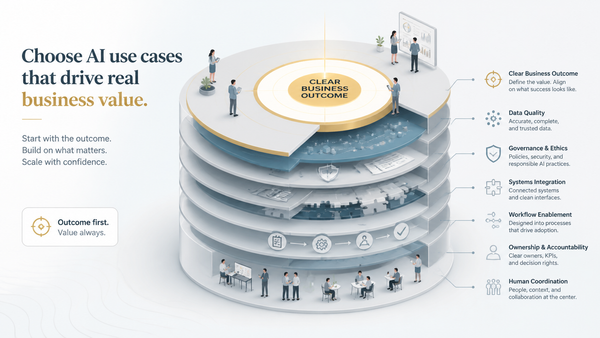
One of the clearest lessons from this series, at least for me, is that progress in Data and AI usually stalls when organizations try to skip the connective work. Strategy is discussed over here. Governance is discussed over there. Data quality is treated as a separate cleanup effort. Use cases are pursued one at a time. Measurement comes later, if it comes at all. Then everyone wonders why the effort feels fragmented.
It feels fragmented because it is.
Someone has to connect the work.
Someone has to help translate between the maturity you actually have and the maturity your plans assume. Someone has to connect use cases to data realities, governance expectations, vendor responsibilities, human oversight, and what success should look like in practice. Someone has to help the organization choose the right channel, not just point to the river and say go.
That is not about adding more process for its own sake.
It is about making progress credible inside the organization and defensible outside it.
In financial services, that matters quickly. If an AI-enabled process is influencing lending, fraud actions, member service, marketing, or communications, the institution eventually has to answer some very basic questions from regulators, auditors, executive peers, and its own leadership. What is this system doing. What data is it using. Who owns it. Where is the human review. How is it being monitored. How would we explain it if something goes wrong.
Those are not signs that innovation failed. They are part of doing the work responsibly.
That is why right-sized navigation matters. Too little structure creates risk. Too much structure creates theater. The point is not to put every organization in the same boat or force them down the same line. It is to help each one read its own conditions clearly enough to choose the right channel, move at a sustainable pace, and still be able to explain its decisions with confidence when it counts.
By this stage of the journey, I do not think most leaders need more big language about transformation. They need a practical way to connect maturity, governance, execution, and trust so progress is real, measurable, and defensible.
That feels like the real gap now.
After everything we have unpacked in this series, where does your organization feel most exposed right now: seeing the journey, choosing the right channel, or building a practical way to move through it?