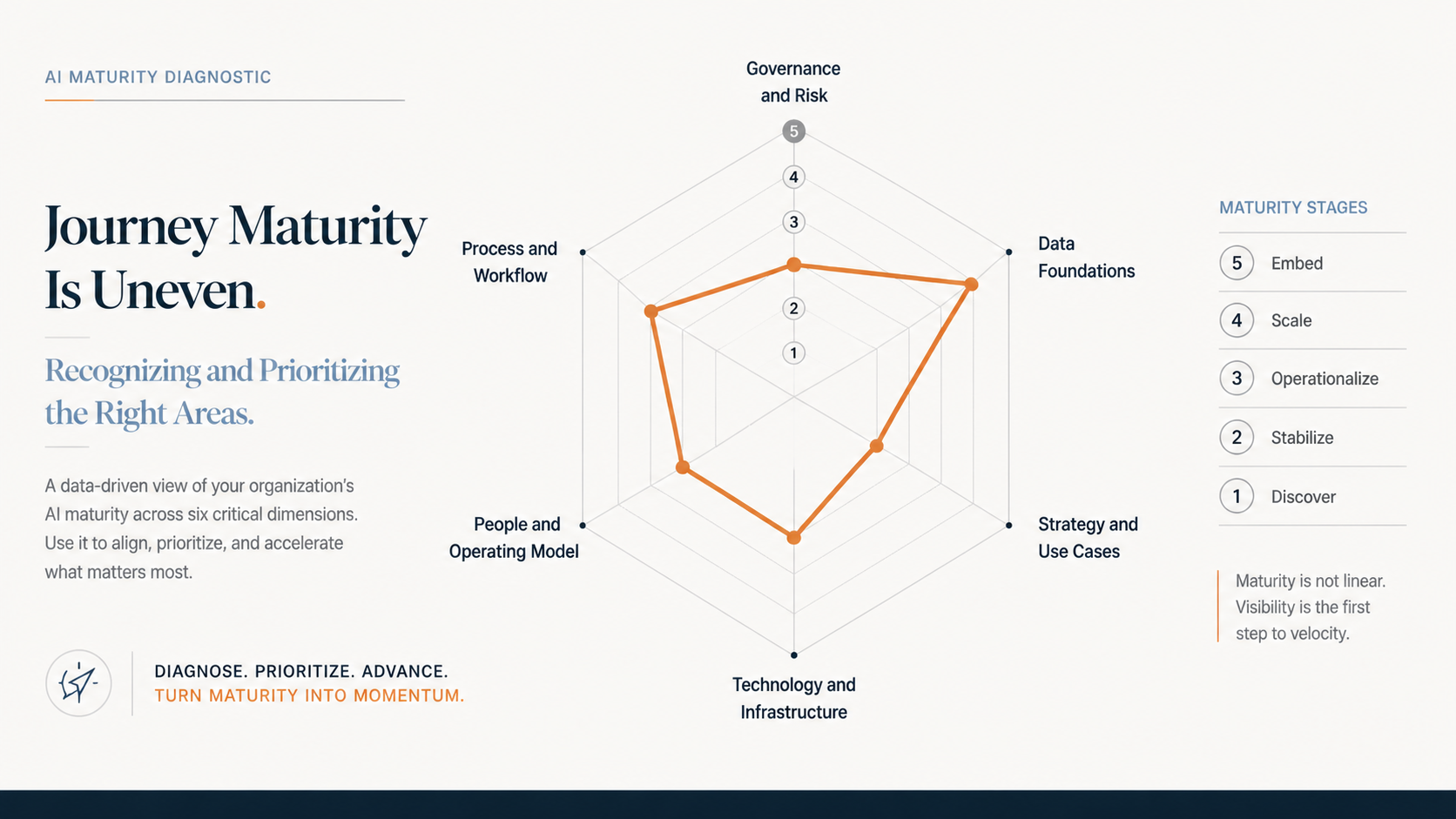
Part of the Data and AI Journey series. In the cornerstone article, the journey was framed as whitewater, not a roadmap: five phases, six connected capability areas, and progress that rarely moves in a neat straight line. Reading the Current is the opening arc of the series. This second article earns its place by showing why maturity is rarely even across the swimlanes, and why that unevenness often explains more than a single maturity label ever could.
Maturity rarely arrives as a clean institutional condition.
It usually shows up unevenly.
An organization may have thoughtful governance language and weak workflow discipline. Another may have strong data stewardship in a few domains but only a loose process for bringing forward new use cases. A third may have solid executive sponsorship and very little clarity about where vendor AI is already embedded. None of those conditions mean the organization is immature in some total sense. They mean maturity is distributed unevenly across the work.
That matters because leaders are often tempted to ask a single summary question: how mature are we? The more useful question is usually narrower. Where are we stronger than we realize, and where is that strength masking a lane that is carrying less than it needs to?
The framework itself points in that direction. The journey runs across six connected capability areas: Governance and Risk, Data Foundations, Strategy and Use Cases, Technology and Infrastructure, People and Operating Model, and Process and Workflow. That is another way of saying one strong lane does not remove the need for balance across the others.
This is where the whitewater framing still helps, as long as it stays disciplined. The issue is not whether one side of the raft looks solid. The issue is whether the whole thing is balanced enough for the next stretch of current.
A strong data team does not compensate for unclear decision rights. Modern infrastructure does not compensate for missing review cadence. A promising use case pipeline does not compensate for weak intake. One strength can create confidence. It cannot carry the entire journey on its own.
What makes uneven maturity tricky is that it often feels like a series of isolated frustrations when it is actually one connected pattern. Governance asks sensible questions, but enters too late to shape the work. Technology can support deployment, but ownership after launch is still fuzzy. Business teams want to move quickly, but the underlying data quality questions keep appearing at the same late stage. Each team experiences a different symptom. The institution is feeling the same imbalance.
A practical example is easy to picture. A credit union may have made real progress on data engineering and cloud modernization. Dashboards are improving. Data pipelines are cleaner. Technical confidence is growing. At the same time, AI use-case intake may still depend on informal conversations, committee review may not yet be consistent, and operating teams may be unclear on who owns monitoring once a capability goes live. The technology lane may be advancing well. The governance, process, and operating model lanes are still catching up.
That is not a failure of effort. It is what uneven maturity often looks like in real life. Some parts of the organization naturally move faster than others. The mistake is turning that natural unevenness into a false sense that the whole journey is further along than it is.
This is why I find the more useful definition of mature to be phase-specific and load-bearing. Mature does not mean every lane is equally advanced. It means the lanes that matter most for the current phase are strong enough to support the next move without creating avoidable drag, confusion, or trust gaps.
That changes the leadership question. Instead of trying to raise every score at once, leaders can ask which weak lane is doing the most to slow, distort, or destabilize the phase they are in. If Discover is active but visibility is incomplete, strengthen inventory and ownership. If Stabilize is underway but workflow is still informal, strengthen process discipline. If Operationalize is the goal but governance still enters late, fix review cadence and decision rights before calling for broader scale.
Organizations rarely need a prettier maturity label. They need a more honest read on imbalance.
Where is your strongest swimlane creating confidence that your weakest swimlane has not yet earned?