Part of the Data and AI Journey series. In the cornerstone article, the journey was framed as whitewater, not a roadmap: five phases, six connected capability areas, and progress that rarely moves in a neat straight line. Reading the Current is the opening arc of the series. This third article earns its place by focusing on one of the most common recognition problems in the journey: using the language of scale before the discipline of stabilization has fully taken hold.
A lot of organizations start using the language of scale the moment activity begins to spread.
That makes sense. More requests show up. More pilots seem promising. More vendors announce AI-enabled features. Executive attention grows. The organization can feel busier, bolder, and more advanced in a very short period of time.
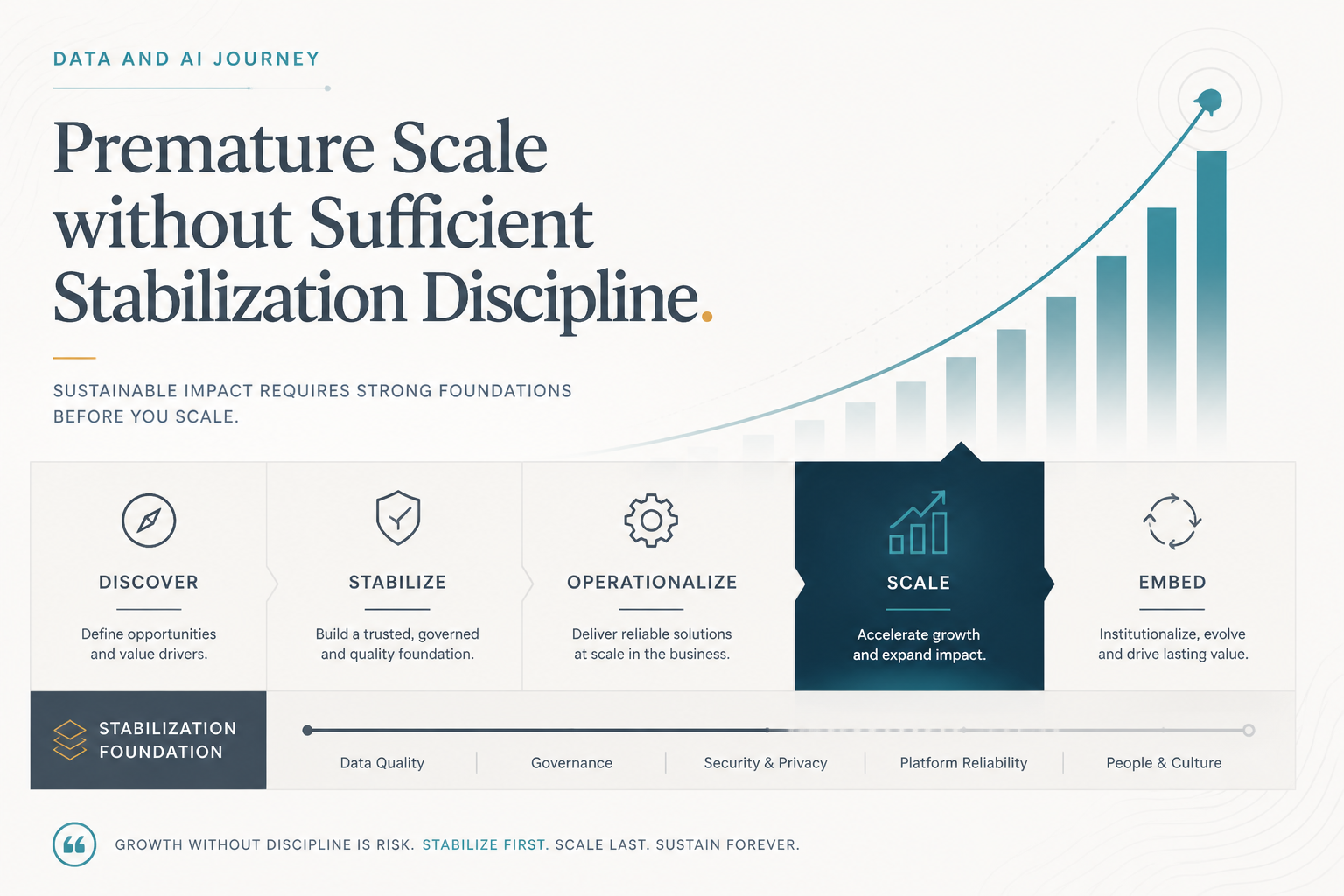
However, the journey map makes a sharper distinction. Stabilize is the phase where governance exists on paper and in practice, roles are assigned, committees are operating, and inventory is becoming complete. Operationalize is where governance runs on a calendar, vendor oversight is active, and metrics are established. Scale comes later, when governance covers the full portfolio rather than a growing set of exceptions.
That distinction is easy to blur because activity is visible while discipline is quieter. People can see new use cases, expanding vendor capabilities, and executive excitement. They do not always see the slower work of building intake, assigning ownership, documenting workflow, classifying risk, or naming the data stewardship needed to support trustworthy use.
Yet that slower work is what allows growth to hold.
Without it, organizations often mistake four things for scale. They mistake volume for repeatability, tooling for readiness, executive attention for operating capability, and local success for institutional maturity. Each one feels persuasive in the moment. None of them tells you whether the organization can absorb more complexity without losing clarity.
Credit unions are seeing a version of this right now. AI often enters through existing platforms: the core, the lending stack, the contact center, fraud systems, or digital banking vendors. Because it appears as an embedded feature, it can feel easier to adopt and easier to distribute. But wider availability is not the same as wider readiness. If there is still no consistent view of where AI is in use, how new functionality enters review, who owns oversight after deployment, or when member-facing implications trigger a higher bar of scrutiny, the organization is still building stabilization muscle.
That is not lack of ambition. It is appropriate sequencing.
In fact, some of the strongest organizations are the ones that get more precise at this point, not less. They recognize that scale is not the spread of activity. It is the spread of something that has already become reliable enough to carry more weight.
You can usually hear the difference in the internal conversation. Earlier-stage organizations talk about what they want to launch. Stabilizing organizations start talking about how work enters, how risk is classified, how data dependencies are surfaced, how exceptions are handled, and how review responsibilities are shared. Those questions may sound less exciting, but they are the reason later growth does not become a source of confusion or rework.
There is also a trust dimension here. When the discipline underneath the work is still uneven, expansion does not just create more activity. It creates more chances for inconsistent outcomes, unclear escalation, and member-facing experiences that are harder to explain or defend. Responsible growth depends on more than good intent. It depends on whether the institution can see, review, and sustain what it is putting into motion.
So the useful question is not whether a lot is happening. It is whether enough has become dependable to support broader adoption without asking a few experienced people to carry the whole thing through force of effort.
At what point does your organization stop needing more AI activity and start needing more stabilization discipline to support what is already underway?