
Part of the Data and AI Journey series. In the cornerstone article, the journey was framed as whitewater, not a roadmap: five phases, six connected capability areas, and progress that rarely moves in a neat straight line. This article is part of Reading the Current, the opening arc focused on helping leaders recognize where they really are before deciding what should come next.
One of the easiest ways to lose clarity on the data and AI journey is to let ambition label the phase before the work underneath has caught up.
That is understandable. Interest builds quickly. New ideas show up from every corner of the organization. A vendor adds AI to an existing platform and something that felt exploratory on Monday starts sounding strategic by Friday. But phase is not best read through enthusiasm. It is best read through evidence.
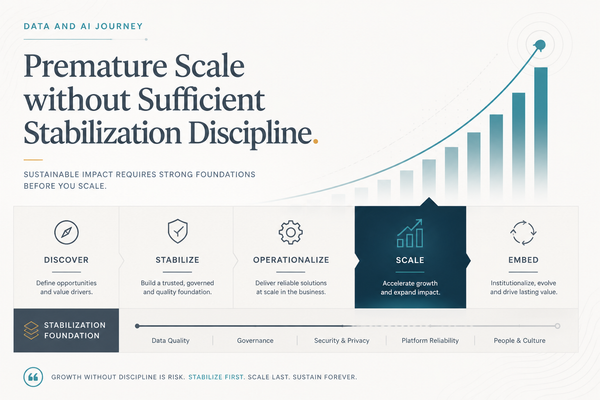
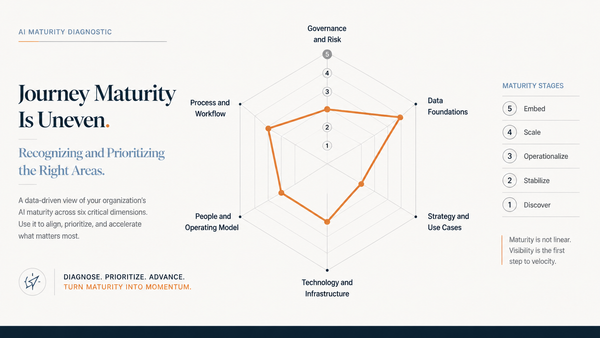
The five phases matter because they describe what becomes true as an organization matures: Discover, Stabilize, Operationalize, Scale, and Embed. They also sit across six connected capability areas, which means no phase is confirmed by one promising team, one useful model, or one strong executive sponsor.
The clearest signals are usually ordinary.
How do ideas enter the organization? Who decides what moves forward? What gets reviewed on a cadence, and what still depends on memory? Where does vendor AI appear without much visibility? What happens when a team wants to move faster than the supporting governance or data discipline allows?
Those are phase questions.
In Discover, visibility is still forming. The organization is surfacing known AI activity, identifying gaps, ranking priorities, and aligning leadership around what is actually in play. Inventory is still incomplete. Ownership is still coming into focus. Similar initiatives may be described very differently by IT, operations, risk, and business leaders because the organization is still building a shared picture of the current state.
Stabilize feels different. Governance begins to exist both on paper and in practice. Roles are assigned. Committees start to operate with real cadence. Inventories become more complete. Data stewardship starts moving from implied responsibility to named accountability. In this phase, the organization is not trying to look finished. It is putting enough structure in place that decisions stop being one-off events.
That often matters more than people expect. A defined intake path, a clearer approval flow, an initial risk classification process, and known data stewards may not look dramatic from the outside. Inside the work, they change everything. They make it easier to see what is entering the organization, who owns which decisions, and where trust can be earned rather than assumed.
Operationalize is where the work starts running on rhythm instead of reaction. The journey map describes this phase as the point where governance runs on a calendar, processes are documented, vendor oversight is active, and metrics are established. At that point, the organization is not rebuilding context every time a new use case appears. It is working from a repeatable operating pattern.
Scale is where language often gets ahead of reality. In the framework, scale means governance covers the full portfolio: every material use case, every relevant vendor, every domain that needs to be tracked and reviewed. It is not simply the moment when more activity is happening.
A credit union can feel this very clearly. AI may be arriving through the core, LOS, digital banking, fraud tools, contact center software, and analytics platforms, often as product features rather than standalone AI projects. That can create real momentum. But if visibility is incomplete, intake is inconsistent, and review paths still vary by department, the organization is still doing important stabilization work, even if the language around it has become bigger.
Embed is quieter than most people expect. Governance becomes part of how the organization operates rather than a separate program. Review cycles are current. Ownership is sustained. Processes continue without special prompting. The model even assumes that minimum viable governance is never permanently achieved, which is a useful reminder that maturity includes returning to the basics before drift has a chance to grow.
A simple test helps here. Look for what continues to happen when the people involved change. If good outcomes still depend on a few experienced people stitching handoffs together, remembering who needs to be involved, or catching issues before they spread, the organization is probably earlier in the journey than its language suggests. If the work continues with visible ownership, regular review, and consistent follow-through, the phase is becoming real.
That is why phase should be read through evidence, not aspiration. Not because ambition is a problem. Because naming the wrong phase changes the decisions that come next.
What evidence inside your organization would convince you that you are truly in the phase you say you are in?