
May 28, 2026
A lot of organizations are having the right conversations right now.
Governance is being discussed. AI inventories are getting started. Data quality issues are being acknowledged. Vendor questions are finally being asked more seriously.
And still, in a lot of places, not much is actually moving.
I do not say that as a criticism. I say it because I think a lot of us can recognize the pattern. The awareness is there. The concerns are real. The language is more mature than it was even a year ago. But there is still a real difference between recognizing what matters and having a practical way to move it forward.
That gap is where a lot of the current tension lives.
A strategy conversation can feel like progress. So can a draft policy. So can an inventory. Even a list of possible pilots can create the impression that things are starting to take shape. Sometimes they are. But just as often, those pieces are sitting next to each other without a clear mechanism that turns them into sequence, ownership, decisions, and follow-through.
That is a very different issue than simply lacking strategy.
I keep noticing that many institutions are not short on awareness. They are not even short on governance language. In many cases, they are not short on good intentions either. What they are running into is the harder work of turning broad agreement into something people can actually operate inside.
That sounds simple until you get into the real conditions most institutions are working through.
Use cases cut across teams. Data issues show up unevenly. Ownership can feel clear until a decision carries enough member, regulatory, or reputational weight that everyone quite reasonably wants a closer look. A vendor capability that seemed straightforward at first can quickly raise bigger questions about accountability, oversight, and whether the organization is truly ready to use it the way it was originally imagined.
So the challenge is usually not just choosing what to do next. It is choosing in a way the organization can support, explain, and sustain.
That is where the friction tends to show up.
You see it when a promising lending use case depends on data that still does not reconcile cleanly across systems. You see it when there is broad interest in using AI to improve member service, but no shared understanding of whether the next step is staff assistance, message drafting, smarter routing, or something member-facing. You see it when everyone agrees experimentation matters, but there is still uncertainty around who can move a lower-risk idea forward, who needs to weigh in, and what should trigger broader review.
At that point, the organization does not need another abstract conversation about innovation. It needs enough operating clarity to make the next decision well.
I think that is an important distinction. A lot of institutions do have principles. They do have inventories underway. They do have policy conversations happening. But those things are not the same as having an operating rhythm that consistently turns discussion into movement. They are inputs. Useful ones. Necessary ones. But still only inputs.
The work changes when the conversation becomes more practical.
What are we trying to improve first? Which decisions or member moments actually matter enough to prioritize? Where is the data foundation strong enough to support progress, and where is it not? What level of oversight fits this use case? What has to be decided centrally, and what can be handled closer to the work?
Those are not small questions. They are also not side questions. They are the work.
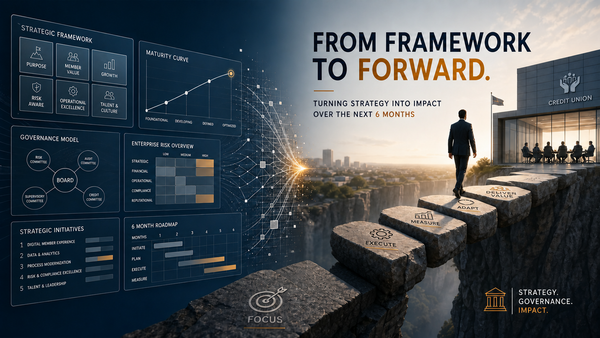
The analogy I keep coming back to is this: a lot of organizations have done the equivalent of agreeing on the destination, discussing the safety rules, and reviewing the route. All of that matters. But eventually you still have to decide who is driving, what vehicle is actually ready, and which road you are taking first. Until that happens, the conversation can stay mature while the movement stays limited.
That is why this moment can feel uncomfortable in such a specific way. Many institutions are not avoiding the issue. They are standing right next to it. They can see the need. They can describe the risk. They can talk intelligently about governance, data quality, and vendor accountability. What is still taking shape is the practical bridge between recognition and repeatable action.
And to be fair, that bridge will not look the same everywhere.
For one organization, the next unlock may be clearer decision rights. For another, it may be a more disciplined intake and prioritization path. For another, it may be the uncomfortable but necessary recognition that the current ambition has outrun the current capacity to support it well. That is not a sign that the organization is behind. Most of the time, it is a sign that the conversation has finally become honest enough to be useful.
In a regulated, member-centered environment, that honesty matters.
Because slow movement is not neutral forever. It delays better decisions. It delays better member experiences. It delays the kind of trust that comes from being able to explain not just what the organization wants to do with data and AI, but how it is actually going to do it responsibly.
Part of the reason this stalls is that organizations tend to talk about maturity as if it rises evenly. It usually does not. That is where a lot of the confusion starts.
Where in your organization does the gap between discussion and movement show up most clearly right now?