
May 27, 2026
If your leadership team is already arguing about KPIs versus OKRs for data and AI, you are not at square one anymore.
But that does not automatically mean you are ready for the level of precision those tools assume.
There is plenty of structure to reach for right now. NCUA has AI resources that touch risk management, vendor oversight, and resilience. NIST has its AI Risk Management Framework with neat categories like Govern, Map, Measure, and Manage. Big-firm maturity models promise a staged path from pilots to “AI at scale.”
The bind usually is not lack of structure.
On paper, the story can look pretty mature. There is a governance page in the deck. There is an AI principles statement. Someone has sketched a five-level maturity curve. Board updates mention responsible AI and oversight.
And yet, when you sit with the team and ask what exactly is supposed to happen next, the answers start to wander.
Frameworks are good at describing the landscape. They give your board, examiners, and executives shared vocabulary. They organize the problem.
What they do not do for you is the messier part. Picking the real starting point for your institution, not the one that sounds best. Admitting which lane is actually constraining you right now, whether that is data quality, ownership, vendor visibility, governance, or simple execution capacity. Being specific about what moves now and what waits.
That is where these conversations often start drifting.
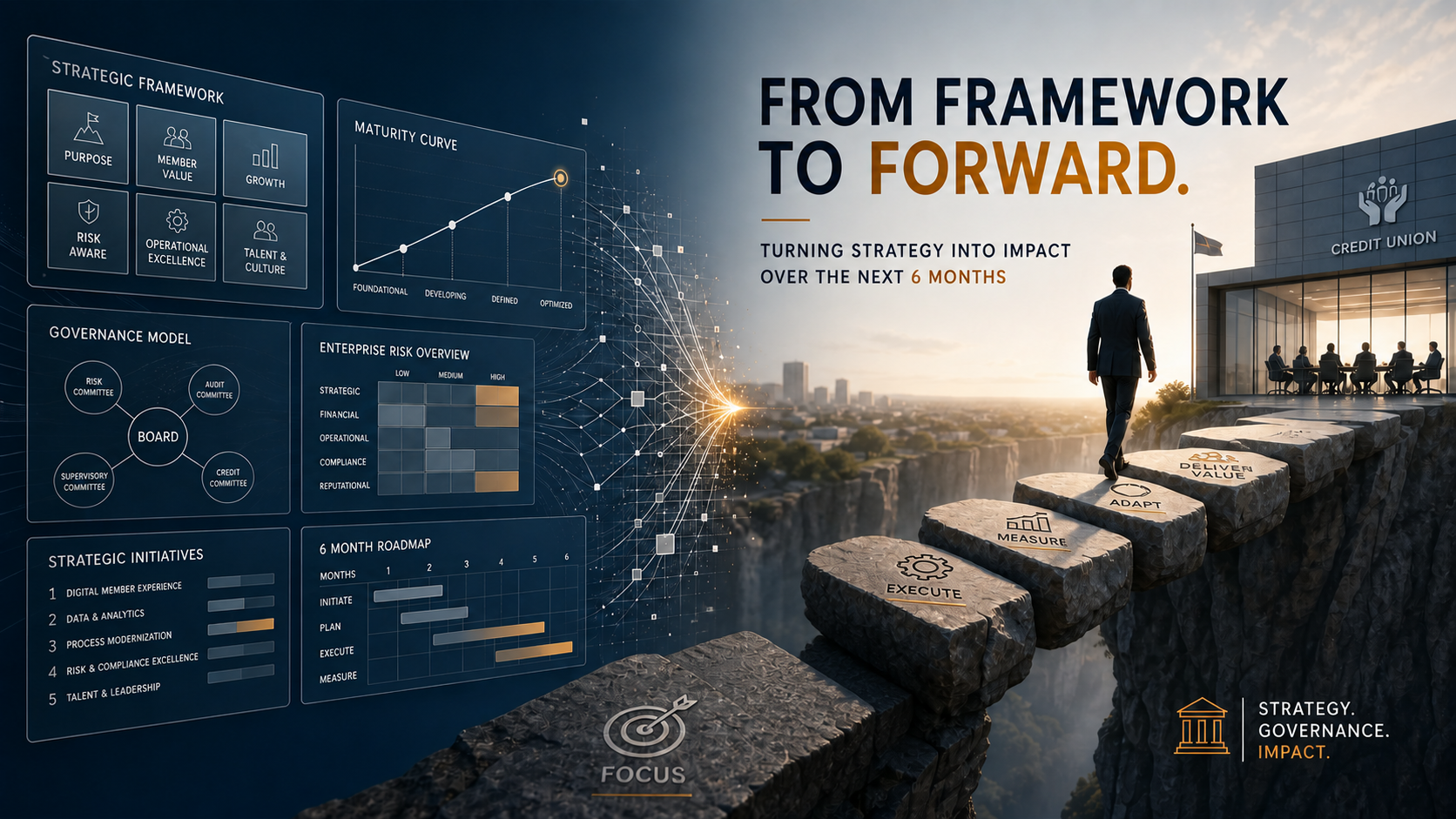
One of the reasons I hesitate with maturity language is that it can make this all sound too slow and too linear. Technology is not moving on a neat three-year roadmap. AI capabilities are changing quarter to quarter. Vendor platforms are changing. Expectations are changing. What looked advanced six months ago can feel ordinary pretty quickly.
So I do not think the answer is to abandon the idea of a journey. I think it is to stop treating the journey like a long program plan.
The journey may be multi-stage. The movement cannot be.
If a team cannot turn strategy into visible movement inside roughly six months, there is a good chance the target starts to drift, the technology changes, priorities shift, or the original problem gets overtaken by something more immediate. That does not mean everything should be built in six months. It means the next step has to be real enough, small enough, and useful enough to matter inside that window.
That changes the kind of questions that matter.
Not where do we want to be three years from now, at least not first.
More like:
- Where are we actually entering, given our data, people, and operating model?
- Which lane is the real bottleneck right now?
- What can we move in the next three to six months that will still matter a year from now?
Without that translation, the KPI/OKR discussion ends up hovering a few feet above reality.
You can write crisp goals about AI-enabled lending decisions or data-driven member engagement. You can track dashboard counts, use case counts, adoption rates, model reviews, whatever you want.
But underneath, nobody is entirely sure whether the organization is still trying to stabilize the basics, stand up a workable operating cadence, sort out ownership, or scale serious use cases.
At that point, the numbers are mostly measuring motion.
Investment makes this even more obvious.
You see big ambitions with small budgets. Roadmaps that stretch across lending, fraud, marketing, operations, and member experience, funded like a single experiment. Governance expectations that read like a large-bank playbook, sitting on top of one or two overextended people and a collection of spreadsheets. Transformation work being squeezed in between day jobs.
And that is part of the honesty this conversation requires.
Sometimes the issue is not that the framework is wrong. It is that the institution is trying to move faster in language than it is willing to support in practice.
In that environment, KPIs and OKRs can create a comforting sense of control. There are dashboards. There are updates. It sounds managed.
But the mismatch is still there: a sophisticated story on the slide, and a journey on the ground that has not really been translated into a sequence of moves the organization can sustain and adjust fast enough to stay relevant.
That is not just a project-management problem.
Once AI starts touching lending decisions, fraud flags, collections strategies, personalized offers, or service interactions, members feel the effects long before any maturity model says you are “ready.” Faster approvals show up quickly. So do confusing denials, inconsistent treatment, awkward automation, or unexplained account friction.
The journey might feel abstract internally. It does not feel abstract to the member.
This is why external frameworks need a second step inside each institution.
They are useful. They give you structure and guardrails. They make it easier to explain why you care about explainability, data quality, monitoring, vendor risk, and human accountability. They give everyone something to point at.
But they stop short of answering the questions only your institution can answer.
With the data we actually have, which use cases are safe enough and important enough to move on now?
Given our size and operating model, what is the minimum viable governance that protects members without freezing progress?
And maybe most importantly, what are we willing to put real weight behind over the next six months so this becomes movement instead of another discussion?
That last part matters more than I think we sometimes admit.
A lot of organizations have enough frameworks already. What they do not have is a practical way to convert those frameworks into short, sequenced moves that build on each other fast enough to keep up with the pace of change.
That is a very different problem than lack of strategy.
It is also why I think KPI and OKR debates get confusing so quickly. Teams are trying to measure a journey that still has not been translated into movement. Or they are trying to measure a three-year maturity aspiration in an environment where the only thing that feels credible is what can be moved, learned, and adjusted in the next two quarters.
That does not mean long-term thinking goes away.
It means the long-term direction should stay steady while the execution horizon gets much shorter.
Member trust stays steady. Responsible governance stays steady. Better decisions stay steady. Clearer ownership stays steady.
But the path forward needs to move in shorter intervals than a lot of classic strategy language suggests.
For this first article in the series, that is really the point I want to put on the table.
The question is not whether frameworks like NCUA guidance, NIST, or big-firm maturity models are helpful. They are.
The question is whether your organization has done the harder translation work. Have you been blunt about where you are actually starting, lane by lane? Have you narrowed the next move enough that it can produce something real inside six months? Have you matched the investment to the maturity story you are telling your board and your teams?
If not, the KPI vs. OKR debate is probably a few steps ahead of where the organization actually is.
There will be a time to tighten the measurement.
But first, the journey has to become real enough to move.
A lot of teams can describe their Data and AI Journey. Far fewer can point to what they are moving, right now, that will still matter six months from now.
What does a credible next six months actually look like in your institution?