February 25, 2026
Everyone agrees AI should be "responsible." Fewer organizations can describe what that looks like on a Tuesday afternoon when the lending team wants to deploy a new credit model, the contact center is asking about AI-powered call summaries, and marketing wants predictive analytics for cross-selling.
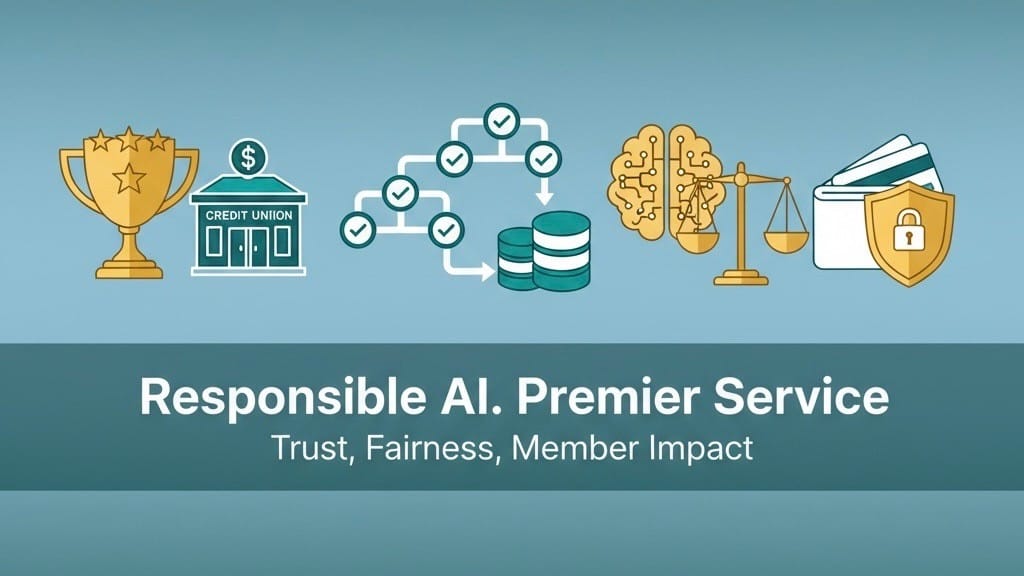
Responsible AI needs to be more than a principle. It needs to be a practice, with specific decisions, controls, and commitments that protect members while delivering the premier services they deserve.
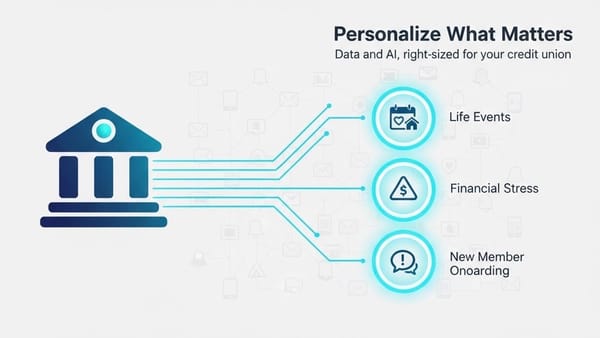
Reframing "Data Monetization" for Credit Unions
In a credit union, "data monetization" shouldn't mean selling data or squeezing more fees from members. Our definition has to be stricter: using data and AI to create more value for members than they could get anywhere else. That shows up as lower friction, better pricing, proactive financial help, or preventing harm before it happens. But the benefit is measured first in member outcomes, not a new line of non-interest income.
A lot of data monetization models talk about layers of value, from raw data to insights to new products. For credit unions, those upper layers only count when they translate into tangible improvements in members' financial lives.
Start With the Member Impact Spectrum
Not every AI use case carries the same risk to members. A practical approach starts by classifying where AI touches members:
High-stakes: Credit decisions, fraud holds, collections prioritization, pricing
→ What members need: Explainability, fairness testing, human review, appeal rights
Medium-stakes: Product recommendations, personalized offers, chatbot interactions
→ What members need: Transparency ("this is AI-assisted"), opt-out options, accuracy monitoring
Lower-stakes: Internal analytics, operational efficiency, report generation
→ What members need: Data security, privacy controls, appropriate use policies
The NCUA's AI compliance framework reinforces this. Any AI that could materially affect members should be treated as high-impact, with stricter controls including independent testing, human review, and evidence of fairness. This isn't about slowing adoption. It's about matching oversight to consequence.
Three Commitments That Make Ethics Operational
Commitment 1: Transparency as default
Members should know when AI is involved in decisions that affect them. This means clear disclosure when they're interacting with a chatbot, not a person. It means adverse action notices that reflect the actual reasons for a decision, not generic checklists that mask algorithmic complexity.
A practical step most credit unions can take now: audit every member-facing AI touchpoint and ask, "Would a member know AI is involved here? And if they asked how it works, could we give them a straight answer?"
Commitment 2: Fairness as a continuous practice, not a one-time test
Fair lending isn't just a compliance checkbox when AI is involved. It requires ongoing monitoring. AI models can drift over time as data patterns change. A model that was fair at deployment can develop disparate outcomes six months later without anyone noticing.
What this looks like in practice:
- Regular disparate impact testing across protected classes
- Override monitoring (are human reviewers consistently overturning AI recommendations for certain populations?)
- Member outcome tracking, not just model performance metrics
- Documented escalation paths when issues are identified
Ethical monetization means we don't celebrate "lift" if it comes at the cost of fairness. More approvals or better risk detection only qualify as success if our members can trust the process that got them there.
Commitment 3: Privacy as a member promise, not just a policy
Member data is the fuel for AI. That creates a responsibility that goes beyond regulatory minimums. The NCUA's resource hub specifically calls out the need to protect sensitive member information and maintain the accuracy of AI-driven decisions.
Questions every credit union should be asking its AI vendors: Is member data used for model training? Can it be used to improve products for other clients? What data retention limits exist? What happens to member data if we terminate the relationship?
Premier service means members can trust that their data works for them (personalized advice, faster service, better fraud protection) without being exploited for purposes they didn't consent to.
The "Premier Service" Test
Here's a simple litmus test for any AI initiative: Does this use of data turn into more financial well-being, less friction, or lower risk for our members in a way we can clearly show them?
If the answer is yes (faster approvals with fair outcomes, proactive fraud alerts that catch problems before members notice, personalized financial wellness nudges at the right moment), that's premier service delivered responsibly.
If the answer is "it saves us money" or "everyone else is doing it," that's not a member-first rationale. It might still be worth pursuing, but it needs a different justification and different guardrails.
Why This Matters
Credit unions that get this right won't just avoid regulatory trouble. They'll build the kind of member loyalty that no marketing campaign can replicate. In a world where trust in AI is low and demand for personalized service is high, the institution that earns the right to say "we use AI to serve you better, and here's exactly how" will define what premier financial service looks like.
How is your credit union defining "data monetization" today, and does that definition start with member value or institutional value? I'd love to hear what's working and what's still a work in progress.