February 23, 2026
In financial services, it feels like personalization has become a default requirement. If your app, site, emails, and contact center are not personalized, you are behind. And to be fair, many consumers do expect a more tailored experience now.
But I think we sometimes miss the more strategic question: Are we personalizing the interactions that actually change trust, loyalty, and outcomes, or just the ones that are easiest to instrument?
One of the most helpful reframes I have seen (and I am still learning to apply consistently) is this: personalization is not a volume game. It is a prioritization game.
Here is a pragmatic way to pressure-test your roadmap before it turns into 47 “personalization” tickets that nobody can measure.
Start with the member moment, not the channel.
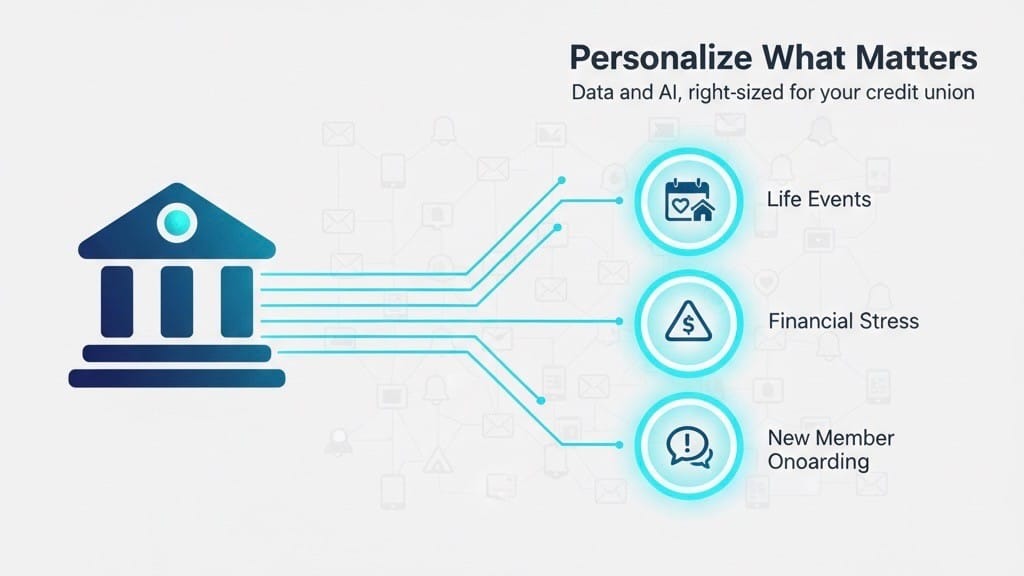
Personalization is often “most commonly practiced” in the app or website, but it can show up across touchpoints including email and call centers. The trap is letting channels drive strategy. Instead, pick the moments where relevance matters most: onboarding, a big financial decision, a service failure, a life event, a hardship signal. (You can personalize a banner all day and still lose the relationship if you mishandle the moment they actually needed you.)
Keep the segmentation simple enough to scale.
A misconception that resonated with me: teams assume personalization requires a ton of data, but meaningful personalization can start with first-party data and contextual signals. Another misconception: personalization equals building and managing endless micro-segments, when a practical starting point can be focusing on three to four primary audiences and improving from there. If your “personalization strategy” only impacts tiny pockets of traffic, it might be sophisticated, but it will not be material.
Treat personalization as an operating discipline, not a launch.
Personalization is not “set it and forget it.” It requires ongoing measurement and iteration because needs change over time. That also means your data quality and governance discipline matters, because you cannot sustain relevance on messy, inconsistent inputs.
Personalization done well is one of those topics boards and executives care about for a simple reason: it is not a marketing feature. It is a loyalty and growth lever when applied at the right moments.
If you had to pick just two member moments to personalize deeply this year (and deprioritize everything else), which moments would you choose and why?