
One of the harder conversations in an early-stage data and AI journey is not about tools.
It is about who owns the work of proving that any of it is creating value.
That sounds simpler than it is. Most organizations can tell you what they are doing. They can list the pilots, the dashboards, the cleanup work, the vendor conversations, the use cases in motion. What gets much less clear, especially early on, is who is responsible for turning all of that into a small number of measures that actually tell leadership whether the business is getting better.
And early on, those measures are rarely sitting there ready to go.
They usually have to be defined, baselined, and made trustworthy enough to steer by.
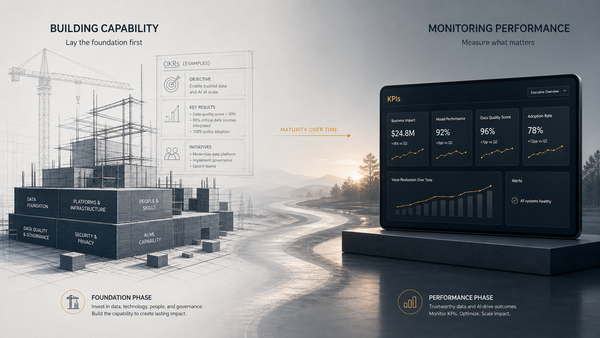
That is the part I think gets underestimated. When an organization is still maturing, the KPI work is not just a reporting exercise at the end. It is part of the build itself. Definitions are still being tightened. Data sources are still being reconciled. Ownership is still being sorted out. Baselines may still be rough. In some cases, the team is trying to improve the process and figure out how to measure the impact at the same time.
That is why I do not think this belongs neatly to one function.
If the lending team wants to improve decision quality, then lending has to own that outcome. If operations wants to reduce friction, then operations has to own that outcome. If member service wants to improve experience and consistency, that business leader has to own the outcome there too. Otherwise, the KPI quickly turns into something the data team is producing for the business instead of something the business is using to run itself.
At the same time, I do not think the business can do it alone.
Early-stage KPI work usually needs a kind of shared construction. The business has to define what better looks like. Data and analytics help translate that into something measurable. Technology helps identify what can actually be captured consistently. Finance, risk, and governance help pressure-test whether the measure is balanced and whether it could create the wrong incentives. If any one of those pieces is missing, the KPI may still look good on paper while being weak in practice.
That is probably why this gets frustrating in real organizations.
Everyone is busy. Nobody wants a new metric exercise. And a lot of people can sense, correctly, that if this gets handled the wrong way it becomes more reporting work without more clarity. But avoiding the work does not solve the problem either. It just leaves leadership with activity measures and a lot of interpretation layered on top.
I think the more useful question is not who owns the KPI in the abstract.
It is who owns the business outcome, and who has to help make that outcome measurable enough to steer by.
That feels more honest to me.
Because early on, most business value KPIs do not arrive fully formed. They start as a business question. Are loan decisions getting better, not just faster? Is member friction going down in a way members would actually feel? Is manual rework dropping, or are we just moving it around? Is the use of AI helping staff make better decisions, or just giving them another tool to manage? Those questions are business questions first. The KPI is the disciplined attempt to answer them consistently over time.
And in an early-stage environment, I think that is where maturity really shows up.
Not in having the perfect dashboard.
In being honest about what is still rough, what can be measured now, what has to be proxied for a while, and what needs to be improved before the metric deserves executive confidence.
There is nothing wrong with that stage, by the way. A lot of organizations are there. The risk is pretending the KPI is mature just because the dashboard exists. A number can be visible long before it is trustworthy. A measure can be reported every month and still not be stable enough to guide decisions at the CEO or board level.
That is why I keep coming back to shared accountability with clear lines.
The business leader should own the value case. The data and analytics team should help build the measure. Technology should help operationalize it. Governance and risk should help make sure the metric is not rewarding the wrong behavior. Senior leadership should decide which of those measures truly belong at the executive level and which ones are still operating indicators that need more time to mature.
That may sound slower than assigning KPI ownership to a single team.
I think it is actually more realistic.
Because what early-stage organizations usually need is not a hero function. They need a way to move a measure from loose and intuitive to defined, repeatable, and decision-useful. That is less about turf and more about disciplined collaboration.
And maybe that is the real point of ownership here.
The business owns whether value is created.
The technical and control functions help prove it.
If one of your organization’s most important value KPIs is still partly manual, still being debated, or still leaning on rough proxy measures, who is actually responsible for maturing it into something leadership would trust enough to act on?