March 15, 2026
We've been asking the wrong question.
Not entirely wrong — but incomplete in a way that's starting to matter more. Whenever AI comes up in a leadership conversation, the reflex is still: What's the ROI? That question made sense in the digital transformation era, when we were measuring cost savings and comparing software licenses. It's not enough anymore.
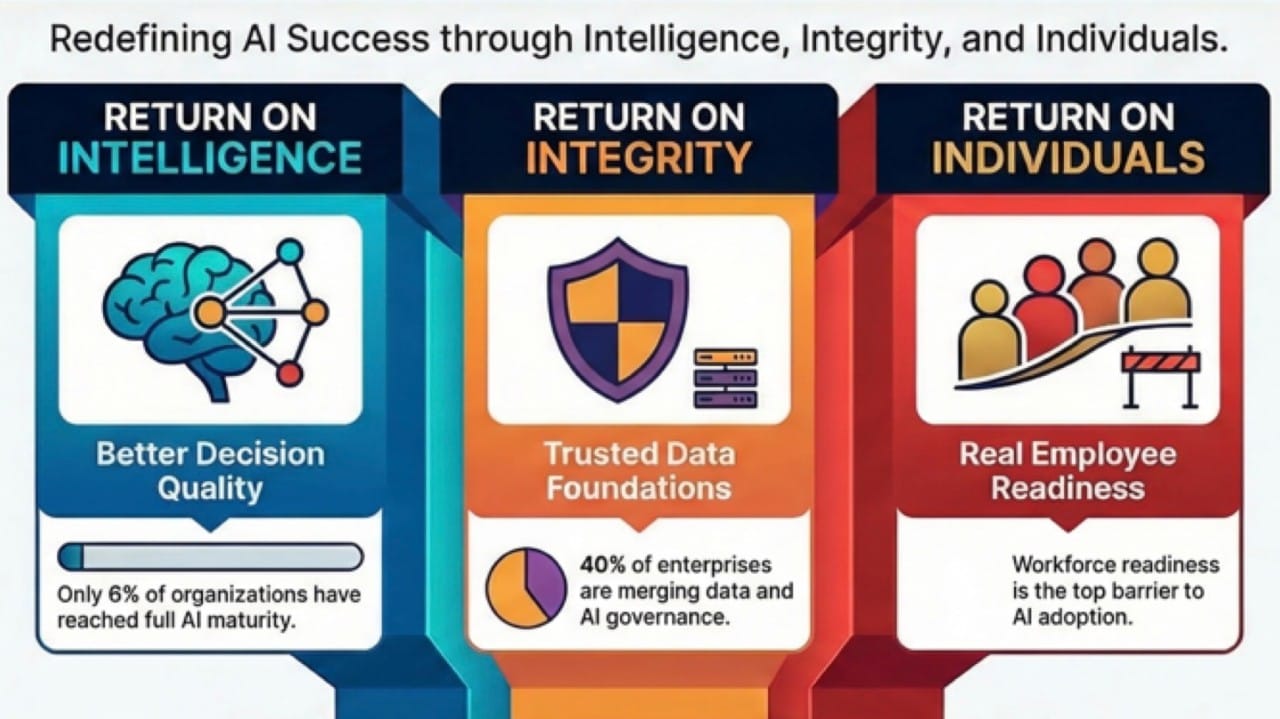
At the Gartner Data and Analytics Summit earlier this month, the opening keynote by Adam Ronthal and Georgia O'Callaghan reframed how organizations should think about AI value. Rather than a single return-on-investment number, they introduced three distinct pillars: Return on Intelligence, Return on Integrity, and Return on Individuals. I've been thinking about how those three frames map to what we actually see in credit union operations — and I think they map closely.
Return on Intelligence asks whether AI is helping us make better decisions, not just faster ones. This is the hardest pillar to defend right now. McKinsey's 2025 State of AI report found that while 88% of organizations report using AI in some capacity, only about 6% consider themselves at full maturity. The gap between deployment and real decision value is significant — and most organizations are still filling it. For credit unions specifically, that tension shows up in lending. A model can return a score in milliseconds, but if the lending team can't explain how decision quality is improving over time — in accuracy, in fairness, in member outcomes — then the intelligence isn't compounding. It's just moving faster.
Return on Integrity is about whether the foundation underneath the AI is actually trustworthy. Forrester has been direct on this: their 2025 predictions called out that 40% of highly regulated enterprises will converge their data and AI governance programs — not just for compliance, but because governance is the precondition for scaling AI responsibly. Gartner's own session reinforced this: the phrase I heard was that reliable AI requires governed, high-integrity data. For credit unions, this is where a lot of programs quietly stall. A chatbot or underwriting model looks clean in a demo. But if the data feeding it hasn't been validated across channels, if exceptions are generating manual cleanup work downstream, or if no one owns the data definitions, the integrity isn't there — and the AI is working harder than it should on a cracked foundation.
Return on Individuals may be the most underestimated pillar of the three. McKinsey's 2025 workplace AI report noted that C-suite leaders consistently cite lack of employee readiness as a top barrier to AI adoption — even as employees are already finding ways to use AI tools on their own, often outside of sanctioned channels. That gap between what leadership assumes about adoption and what's actually happening on the floor is where AI programs quietly fail. If staff are reverting to their old process the moment no one is watching, the tool isn't embedded. It's just another thing to work around.
This is where the framing that helps me most: AI is less like buying a better calculator and more like adding a very fast junior analyst to the team. Genuinely valuable — but only if they have reliable data to work with, understand the business context, and have clear human supervision. A junior analyst left unsupervised with bad data and no business grounding doesn't save you time. They create cleanup work.
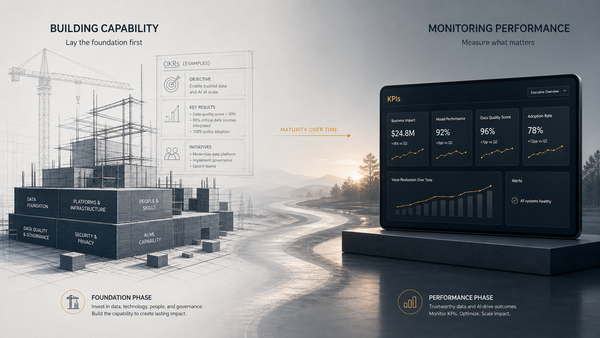
So when I think about the right scorecard for AI in our space, I'd put it this way: Are lending and collections making better, faster, and fairer decisions — and can we prove it? Is member data more trusted across channels, not just accurate inside one report? Are staff more confident because of the tools, not more monitored by them? Can we point to a handful of wins that connect directly to the P&L and to member trust?
Forrester's 2026 predictions are blunt on what happens when these questions don't have good answers: they estimate that enterprises will delay 25% of planned AI spend because value isn't showing up where leaders expected. AI in 2026 won't be funded on promise. It will be funded on proof.
The question I'd rather be ready to answer isn't "What did AI save us?" It's "What did AI help us do better for our members — and how do we know?"
If you had to defend your current AI investments to your board entirely in member outcome terms, how would you tell that story?