May 26, 2026
Most organizations have heard both terms.
KPIs. OKRs. They come up in planning meetings, strategy conversations, and leadership decks all the time. Sometimes they even get used almost interchangeably.
I do not think they are interchangeable.
And in a Data and AI Journey, the difference starts to matter pretty quickly.
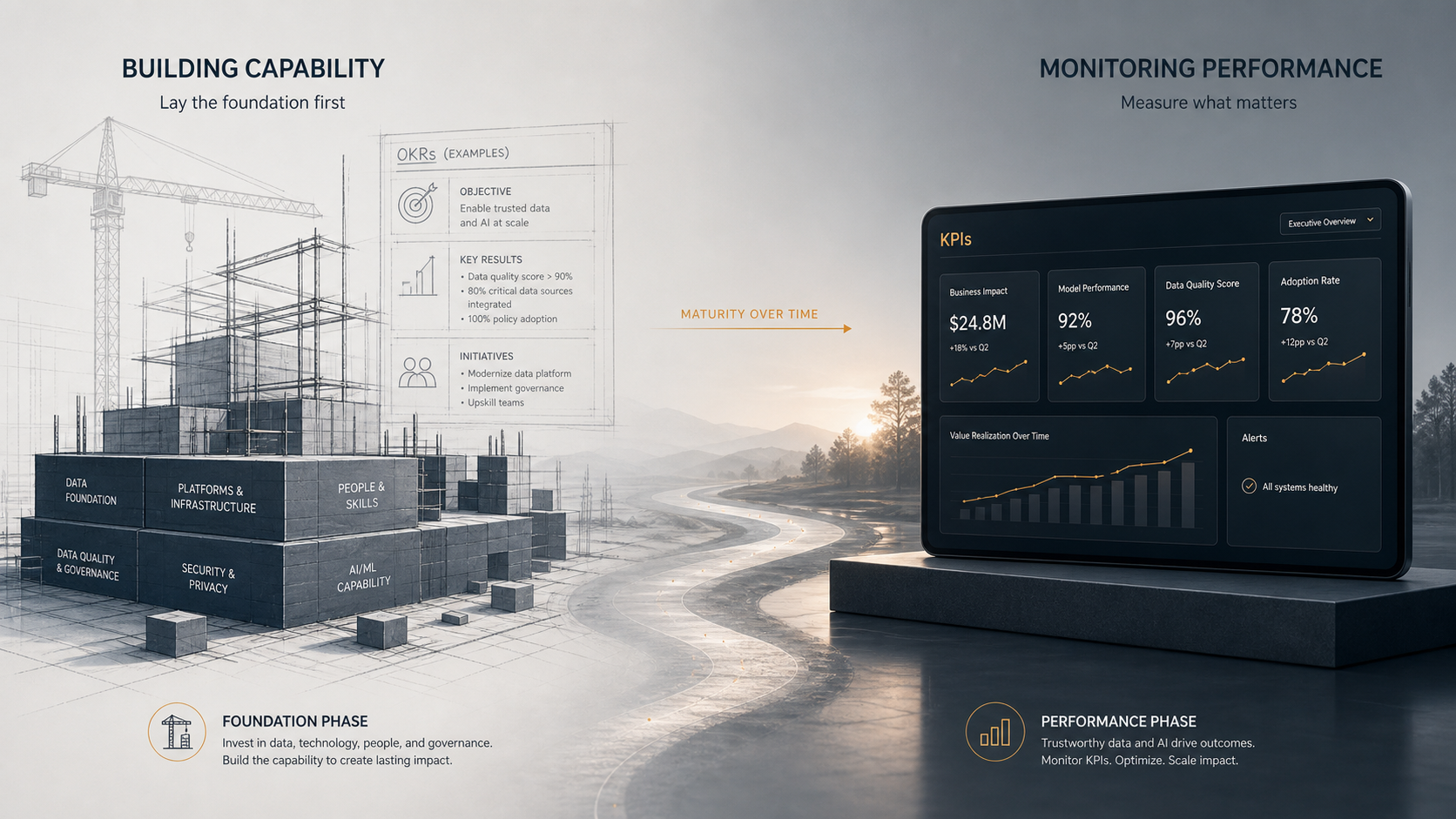
A KPI is usually there to help you track how something is performing once it is real enough, stable enough, and defined enough to manage against. An OKR usually shows up when you are trying to build something, improve something, or move something forward that is not quite where it needs to be yet.
That sounds simple enough.
In practice, it usually is not.
Because a lot of organizations are being asked to show progress before the foundations are really in place. Leadership wants a scorecard. The board wants to know what is improving. Teams want proof that all the effort is leading somewhere useful. That is understandable. But when data is still being baselined, definitions are still being worked out, ownership is still fuzzy, and the operating cadence is still immature, a KPI can end up looking more solid than it really is.
That is where things get tricky.
A metric can be visible long before it is trustworthy. It can show up on a dashboard, get talked about in meetings, and still not be strong enough to guide real decisions. I think that is one of the more uncomfortable parts of this moment for a lot of organizations. The pressure to measure is real. The foundations underneath the measurement are still catching up.
That is one reason I think OKRs often matter more earlier in the journey.
If you are trying to establish data owners, identify stewards, define critical data elements, create quality thresholds, or stand up an intake and review process for higher-impact use cases, you are not really in steady-state measurement yet. You are still building capability. You are trying to get from loosely understood to consistently run. That is much closer to OKR territory than KPI territory.
In other words, sometimes the work is not to monitor performance. It is to build the thing that will eventually be worth monitoring.
That is an important distinction.
Take something like lending data. If a credit union is still trying to get clear on who owns key data elements, what those elements actually mean across systems, how exceptions are reviewed, and what level of quality is fit for purpose for credit decisions, then that is not just a KPI conversation. That is a build conversation. An OKR can help focus the work. Name the objective. Define what progress looks like over the next quarter or two. Get specific about what has to be true by the end of that cycle.
Then, once that work is in place, the KPI starts to mean more.
Now you are in a better position to say whether turnaround time is improving in a meaningful way, whether exception rates are coming down for the right reasons, whether decision quality is getting better, or whether member friction is actually decreasing instead of just being moved around. At that point, the metric is not just something visible. It is something leadership can start to trust.
I think this is where a lot of the confusion comes from. Organizations often try to use KPIs to do work that OKRs are better suited for. They want the dashboard before they have the ownership model. They want the performance measure before they have the baseline. They want proof of improvement before they have built the conditions that make improvement measurable.
And to be fair, that pressure is real. Nobody wants to be stuck in endless foundation work.
But skipping over that stage does not make it disappear.
It usually just means the organization ends up with measurements that sound more mature than the underlying operating model actually is.
The other nuance here is that maturity does not move evenly. One part of the organization may be ready for real KPI management, while another part still needs OKR-style focus because the basics are not settled yet. Fraud may be further along. Lending may still be working through core data definitions. Member service may have decent operational measures but weaker data ownership underneath. That is why I do not think the answer is to choose one framework and declare it the winner.
I think both matter.
The harder question is whether you know which job each one is doing at a given point in the journey.
To me, that is where the real maturity conversation starts. Not whether a credit union has KPIs. Not whether it has OKRs. But whether it is honest about what is stable enough to steer by and what still needs focused effort to build.
Because in this space, that line matters.
OKRs can help build the foundation.
KPIs can help steer once that foundation is real.
And getting the timing right between those two may be one of the more important judgment calls leadership has to make in a data and AI journey.
At your credit union, are the measures leadership is reviewing truly mature enough to steer by, or are some of them still standing in for foundational work that needs more focused build effort first?