February 19, 2026
Here’s a stat that should make every executive pause: roughly 65% of transformation efforts fail to deliver their intended value. Trillions have been spent globally, yet failure rates remain stubbornly high.
What’s striking is how often these initiatives are framed as “IT projects,” even though the real levers are business strategy, leadership, and investment. Data and AI may live on technical platforms, but they are much more likely to create value when they’re owned and led by the business.
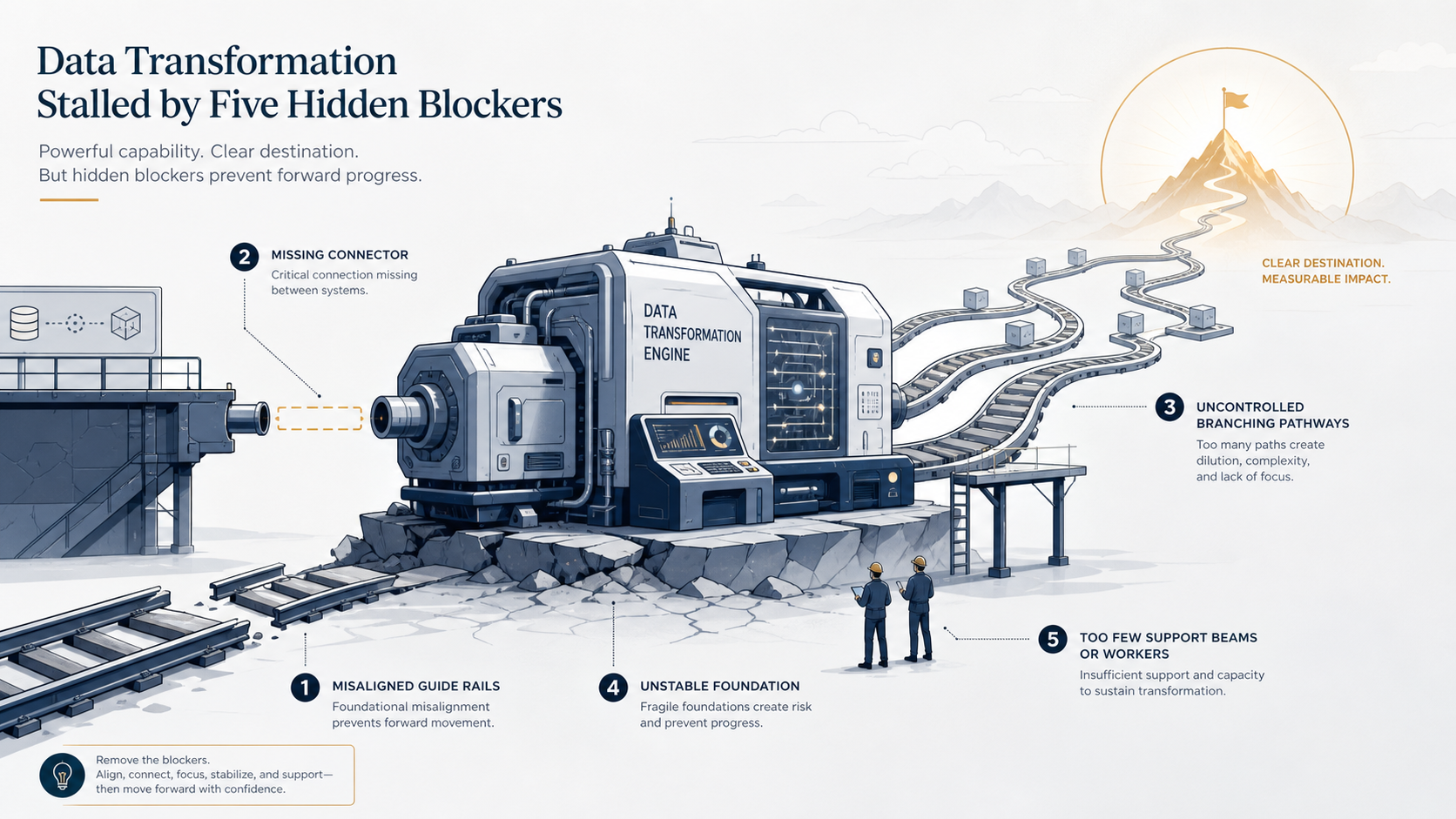
Over time, I’ve seen five patterns show up again and again. Industry research echoes these same themes.
Strategy misalignment
The data program isn’t tied to specific business outcomes. There’s a roadmap, but it doesn’t clearly answer: “What decision, process, or member outcome will this change in the next 12–18 months?” As we talked about in Post 2, when data work isn’t anchored in business strategy, it drifts into interesting, but not impactful, projects.
Missing alliances
When data and AI are seen as “IT’s thing,” they struggle. Successful transformations have business leaders such as lending, operations, finance, and compliance, at the table as co-owners, not just stakeholders. Studies keep pointing out that weak business–technology collaboration is a leading cause of stalled digital programs.
Scope creep
Many initiatives start focused and then quietly expand. A reporting refresh becomes a full data platform rebuild plus three AI pilots. Each addition feels reasonable; together, they create something no team can deliver on time. Scope creep especially hurts when business leaders expect quick wins and instead see a never-ending project.
Skipping foundations
This is where the wheels often come off. Organizations want AI-driven credit decisioning or hyper-personalized member journeys but haven’t invested in data quality, governance, or clear definitions. In Post 3 and Post 4, we talked about maturity and “fit-for-purpose” quality—the idea that the right level of quality depends on the decision you’re making. Industry surveys keep showing data quality and integration as top blockers to AI success. My experience matches that: if foundations are shaky, everything on top wobbles.
Under-resourcing
If there’s one pattern I see most often, it’s this. Ambitious goals, pilot-level budgets. Teams asked to “transform” while still doing their day jobs, with no real tradeoffs. Research on large-scale tech programs is blunt: underinvestment and fragmented focus are major predictors of failure. You can’t expect enterprise outcomes from a part-time, stop-start effort. If the investment doesn’t match the ambition, one of them has to change.
In many organizations, people underestimate both of these last two patterns: foundations and resourcing. It’s easy to get excited about visible use cases and underplay the grind of data cleanup, governance, and change management. It’s just as easy to say yes to a big vision without insisting on the sustained support it really requires.
The organizations that do better treat data explicitly as a business asset, not a technology experiment. Business leaders define the outcomes, co-own the work, and protect the investment. IT is a crucial partner, but not the sole owner.
Which of these five patterns feels most familiar in your world right now? And when you look at your own roadmap, where do you see the greatest opportunity to change the story for your next data or AI initiative?