I have watched the same pattern show up enough times that it feels worth naming.
An organization builds real momentum around a data or AI initiative. Leadership is aligned. The use case makes sense. The team is motivated. Then somewhere between the plan and production, things get harder than expected. Not because the idea was flawed. Because the environment around it was murkier than anyone realized going in.
Systems that were assumed to be clean turned out to have gaps. Ownership that seemed obvious got blurry when the work crossed team boundaries. Workflows that looked simple depended on manual steps nobody had documented. Data that everyone trusted had quality problems that only surfaced once something was actually relying on it.
None of that is unusual. In fact, it is one of the more predictable sources of friction on the Data and AI Journey.
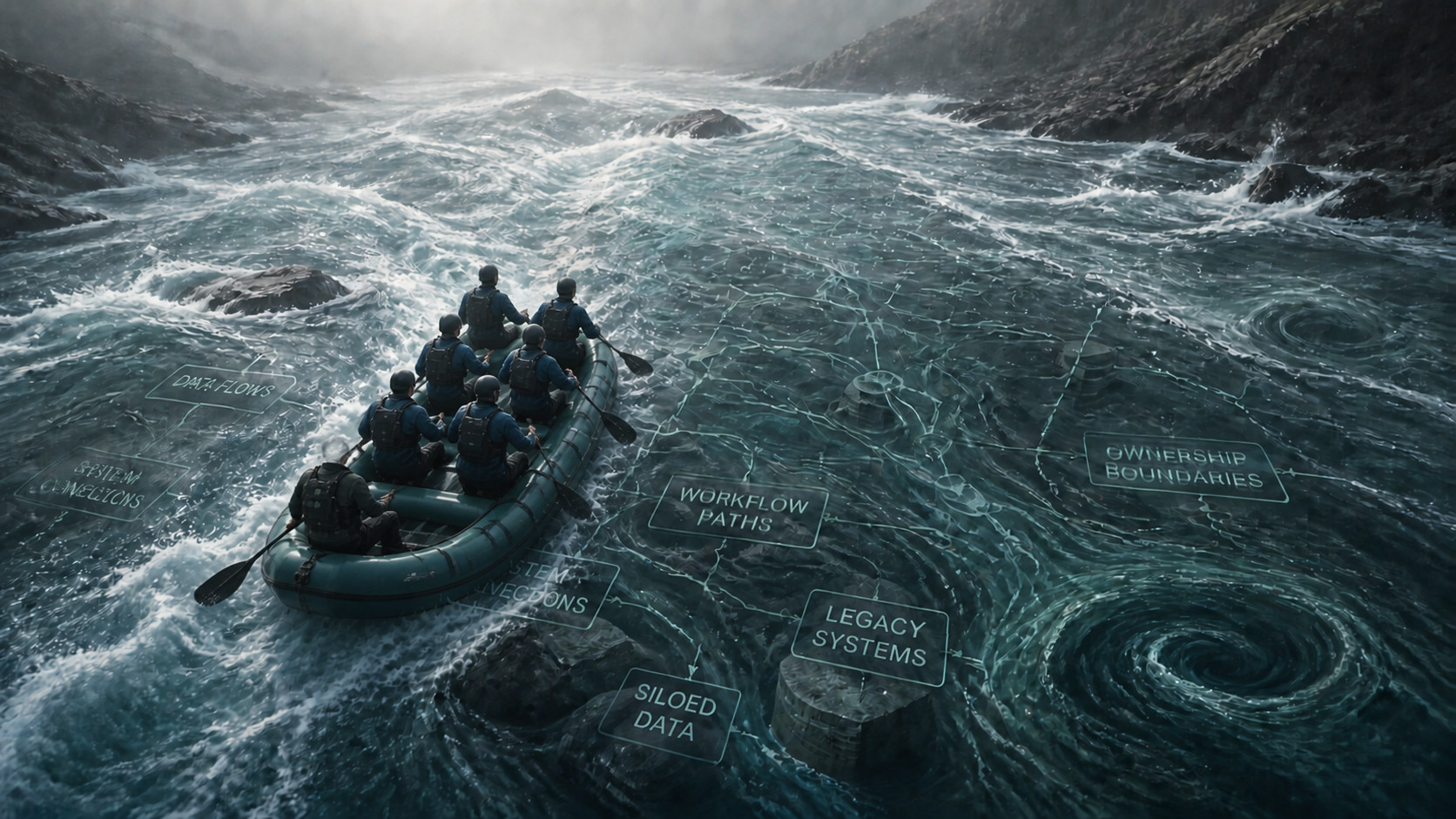
In the cornerstone article, I used the whitewater metaphor to describe why this journey rarely unfolds in a straight line. Conditions change, the path shifts, and the same move can feel very different depending on what is in the water around you. This article is about one part of that: what is actually in the water, and whether your organization can see it clearly enough to move well.
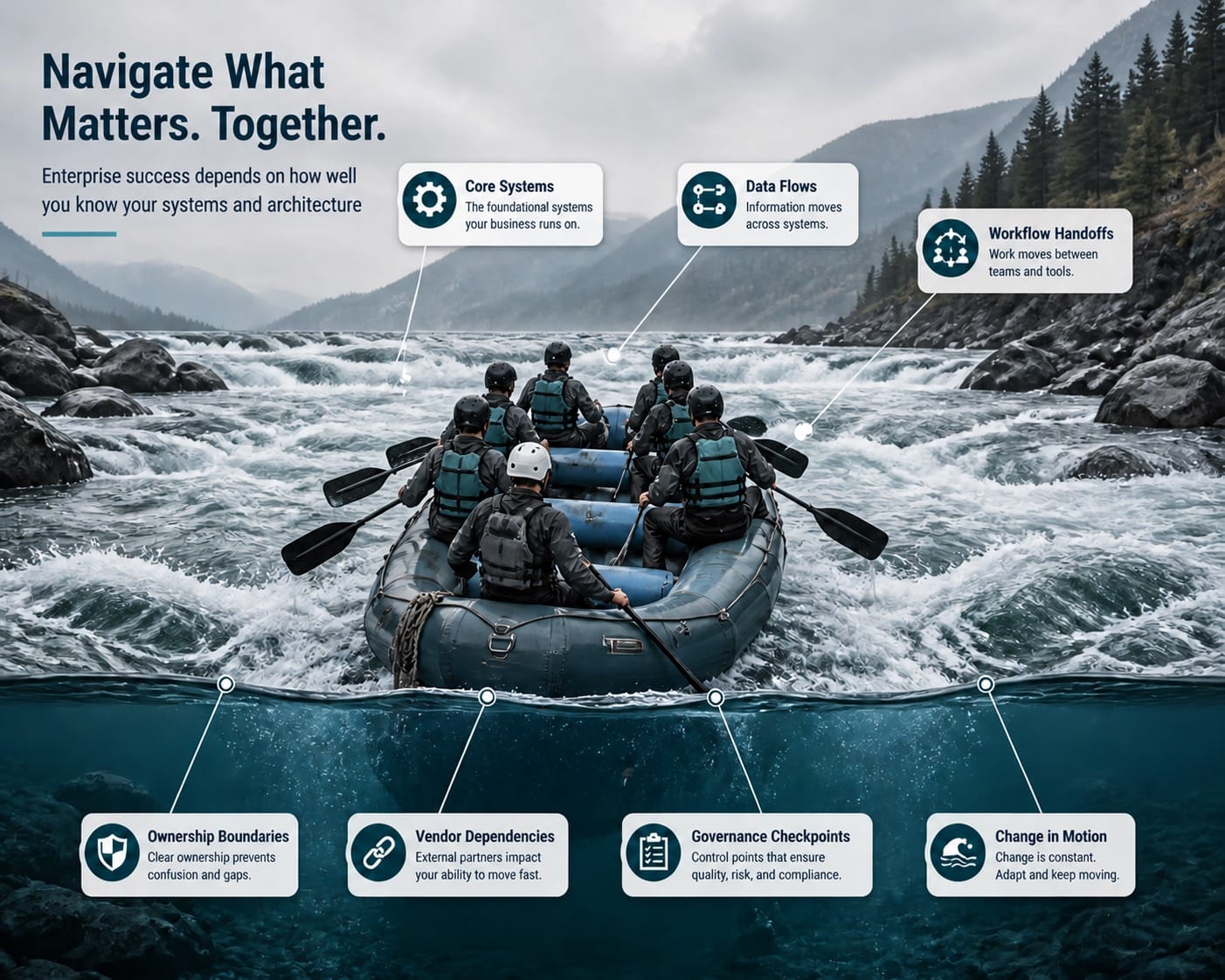
That is where enterprise architecture comes in. Not as a formal program that only large organizations can justify. More as a basic capability. Can the organization see its environment clearly enough to make a good next decision?
A lot of teams can answer the use case question with real confidence. Fewer can answer the surrounding questions with the same confidence. Which systems does this touch. Which data does it depend on, and how clean is that data. Who owns the workflow it lives inside. Where are the brittle integrations that nobody has formally mapped. How much change is already moving through the same part of the organization.
Those are the conditions that shape whether a move lands cleanly or generates drag.
And the organizations that are more honest about those conditions earlier tend to have better outcomes. Not because they slow down, but because they stop being surprised by the same kinds of problems.
For a lean organization, this does not require a large architecture function. It may require nothing more than a cleaner inventory of core systems, a more honest view of where important data moves, and a discipline around asking what a new initiative actually connects to before it gets very far down the road. That kind of visibility is achievable without adding headcount or standing up a formal practice.
For a more mature organization, the same capability needs more structure because the environment is more interconnected and the cost of poor visibility compounds faster. More systems, more vendors, more regulatory exposure, more teams whose work touches the same data flows.
A concrete example helps make this real.
A team introduces a generative AI assistant into an internal workflow. At first, it looks like a fairly contained decision. Pick the tool. Configure it. Train the team. But once it gets close to production, the environment starts to matter. Which content is it pulling from. Who maintains that content. What are the retention and permissions rules. Where does escalation go when the answer is wrong. Who owns the workflow it is embedded in. What happens when the underlying process changes.
If the organization has reasonable visibility into those questions, implementation tends to go smoothly. If it does not, the strain surfaces later as rework, ownership disputes, and a growing list of things that should have been figured out earlier.
That is not a technology problem. It is a visibility problem.
Getting clearer on your environment is one of the more practical early steps on the journey. Not because it is a prerequisite for everything else, but because the organizations that do it tend to sequence the rest of the work better.
What part of your environment is hardest to see clearly right now: the data, the systems, the workflows, or the ownership?