May 18, 2026
Last week featured another good discussion, and it helped me see these recent posts a little differently.
When I look back at what I’ve been writing on data, AI, governance, and maturity, I do not see a list of separate topics anymore. I see different parts of the same picture. Data quality, governance, vendor responsibility, member trust, maturity. They are all looking at the same landscape from a different angle.
That is probably why so many organizations feel like they are working hard and still struggling to describe the full journey clearly. There are good efforts underway. Data is getting cleaned up in lending. Someone is piloting an AI capability in member service. Vendor oversight is getting more attention. A governance committee is starting to take shape. None of that is off track. In most places, that is exactly what progress looks like. The harder part is seeing how those efforts relate to one another and where they are supposed to lead.
And even before the technology planning starts, there is a more basic business question sitting underneath all of it. Who are we as an organization. What do our members need from us. How do we want to serve them. Where do we want to respond differently, faster, more intelligently, or more consistently than we do today. If that part is still fuzzy, the technology conversation tends to get fuzzy right along with it.
That is where the idea of a journey becomes useful for me.
Not a rigid transformation plan. Not some perfectly sequenced model that assumes a stable world and unlimited capacity. Something closer to a navigation tool. You still need a destination. You still need a sense of the route. But you also know conditions are going to change, and you need a way to adjust without losing sight of where you are trying to go.
In this space, the destination is usually not that hard to say out loud. Use data and intelligent tools to make better decisions, improve member and customer experience, operate more effectively, and do it in a way people can trust. The complication comes from everything sitting underneath that statement: legacy systems, fragmented data, unclear ownership, vendor dependencies, resource constraints, regulatory expectations, and all the very human realities that make change uneven.
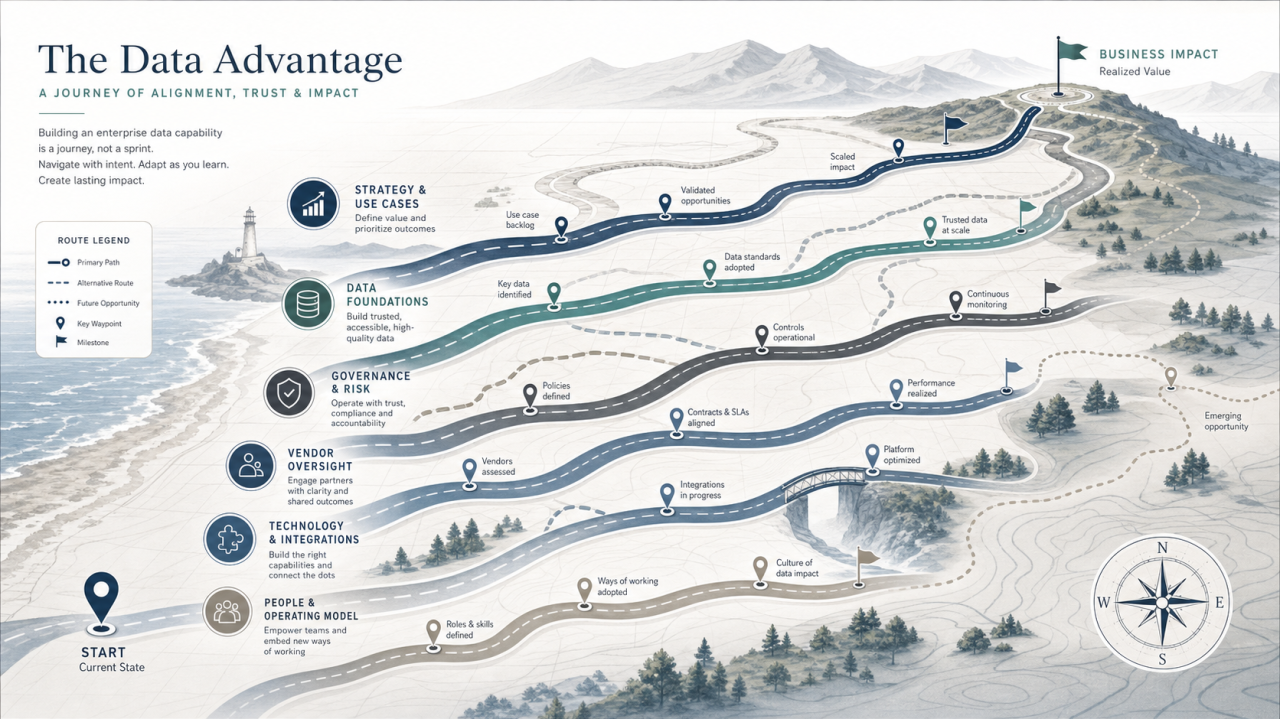
That is why I keep picturing the journey visually.
Across the page is time: what needs attention now, what needs to be built next, and what may matter later. Down the page are the lanes most of us already recognize: strategy and use cases, data foundations, technology and integrations, governance and risk, people and operating model, vendor and third-party oversight. Once you lay it out that way, the conversation gets more honest. One lane may be moving well. Another may still be early. A third may be stronger than you realized once you actually put it on paper.
That kind of view matters because it keeps organizations from telling themselves two stories that are both unhelpful. One is that everything is farther along than it really is. The other is that nothing meaningful can happen until every lane is fully mature. Neither one is true. Most organizations are moving in uneven but understandable ways, and the real value is in being clear-eyed about what is solid, what is fragile, and what the next sensible move actually is.
That also changes how I think about measurement.
If the journey stays at the level of ideas, it remains easy to talk about and hard to manage. The moment you put a few baselines and a few meaningful KPIs under it, the conversation changes. Now you are looking at current loan decision time and where it should go. Manual rework in a key process and whether it is actually coming down. Critical data elements with defined ownership. AI-enabled journeys with documented human oversight. Vendor arrangements with clear responsibility mapped out. You are not trying to measure everything in sight. You are trying to identify the few signals that tell you whether the organization is actually moving forward in the ways that matter.
That becomes even more useful when something changes, which it always does. A vendor introduces embedded AI faster than expected. A regulation shifts. A member journey starts showing more friction. A KPI that looked fine at first turns out not to be telling the full story. When that happens, you do not have to start over from zero. You go back to the journey, look at the lane it affects, reassess where you are, and adjust the next step.
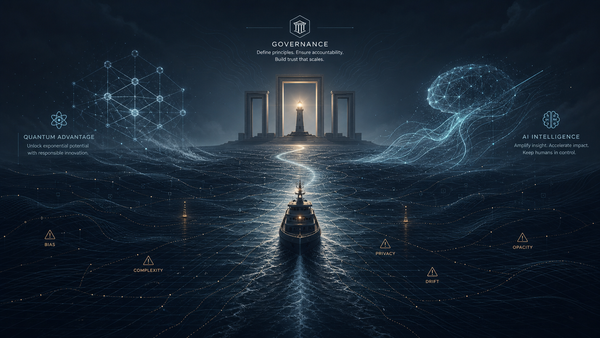
When I pull the lens back, that is really what these past few months of writing have been circling around. Right-sized governance. Fit-for-purpose data quality. Shared responsibility with vendors. Clear business ownership. Trust as a design requirement, not a communications line after the fact. None of those are isolated ideas. They are all part of how an organization learns to move from awareness to intention, from intention to discipline, and from discipline to something more embedded and durable.
I suspect the differentiator over the next few years will not be who can say they launched the most AI pilots. It will be who can explain, in plain terms, where they are headed, why that path fits their members and their business, what the next step is, and how they know whether progress is real. The tools will change. The environment will keep changing. What will matter is whether the organization knows how to navigate.