One of the things I appreciate about working in Data and AI right now is that there is no shortage of meaningful topics to think about.
The challenge, of course, is that they do not arrive one at a time.
Sometimes they show up all at once. A major model release. Executive actions that could shape the policy and cybersecurity conversation. A quantum discussion that starts to feel less like a distant horizon topic and more like something that should influence how we think about data now. When that happens, the real work is not just noticing what is new. It is deciding what actually belongs in the larger journey.
That is where I found myself with this next set of articles.
Not wondering whether these topics mattered. They clearly do. The harder question was how to place them correctly. Because a Data and AI journey can lose its shape if every new development gets treated like a separate track. And I do not think the goal is to chase everything. The goal is to stay clear on which developments should change how we think, how we govern, and how we prepare.
That is the filter I keep coming back to. Does this development change how we should think about governance, data, risk, operating discipline, or decision-making? If it does, then it belongs in the journey.
Quantum is a good example.
I want to be transparent here, because my own thinking on this has evolved. Until fairly recently, I was one of the people who would have said quantum was still far enough out that if an organization had not addressed the basics of its current data and AI strategy, it probably did not belong near the top of the list. My instinct was to stay focused on fundamentals and make sure the right partners were in place, especially partners with the resources and depth to leverage quantum when it became practical.
I still think there is wisdom in that.
But I have become less comfortable treating quantum as someone else’s future issue.
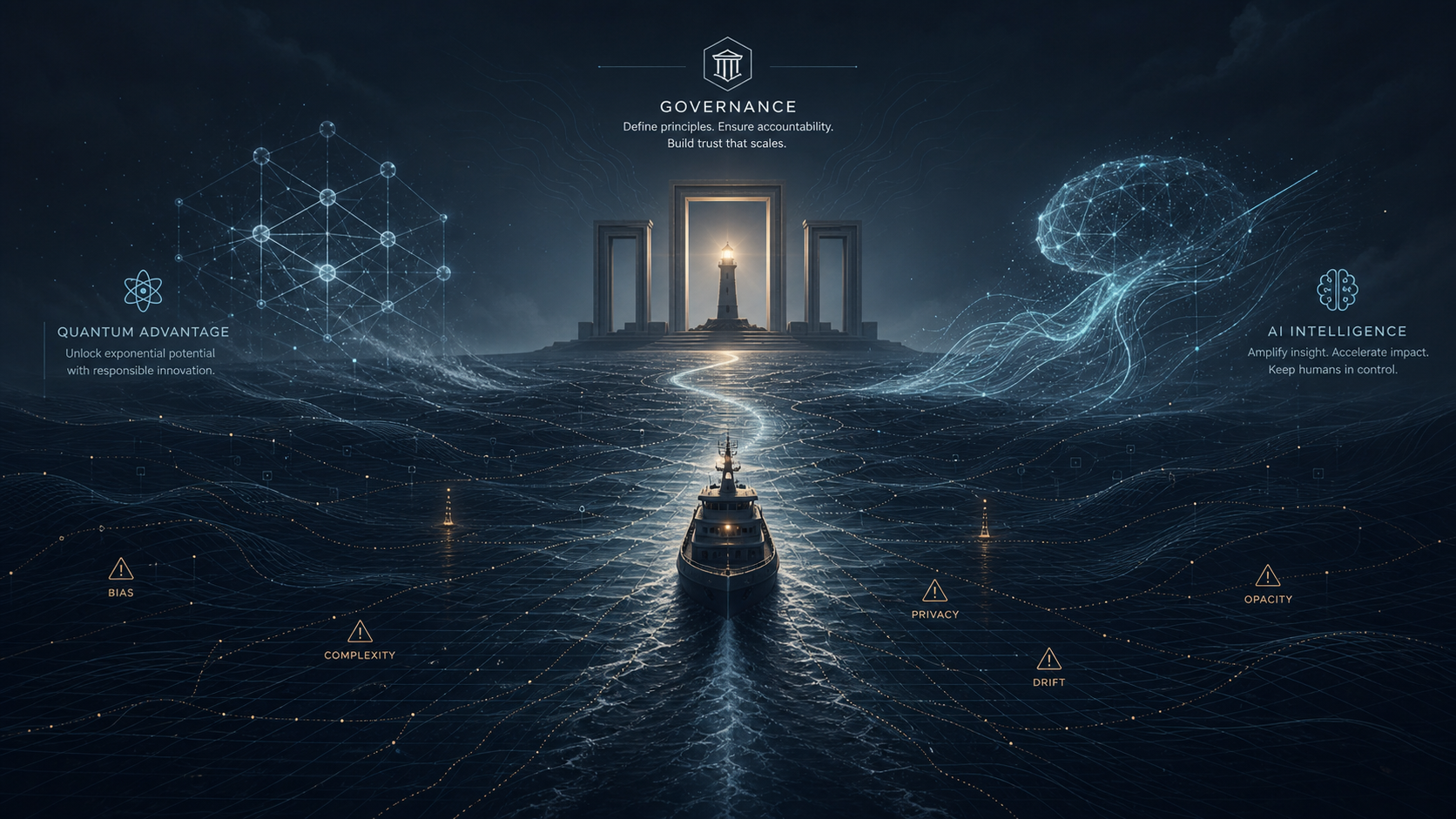
Not because I think most organizations need to suddenly act as if quantum is tomorrow’s implementation priority. They do not. But because it raises a much more immediate question than I used to give it credit for. If some of the data we hold today needs to remain protected for a long time, are we thinking seriously enough about retention, classification, stewardship, and eventually the move toward suitable post-quantum cryptography? That is not just a technology question. It is a data governance question, which means it belongs directly in the journey.
Claude Fable gets to the same larger issue from a different direction.
I do not think every model release deserves its own strategic response. But some of them are worth paying attention to because they tell us something about the pace and shape of change. What interests me here is not just that capability is moving again. It is what that capability means for safeguards, retained interactions, vendor dependence, and the wider set of threats organizations need to think about.
That is where the topic gets more serious.
If more capable models expand what is possible in the wrong hands, increase the value of retained prompt and response data, or shift the threat landscape in ways many organizations have not fully accounted for, then this is not just a model announcement. It is a reminder to think harder about data handling, logging, retention, monitoring, third-party exposure, and whether our security assumptions are keeping pace with model capability.
Recent policy developments belong in the same conversation.
It is easy to think of executive orders as something adjacent to the real work, something for legal, compliance, or public policy teams to interpret. But they also tell us where expectations are heading. They signal what kinds of oversight, secure deployment, governance evidence, and institutional accountability are likely to matter more in the near term.
That matters because policy does not just create obligations. It also sharpens priorities.
If AI, cybersecurity, oversight, and accountability are being drawn closer together, then organizations need to be ready for that convergence. That makes policy part of the Data and AI journey too, not a separate policy lane off to the side.
That is why I wanted to pause and frame this before jumping into the next few pieces.
These are not three unrelated topics. They are three different ways of testing the same thing. How strong are our data foundations? How current are our threat assumptions? How mature are our governance habits? And how ready is our operating model for a world where both technical capability and policy expectations are moving faster than many organizations are used to?
So this week, I am going to take these one at a time.
One article on quantum, and why the immediate issue is not hype but long-horizon data protection, retention, and post-quantum planning.
One on Claude Fable, and what more capable models could mean for safeguards, retained information, threat exposure, and enterprise readiness.
And one on recent policy actions, and what they may signal for secure deployment, oversight, and the shape of responsible AI governance going forward.
That feels like the right way to handle this moment.
Not as one article trying to do too much, but as a connected set of pieces that all stay anchored to the same larger direction.
Because the Data and AI journey still is the larger direction.
And maybe that is the real point. The goal is not to react to every development. It is to build enough clarity, judgment, and discipline that when meaningful developments do happen, you know where they belong and what they should change.
What is the topic you are finding hardest to place right now in your own Data and AI journey?