
The Data and AI journey hasn’t had a clear rulebook. Most organizations had to start moving and figure it out as they went, using good judgment to keep momentum.
That is still the reality in a lot of places.
But recent policy actions are starting to add something organizations have not really had before: clearer signals around secure deployment, stronger oversight, and the shape of responsible AI governance going forward.
Two executive orders matter here.
One focuses on advanced AI in the context of cybersecurity, critical infrastructure, and secure deployment. The other tells federal financial regulators to take a hard look at their own rules, guidance, supervisory practices, and application processes to identify where they may be holding innovation back.
Taken together, they start to change the feel of the landscape.
For the last few years, most organizations have been doing the best they could with limited guidance. If you tried to move carefully, be transparent, and put basic guardrails in place, that counted for a lot. In many cases, organizations were relying on good faith and local judgment while the broader regulatory picture was still taking shape.
Now, the landscape is beginning to feel more settled.
Not finished. Not fully defined. But more settled.
That comes with a mix of reactions.
On one side, there is some relief. If you have been investing in foundations like data visibility, ownership, governance, vendor oversight, and security, there is more reason to believe that effort was pointed in the right direction. The policy direction is starting to line up with the hard, often unglamorous work organizations have already been doing.
On the other side, there is still some understandable uncertainty.
Decisions are already in motion. Vendors have been selected. Use cases have been approved. Governance structures have been built based on what made sense at the time. And while the direction is becoming clearer, many organizations are still trying to understand what these signals will mean in practice over time.
That is where the Data and AI journey framing still feels useful.
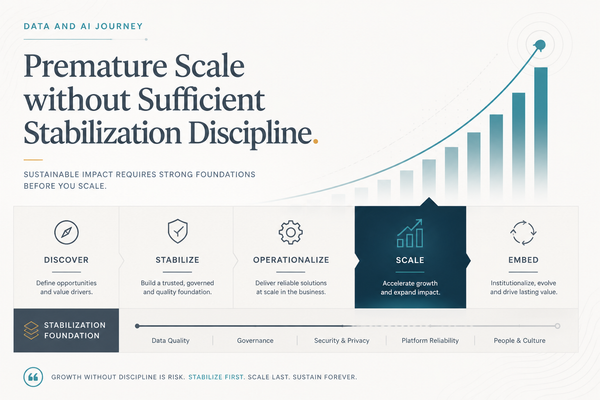
Early in the journey, the work is basic but important: know what you are using, who owns it, which data it relies on, and where there are obvious gaps in control. Later, governance moves from having a policy on paper to actually operating with intention through intake, vendor review, security involvement, and oversight that is part of the way the organization works. Eventually, governance stops being a side effort and becomes part of how the organization runs.
These policy moves do not change that arc.
What they do is give organizations a better sense of where things may be heading. They offer more shape around what secure deployment, oversight, and responsible progress are likely to require.
For earlier-stage organizations, that can actually be grounding. The takeaway is not that everything needs to happen at once. It is that the basics still matter, and they remain the right place to start.
For organizations that are further along, the question gets sharper.
Are current structures enough for the kind of secure deployment, oversight, and accountability that are now being discussed more explicitly? Or are there parts of the journey that still need to catch up?
We are not at a point where everything is settled. But we are getting past the point where organizations had almost nothing to work with beyond good judgment and good intent. The guardrails are beginning to take shape. Regulators themselves are also being pushed to support innovation in a secure way. And that creates a very different kind of moment in the Data and AI journey.
There is still uncertainty in it. Of course there is. But there is also more direction than there was even a short while ago, and that matters. It gives organizations a better sense of what responsible progress is likely to require and a little more confidence that the foundational work they are doing now is pointing in the right direction.
Resources
- Promoting Advanced Artificial Intelligence Innovation and Security
- White House issues executive order on AI and cybersecurity
- “Promoting Advanced AI Innovation and Security” executive order overview
- Integrating Financial Technology Innovation into Regulatory Frameworks
- Executive Order Signals Federal Shift on Fintech Regulation
- President Trump Issues Executive Order on Fintech Innovation