February 12, 2026
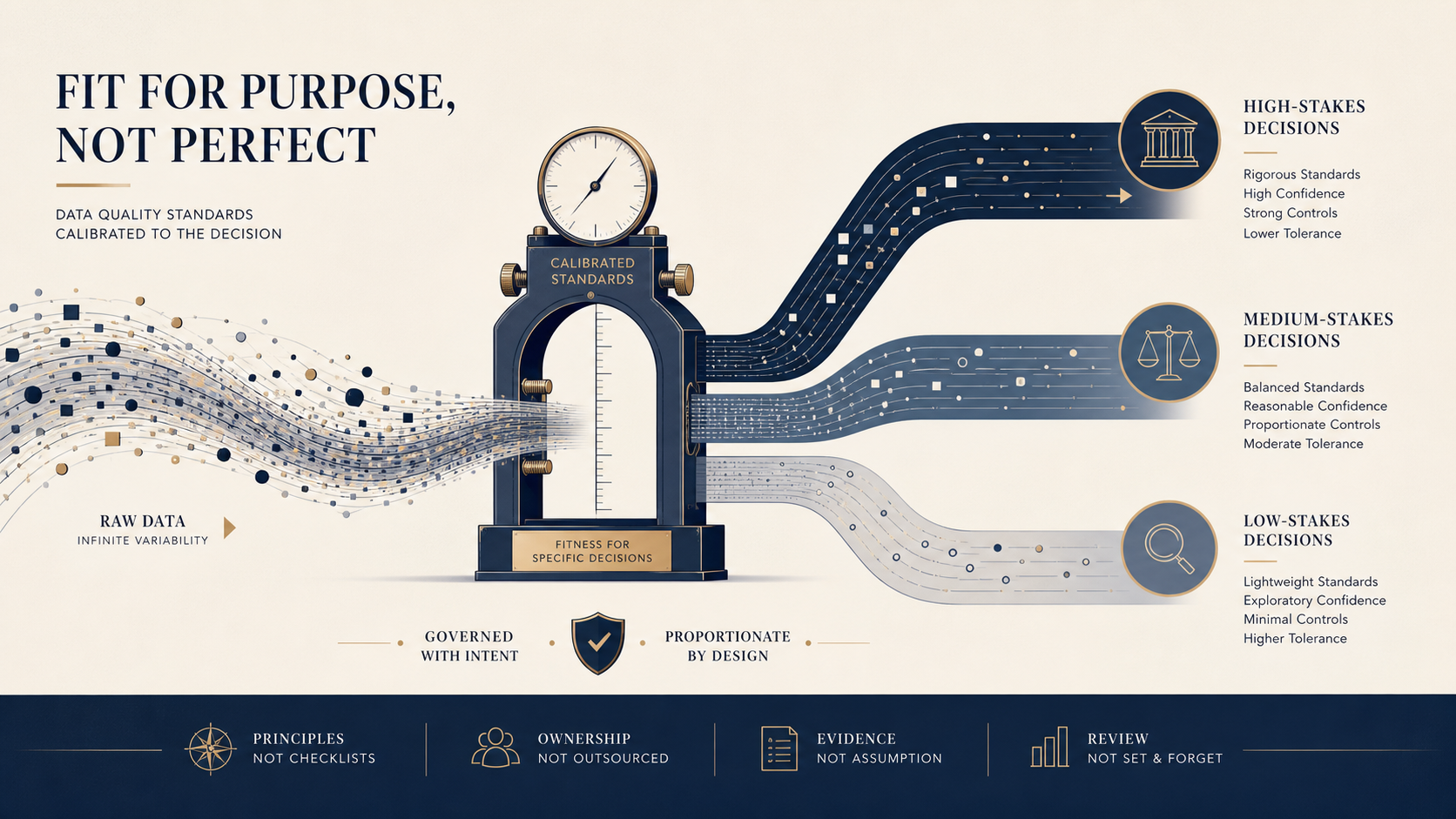
Most credit unions quietly apply a “gold-plated” standard to all data or no standard at all, then wonder why AI conversations stall before they start. The shift that actually unlocks progress is moving from “perfect data” to “fit-for-purpose” data quality.
Instead of asking, “Is our data clean?” the more useful question is, “Clean enough for what decision?”
The standard that matters is whether data is sufficiently accurate, complete, and timely for the specific decision or process where it is used.
In practice, many organizations benefit from sorting decisions into three broad tiers:
- High-stakes: lending decisions, regulatory and board reporting, fair lending analytics. If this is wrong, members can be harmed or you can fail an exam. Quality expectations must be very high.
- Medium-stakes: marketing campaigns, portfolio planning, staffing models. If this is wrong, money is wasted or opportunities are missed, but individual members are less likely to be directly harmed.
- Low-stakes: exploratory analysis, hypothesis-testing, early-stage innovation work. Directional accuracy is often enough, as long as results are not treated as production truth.
With that lens, the central business question shifts from “Is this data perfect?” to “Given the consequences if we are wrong, how good does this data need to be?”
Applied to day-to-day work, this framing becomes concrete very quickly:
- Lending: Delinquency reports and decisioning data for credit approvals belong in the high-stakes tier. If a member is denied a loan because of inaccurate information, that is both a member-impact and regulatory problem.
- Member experience: Segmenting members for an education campaign based on slightly imperfect product data typically falls into the medium-stakes tier. A few members may receive a less-than-ideal message, but no one’s financial health is directly at risk.
- Operations and planning: Early experiments using analytics or AI to summarize call-center interactions or understand branch traffic patterns can start in the low-stakes tier, provided no automated output is pushed directly to members or regulators.
When leadership teams label the decision first and the data second, conversations change. Instead of debating “Is our data good?” they focus on “For this specific use, what level of quality is required and what are we willing to invest to get there?”
AI does not repair weak data foundations; it scales whatever quality already exists.
Inconsistent lending data leads to inconsistent AI-assisted decisioning, and noisy member attributes lead to “personalized” outreach that feels random rather than relevant.
As boards and executives ask more questions about AI strategy, more organizations are realizing that different AI use cases map directly to those same quality tiers:
- High-stakes AI: credit decisioning, fraud detection, collections strategies. These require high-stakes data quality and strong oversight, because errors are amplified at scale.
- Medium-stakes AI: marketing recommendations, branch staffing optimization, member churn prediction used for planning. These can tolerate some noise but still depend on reasonably reliable inputs.
- Low-stakes AI: internal prototypes, scenario modeling, and insight exploration. These are appropriate places to learn with imperfect data, as long as outputs are clearly labeled and not operationalized prematurely.
Organizations that embrace fit-for-purpose quality tend to move faster without pretending they have solved every data issue. They bring AI-enabled capabilities to market sooner while still protecting members and satisfying examiners, because investment is concentrated where the stakes are highest.
Many data and technology leaders have experienced the temptation to frame the work as “we need to clean everything” before doing anything advanced. It sounds responsible and often wins agreement in principle, but it usually fails the reality test on budget and capacity.
A more sustainable pattern emerging in the industry is to narrow early efforts to the data elements that drive specific high-stakes decisions, such as loan approvals or key regulatory reports. That focus not only delivers results faster, it also builds trust with business and risk leaders who can see how targeted improvements change real outcomes rather than just dashboards.
This approach still acknowledges the long-term goal of broader data improvement, but it aligns with a progress-over-perfection mindset and avoids under-resourcing the areas where the consequences of bad data are most severe.
Looking at your own roadmap, where could explicitly defining high-, medium-, and low-stakes data quality tiers help your executive team move faster on AI and analytics, without compromising member trust or regulatory expectations?