March 3, 2026
Something I’ve been thinking about lately: a lot of credit unions have made serious technology investments over the last few years. New cores. Modern digital banking. Upgraded card platforms. AI-assisted lending tools. Real, meaningful investments.
And yet the member experience doesn’t always feel like the sum of those parts.
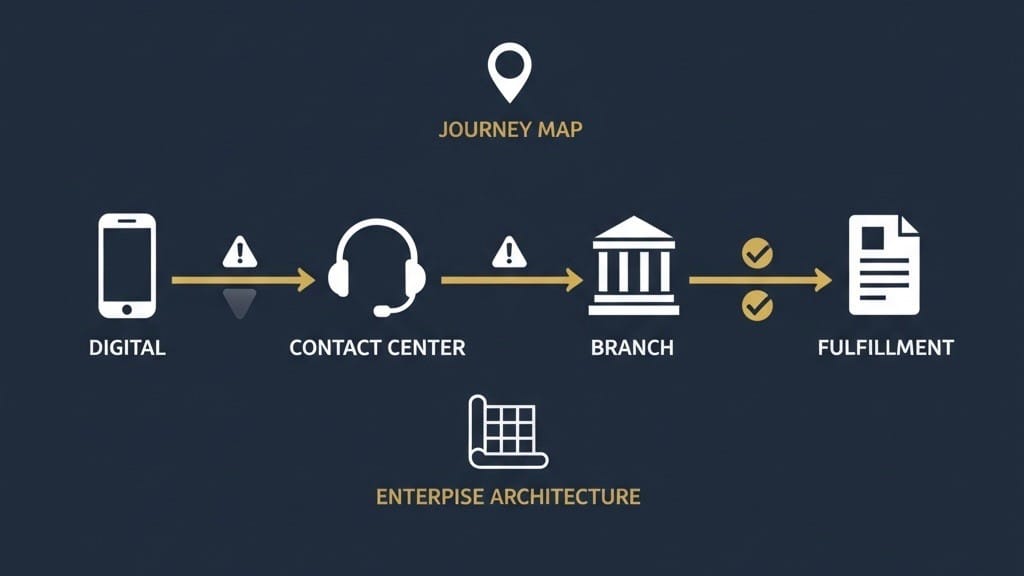
That gap is worth examining—because in most cases it isn’t a technology problem. The platforms are doing what they’re supposed to do. The gap tends to live in the handoffs. A member starts something in one channel and has to restart in another. Staff toggle between systems that don’t share context. Decisions made in one part of the organization aren’t visible to the next person in the journey.
Two tools that I’ve found genuinely useful for surfacing where those gaps are—and for building the case to close them—are journey mapping and enterprise architecture.
Journey mapping is exactly what it sounds like: following a specific member experience from start to finish, across every channel and touchpoint, and documenting what actually happens—not what we think happens. Done well, it’s a cross-functional exercise. Lending, operations, digital, contact center, and technology in the same room, tracing the same path. What tends to emerge is a shared picture of where the friction lives—and often, it’s the first time everyone has seen the full journey together in one place.
Enterprise architecture takes a complementary view from the systems side. Rather than following the member, it maps how data, applications, and integrations connect across the organization. It helps answer: where is information flowing cleanly, where are the gaps or redundancies, and where would a targeted integration remove friction that shows up in multiple journeys at once?
Together, these two lenses—member-side and systems-side—make it much easier to prioritize. Instead of debating which platform to upgrade next, the conversation shifts to: which connections, if made, would improve the most journeys with the least disruption?
The good news is that closing those gaps doesn’t usually require the next big platform purchase. It requires asking a different question: not “what do we need to add?” but “where are the connections between what we already have?”
A few questions that tend to surface the most useful answers:
- For our most important member journeys—first loan, financial hardship, onboarding—what does the experience actually look like across all channels today?
- Where do members repeat themselves, or re-enter information they’ve already given us?
- When we map our systems and integrations, where do the friction points in those journeys actually originate?
The answers are usually pretty specific. And specific is good, because it means the work is manageable.
What member journey would you map first if you had a cross-functional team in a room for a day?