March 16, 2026
We have more dashboards today than at any point in credit union history. But if I’m being honest, I think a lot of us are starting to ask the same question: are all of these dashboards actually helping us make better, faster decisions for our members?
Sometimes they are. A lot of times, they are not.
That doesn’t mean the dashboards are bad. In many cases, they’re well designed, thoughtful, and full of useful information. The problem is that they still leave the hardest part to people. Someone has to look at the chart, interpret what changed, decide what matters, and then figure out what the business should do next.
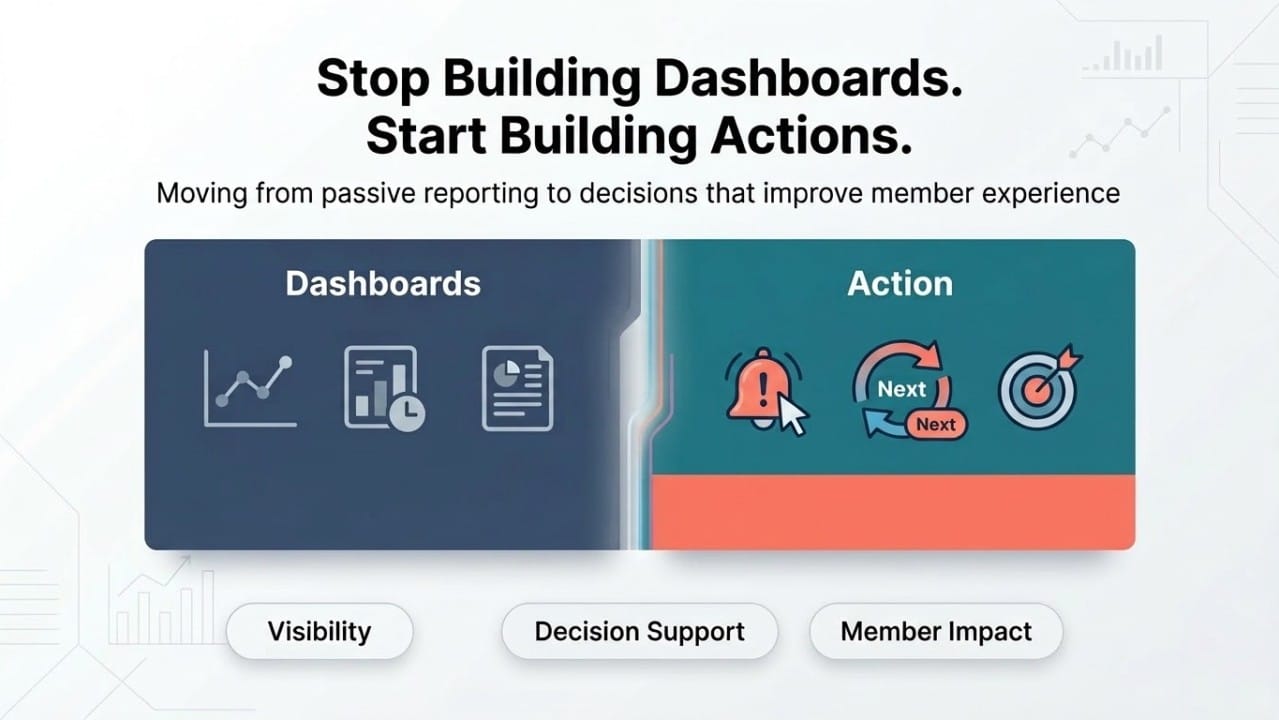
That was one of the reasons a Gartner session stuck with me this week. Georgia O’Callaghan put language around something many of us have probably felt for a while: dashboards are not dead, but too often they stop at showing the problem instead of helping the business move toward action, even as analytics tools are becoming more proactive about surfacing insights and recommending next steps.
That felt true to me.
Because when you strip away all the terminology, this is really a very practical conversation. It is the difference between knowing and doing. It is the difference between a dashboard that tells you auto loan applications are dropping off and a system that helps you see where members are getting stuck, why it may be happening, and what your team should do about it.
That is a very different kind of value.
And I think it matters especially for credit unions, because we are relationship organizations. We are not in the business of simply producing information. We are in the business of helping people make good financial decisions, reducing friction when they need us, and showing up in ways that feel timely and personal.
If that is the mission, then insight by itself is not enough.
What we really need is a tighter connection between data and action. Not more reporting for reporting’s sake. Not another dashboard because someone asked for one. A better way to help a lender, a branch leader, a contact center team, or a digital channel owner know what is changing and what the next best response should be.
That also changes how I think about the role of the data team.
For years, a lot of data teams have been measured by what they produce: dashboards, reports, scorecards, visualizations. All of that still matters. But I think the bigger opportunity now is to measure ourselves by what we enable. Did the business get clearer? Did a decision get faster? Did a member experience improve? Did we reduce friction in a way the member could actually feel?
That is a more meaningful conversation than whether a dashboard got delivered on time.
You can already see parts of this model emerging in the market. Capital One, for example, uses digital tools that identify recurring charges and free trials, and in some cases let customers block future charges or cancel subscriptions directly in the app. That is a good example of data showing up close to the moment of action, not sitting off to the side waiting to be interpreted.
I don’t think the answer is to throw dashboards away. Gartner’s own point was more balanced than that: dashboards still have a role as a place for visibility, verification, and alignment. But they should support decisions, not pretend to be the decision.
As I pack for the CULytics Summit in Atlanta, that is the conversation I’m most interested in having with peers.
Are we helping our organizations interact with data in a way that leads to action, or are we still mostly asking people to stare at charts and do the translation themselves?