The business value belongs to the analytics function and the business users it serves, and it should be defined by them before the natural-language features are switched on. The outcome is faster insight, fewer routine requests bottlenecked on analysts, and genuine self-service, achieved by adding AI and plain-language querying to BI platforms so business users can ask a question and get an answer, chart, or summary without writing a query or waiting on a person. The owner is the analytics or data leader, with the business stakeholders who consume the numbers as co-owners; the metrics are request turnaround, analyst backlog, and self-service adoption. If those are not named and a baseline is not captured, the feature becomes a novelty people try once, and the analytics team never sees its backlog actually shrink.
These features ship ready to use and deliver immediate productivity, which places them at the easy end of the delivery range on day one. The early experience is good. It is good precisely because it sidesteps the question the organization never resolved, and it sidesteps it only until two users ask the same question and get different answers.
What it actually takes to deliver
The ceiling appears not in the AI but in the data definitions beneath it, the moment different parts of the organization use different definitions of the same things, which in most organizations is the normal state. Revenue is the clearest example. One department counts bookings, another counts recognized revenue, a third nets out refunds and a fourth does not. Each definition is legitimate in its context, but none is encoded anywhere the AI can treat as authoritative. When a user asks for revenue, the AI resolves the question against whatever logic it can find or infer, and different users, contexts, and underlying tables produce different answers. The same happens with active customers, churn, margin, and any metric with more than one reasonable definition and no single governed one. Dimensional hierarchies compound it: if one part of the business rolls up regions one way and another differently, the AI's regional breakdowns will not reconcile, and users will not know why.
What the AI does here is subtle and damaging. It does not create the inconsistency, which was always present in the gap between how teams defined their metrics. It surfaces the inconsistency, at scale, to everyone, instantly. Before the AI, the disagreement was hidden because each team produced its own reports through its own analysts who knew their team's definitions, and the friction of manual reporting masked it. Remove the friction, let everyone query the same tool, and the latent disagreements become visible contradictions delivered with the false confidence of an automated answer. The tool meant to give everyone a shared view instead gives everyone a slightly different one, each rendered authoritatively.
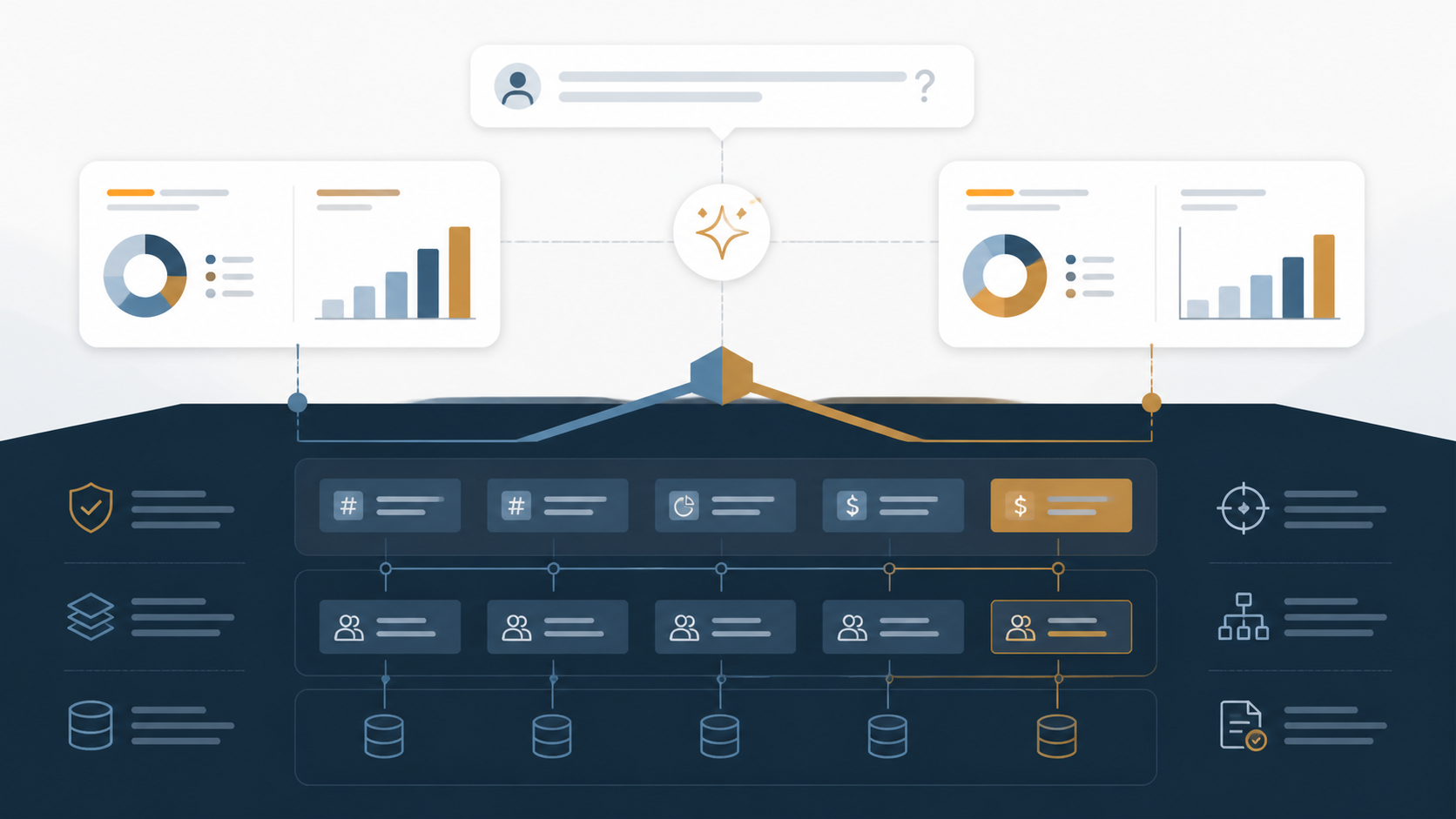
What the use case actually requires is a governed semantic layer: agreed, maintained metric definitions, consistent KPI logic, and standardized dimensional hierarchies the AI resolves questions against. In practice this is a defined layer between the raw data and every consuming tool, where revenue, active customer, churn, and margin each have one canonical definition expressed as governed logic, and where the regional, product, and organizational hierarchies are specified once and reused everywhere. The AI then answers against those definitions instead of inferring its own. That semantic consistency does not ship with the BI tool. The tool provides the natural-language interface; the organization has to provide the single, governed meaning of its own numbers, and without it the interface accelerates the spread of inconsistency rather than resolving it.
This is also where the absence of a governed metrics layer becomes everyone's problem, including leadership's. Inconsistent definitions have always cost something, but the cost was absorbed quietly, in reconciliation meetings and the low-grade friction of never quite agreeing on the numbers. AI-augmented analytics takes that hidden cost and puts it in front of executives, because the contradictions now appear in self-service answers they are looking at directly. The tool turns a chronic, tolerated problem into an acute, visible one. That is uncomfortable but useful if read correctly: the contradictory answers are not a failure of the AI but a diagnosis, the clearest signal the organization will get that it lacks a governed definition of its own most important numbers.
What to ask, prepare, and implement
Ask whether you have agreed, governed definitions for your core metrics and standardized dimensional hierarchies or whether definitions vary by department, and whether two users asking the same question of the tool would get the same answer. Prepare by treating the rollout as the forcing function to build the semantic layer, agreeing on what revenue means, what a customer is, and how hierarchies roll up, and encoding those definitions where the AI and every other tool resolve against them. Implement against that governed layer rather than letting the AI infer logic per query, and resist the undisciplined response of blaming the tool, restricting it, and returning to siloed reporting, which buries the problem without solving it.
Resources to make it land
On people and roles, the central one is an owner for the metrics layer, someone, often an analytics-engineering lead, accountable for the canonical definitions, with business owners for each domain who agree on what their numbers mean. This is as much a governance and negotiation role as a technical one, because the hard part is getting departments to converge on definitions they have held differently for years.
On skills and external help, the differentiating capability is semantic-layer modeling and metric governance rather than the AI feature itself, and outside help is most valuable for designing and standing up that layer when the organization has never centralized its definitions. On data work and tooling, the requirement is a governed semantic or metrics layer between the raw data and the consuming tools, canonical metric definitions expressed as reusable logic, standardized dimensional hierarchies, and a BI setup configured to resolve the AI's answers against that layer. That layer is the real asset, because it makes every report, dashboard, and future AI analytics capability consistent, while the AI feature is only what exposed the need for it.
The readiness questions are these. Do you have agreed, governed definitions for your core metrics and standardized dimensional hierarchies, or do definitions vary by department? If two users ask the same question of the tool, will they get the same answer? And do you have an owner for the metrics layer who can drive convergence on definitions? If the answers are no, the question is not whether your business users can now ask questions in plain language, because they can, but whether you are prepared to build the governed semantic layer first, or willing to let AI broadcast your unresolved metric disagreements to everyone at once.