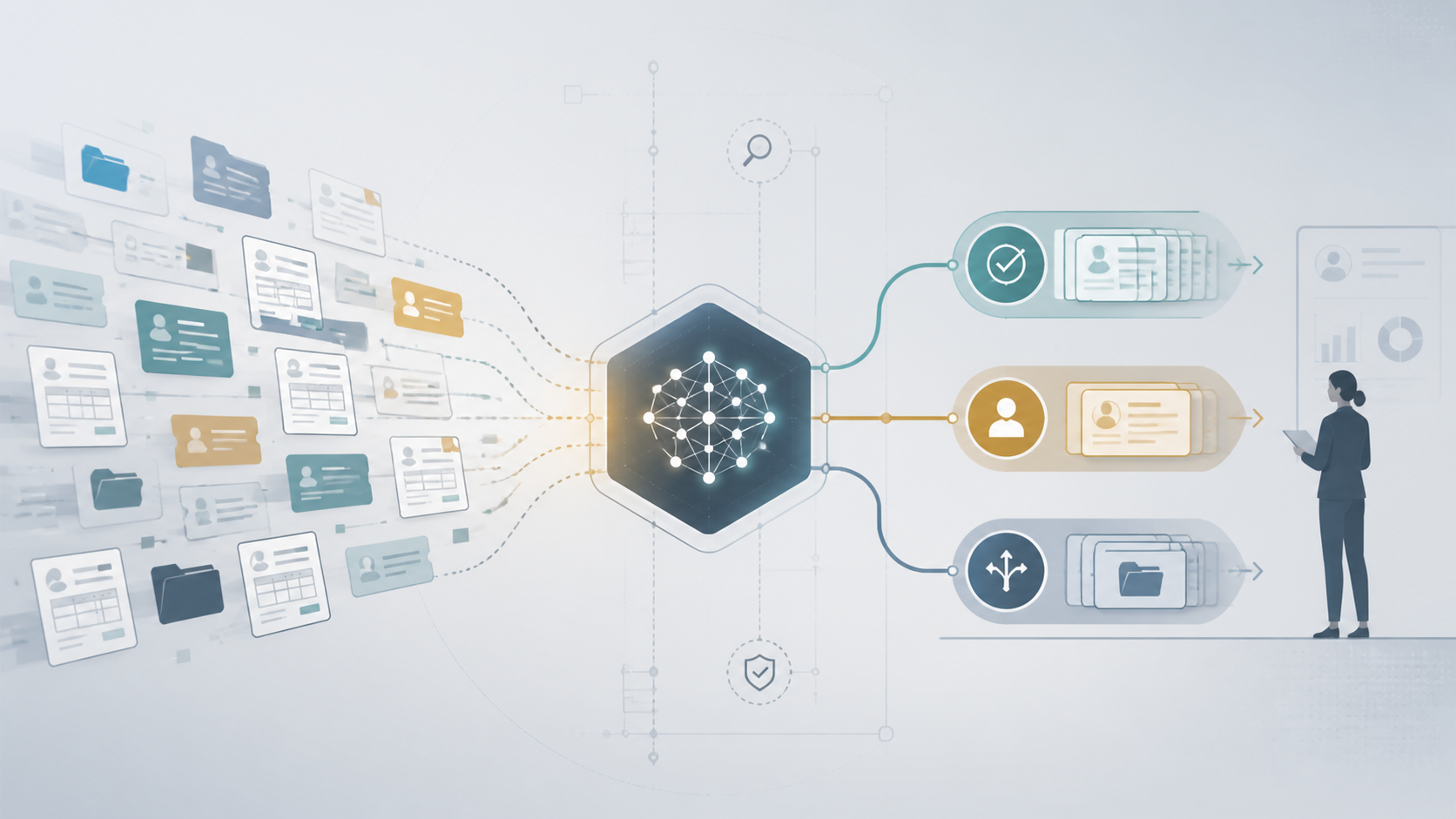
The business value belongs to operations, and it should be stated by operations before a model touches a single request. The outcome is lower cost, higher throughput, and more consistent handling than the patchwork of rules and human judgment it replaces, achieved by using AI to triage, route, and approve high-volume work: directing support tickets, approving routine expenses, triaging applications, sorting incoming requests to the right queue. The owner is an operations leader who holds the cost and throughput numbers; the metrics are cost per item, throughput, cycle time, and routing accuracy. If those are not named and a baseline is not captured, you cannot tell whether the automation paid off, and you will have automated a process without knowing what it was worth.
The model's ability to route well is rarely the constraint. A claims operation that automates triage sees throughput rise and handling time fall almost immediately, which is why this looks like a straightforward efficiency project. It sits in an unusual place on the delivery range, because the difficulty is not data messiness or model quality. It is that the output is a decision, this goes here, this is approved, this is escalated, made automatically at scale, and a consequential automated decision needs an accountability structure that the old manual process carried implicitly and the automation does not.
What it actually takes to deliver
When a person routes a request, accountability is intact without anyone designing it. A human made the call, can explain it, and sits in a clear line of responsibility. Replace that person with a model and the efficiency carries over but the accountability does not. It has to be deliberately rebuilt, and most pilots prove the model can route well, declare success, and move to production without rebuilding it. The gap then surfaces in production, attached to a real failure.
The questions that have to be answered are concrete. When the model routes a request, who owns that decision? If the routing is wrong, who is responsible, the team that received the misrouted work, the team that should have, the people who deployed the model, or the model, which cannot be held responsible for anything? When a decision has to be explained to a customer or an auditor, can the organization reconstruct why the model routed as it did? And which decisions are too consequential to fully automate and require a human in the loop before the action is taken? These need answers before automation goes live: defined ownership of the inputs the routing depends on, decision lineage so any automated decision can be traced and explained, and human review protocols specifying which decisions are automated outright, which are automated with confirmation, and which stay human.
The reason this trap is common is that the gap does not appear in the pilot. There the model routes well, metrics improve, and there is no incident to test ownership of a bad decision, because volume is small and the team is watching closely. The gap is latent. It becomes visible only when the automation runs at full scale, the humans have stopped watching because the system appeared to work, and a routing decision goes wrong in a way that matters. At that point the organization discovers it automated a decision without deciding who owns it. The work moved faster, but responsibility dissolved: no clear accountable party, no clean lineage to explain what happened, no protocol that would have caught the case before it caused harm. The efficiency gain is real, and the accountability vacuum is also real, created silently by the first.
This is also where the operating-model question becomes unavoidable in a way it is not for many other use cases. Elsewhere the hard organizational questions can be deferred. Here they cannot, because the automation changes who, or what, is making decisions with consequences. That is not a reason to avoid the use case. It is a reason to scope it honestly as an accountability redesign rather than a tooling project, because the accountability framework you build, ownership, decision lineage, and calibrated review, is reusable across every future automation, which is what lets you safely automate more decisions over time instead of rediscovering the gap each time.
What to ask, prepare, and implement
For each decision you intend to automate, ask who owns the outcome and who is accountable when it is wrong, whether you can trace and explain any individual automated decision after the fact, and which decision types are too consequential to run without a human checkpoint. Prepare by defining data ownership for the routing inputs, building decision lineage into the design rather than bolting it on, and setting review protocols calibrated to consequence. Implement with the accountability structure in place before the model routes a live request, treating it as part of the build, not a follow-on, so the efficiency you capture is durable because it is accountable.
Resources to make it land
On people and roles, the central one is a process owner who holds the operating model, not just the metric, plus named owners for the inputs the routing depends on and a defined accountable party for each class of automated decision. Risk or compliance involvement is warranted wherever a misrouted or wrongly approved item carries real consequence. You do not primarily need modelers; you need someone who will own how decisions are made now that a model makes them.
On skills and external help, the differentiating capability is operating-model and process design rather than machine learning, and outside help earns its place when the organization has no experience redesigning accountability around automated decisions, which is more an operations and governance discipline than a technical one. On data work and tooling, the requirement is clear ownership of routing inputs, decision lineage that captures why each automated decision was made, confidence signals that let you separate routine cases from those that should go to a human, and a review-protocol mechanism that enforces the human checkpoints you defined.
The readiness questions are these. For each decision you intend to automate, have you defined who owns the outcome and who is accountable when it is wrong? Can you trace and explain any individual automated decision after the fact? Have you set review protocols calibrated to the consequence of each decision type? If the answers are no, the question is not whether AI can route your requests well, because it can, but whether you are prepared to redesign accountability before automation goes live, or willing to discover the gap the first time a decision goes wrong and no one can say who owns it.