The business value belongs to operations and reliability, with finance as a co-owner, and it should be defined by them before the first sensor feeds a model. The outcome is less unplanned downtime, longer asset life, and maintenance spend directed where it matters, achieved by using sensor data and time-series models to predict equipment failure before it happens so maintenance is performed when an asset needs it rather than on a fixed calendar. The owner is the reliability or operations leader who answers for uptime; the metrics are unplanned downtime, mean time between failures, maintenance cost, and avoided premature replacement. If those are not named and a baseline is not captured, the program becomes a sensor deployment in search of a result, and finance never learns whether the capital was well spent.
The dependency here is not acquiring sensors, which most organizations attempting this already have. It is the data discipline between the sensor and the model, and that places the use case toward the demanding end of the delivery range for a reason that has nothing to do with model sophistication. A manufacturer can instrument a production line, stand up the program, and find the predictions unreliable in ways no one can quite diagnose, at which point the maintenance team reverts to its own intervals and judgment and the sensor investment becomes a data feed no one acts on. The pattern repeats across industries, and the cause is almost always the same: the organization assumed the hard part was the sensors and the model, when the hard part was the data discipline in between.
What it actually takes to deliver
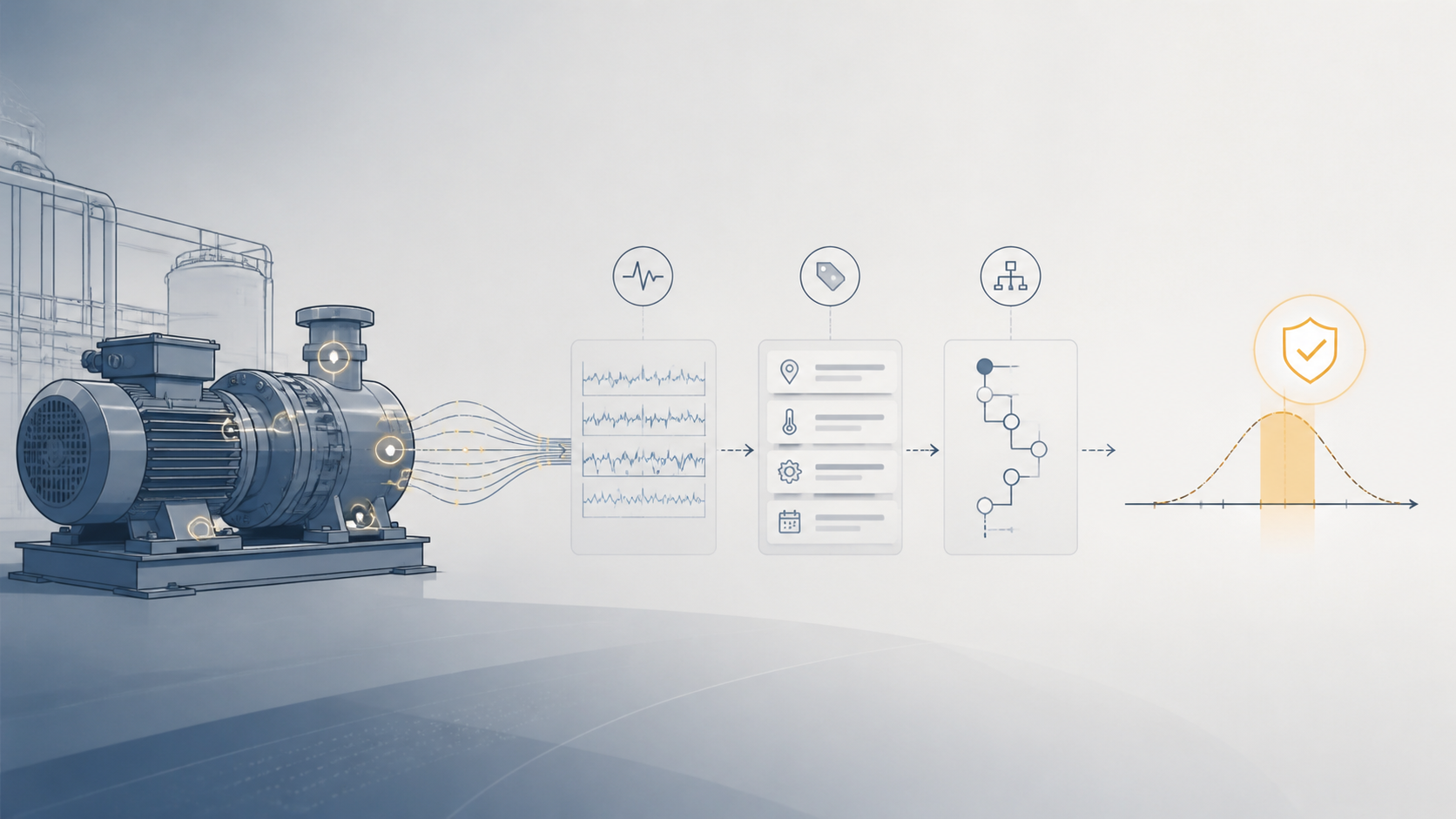
A sensor reading is not automatically useful data. Between the physical measurement and a trustworthy model input sit requirements organizations consistently underestimate.
Sampling consistency is the first. If a vibration sensor samples at one rate on one machine and a different rate on another, or if sampling drifts over time, or if readings drop out during the high-load periods that precede failures, the model is learning from an inconsistent signal. It cannot distinguish a real change in the asset's behavior from an artifact of how the data was collected, and the reliability engineers may not even know the sampling is inconsistent, because no one owns the question of whether sensor data is collected the same way everywhere.
Metadata is the second, and it is where most programs quietly fail. A time-series reading is close to meaningless without context: which specific asset, in what operating condition, at what load, under what environmental conditions, with what maintenance history. A temperature spike means one thing during normal operation and something entirely different during a known stress test. If that context is not captured and attached to the readings, the model is interpreting numbers it cannot place. It will find patterns, but it cannot know whether they mean anything, and neither can the people relying on it.
Lineage is the third, the chain from a sensor reading to a maintenance decision. When the model predicts a failure, a team is dispatched, and the prediction turns out wrong, someone needs to trace it back: which readings drove this, were they valid, what was the asset actually doing at the time. Without that lineage every wrong prediction is unexplainable, and a sequence of unexplainable wrong predictions is precisely how a maintenance team loses confidence and stops acting on the system.
What ties these together is where the discipline has to live. Predictive maintenance is one of the clearest illustrations of why data readiness is not a data team problem. A data team cannot fix inconsistent sampling from a control room. Sampling consistency, metadata capture, and operating-context tagging depend on how assets are instrumented and operated on the floor, by the people who run them. If the context about operating conditions is not captured at the source, no downstream engineering can recover it. This is why programs run as data science projects tend to stall: the data scientists build competent models on whatever data they are handed, the data turns out inconsistent and context-free, and the models underperform through no fault of the modeling.
What to ask, prepare, and implement
Ask whether your sensor data is sampled consistently across assets with operating-condition metadata captured at the source, whether you can trace a maintenance prediction back to the readings that produced it and validate them, and whether there is asset-level ownership of data quality or the sensor is someone's responsibility while the quality of what it produces is no one's. Prepare by establishing time-series governance, consistent sampling, attached metadata, and source-to-decision lineage, as an operational discipline embedded in how assets are managed. Implement with that discipline owned where the asset lives, by the people responsible for the asset, because they are the only ones positioned to ensure the data reflects reality, and instrument the program so condition data accumulates into something reusable rather than evaporating after each prediction.
Resources to make it land
On people and roles, the decisive one is asset-level ownership of data quality, the reliability or operations people who run the equipment made accountable for the completeness and consistency of what the sensors produce, alongside a program owner who connects that data discipline to the maintenance decisions and the financial case. Data engineering supports the pipeline, but it cannot own the floor-level discipline, and treating it as the owner is the common mistake.
On skills and external help, the differentiating capability is time-series and sensor-data engineering combined with operational reliability knowledge, and outside help is most useful for standing up the time-series governance and integration that internal teams rarely have done before, less so for the modeling itself. On data work and tooling, the requirement is consistent sampling across assets, an operating-condition and maintenance-history metadata layer attached to the readings, a time-series platform that preserves source-to-decision lineage, and validation that lets you check a prediction against the data behind it. Done well, that asset data foundation is worth more than the predictions alone, because consistent, contextualized, traceable condition data is the basis for digital twins, performance optimization, and capital planning grounded in real condition rather than a calendar.
The readiness questions are these. Is your sensor data sampled consistently across assets, with operating-condition metadata captured at the source? Can you trace a maintenance prediction back to the readings that produced it and validate them? Is there asset-level ownership of data quality? If the answers are no, the question is not whether you have the sensors, because you likely do, but whether you are prepared to establish the operational data discipline first, or content to collect numbers the organization will eventually stop believing.