
March 2, 2026
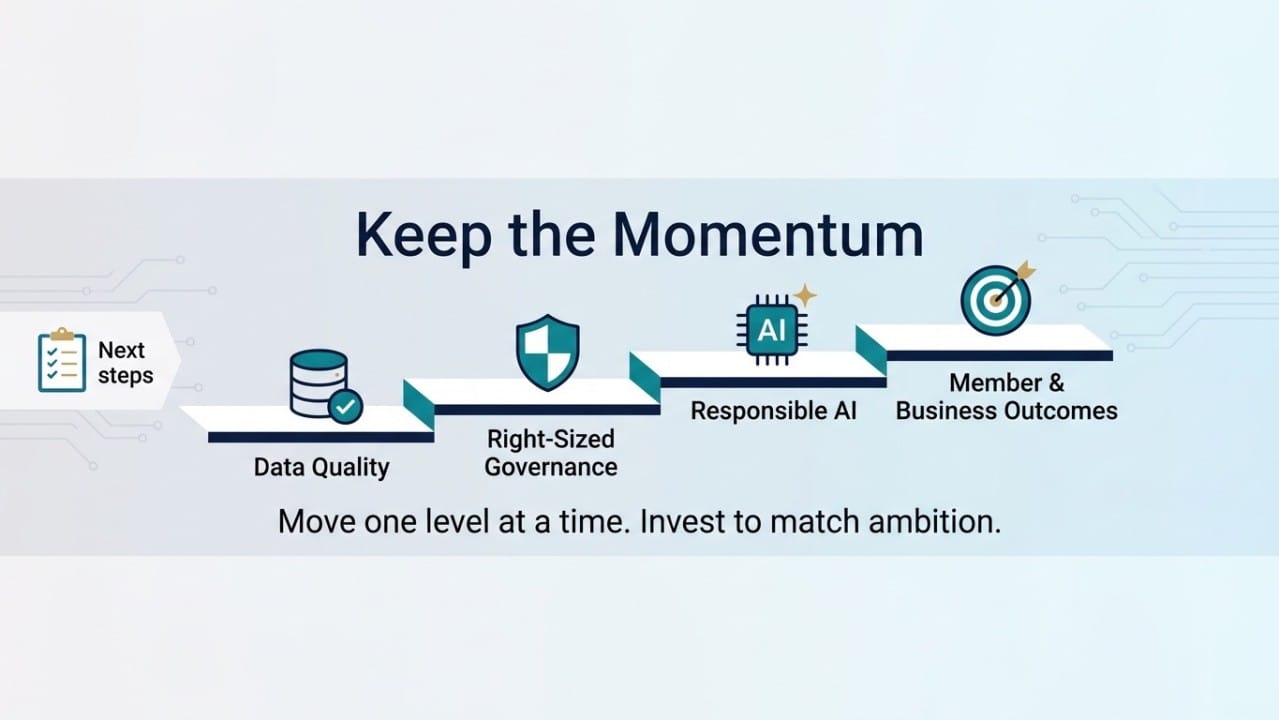
Over the last couple of weeks, we have covered governance, data quality, AI types, strategy alignment, teams, risk, and collaboration in a credit union context. The thread running through all of it is clear: progress should be right-sized to your reality, but it also needs enough pace and investment to avoid quietly falling behind.
Right-sized, but not slow
The maturity model we used is intentionally incremental: Aware, Reactive, Proactive, Managed, Optimized. Moving one level at a time is still the most sustainable way to grow capability, because it aligns expectations, skills, and processes with where you actually are.
There is a risk, though, in getting too comfortable at a level that once felt like progress. While your organization is stabilizing at “Reactive” or “Proactive,” peers and competitors are continuing to move, member expectations are rising, and regulators are sharpening their questions around data and AI. Staying put for too long becomes its own form of risk.
The goal is not reckless acceleration; it is deliberate, visible movement. Each step up the maturity curve should be intentional, measurable, and anchored in outcomes your executive team and board already care about.
Ambition, maturity, and investment must match
Another consistent theme in the series has been the relationship between ambition, maturity, and investment.
- When ambition is high, maturity is modest, and investment is thin, transformations almost always stall.
- Treating data and AI as a side project, or funding them at pilot levels while expecting enterprise results, is one of the fastest paths to visible failure.
- Mature organizations align commitment and resources with what they are asking these initiatives to deliver.
A few ways to keep that alignment front and center:
- Use the three core questions from early in the series: Where is our maturity today, what business outcome are we aiming for in the next 12–18 months, and what can we realistically sustain?
- When new demands show up (“We need AI in lending,” “We should personalize everything”), bring the investment lens into the conversation: “Given our starting point, what level of funding, capacity, and sponsorship would it actually take to do this well?”
- If the investment can’t move, help scale back the ambition to something that matches your current level and still creates meaningful member and business value.
This isn’t about arguing for bigger budgets for their own sake. It is about avoiding a pattern where under-resourced initiatives create fatigue and skepticism that make future progress harder.
Urgency without panic
Technology, member expectations, and regulatory focus are moving quickly. Boards and executives are beginning to treat data and AI maturity as core to strategy, not optional add-ons. The risk now isn’t just falling behind on features; it is falling behind on trust, resilience, and the ability to explain and defend how decisions are made.
You can help by:
- Keeping the focus on moving one maturity level at a time, but making sure there is a next level identified and visible.
- Highlighting where under-investment is putting ambitions at risk, using specific business examples rather than abstract warnings.
- Framing momentum as a member and risk imperative: “If we pause here too long, we don’t just miss opportunities; we make it harder to meet expectations that are already shifting.”
Your role as a facilitator
None of this requires owning the entire program. It does benefit from someone who can:
- Bring shared language maturity levels, fit-for-purpose quality, AI “flavors,” shared responsibility into discussions so people are talking about the same thing.
- Ask grounding questions about ambition, pace, and investment at key decision points.
- Connect proposals back to members, regulators, and strategy so urgency feels justified, not reactive.
As you look ahead, where do you see the biggest gap in your own organization: staying too comfortable at a current maturity level, moving too slowly given how fast expectations are changing, or expecting transformation-level outcomes from pilot-level investment?