
What caught my attention with Claude Fable 5 was not just the model itself. It was the possibility that the terms around using it may be shifting with the capability.
That matters more than it might sound at first.
If retention changes, fallback behavior changes, or the vendor conditions change, then this stops being a simple model upgrade. Someone has to notice that. Someone has to decide whether the governance answer changed too.
For a while, a lot of organizations could treat enterprise model access as relatively settled. The model might improve, but the surrounding assumptions stayed mostly intact. Your protections were your protections. If you were already approved to use the platform, the next release often felt like more of a capability question than a governance one.
That is the part that may be changing.
If a new model comes with different retention assumptions, different routing behavior, different fallback logic, or different use restrictions, then “we already approved the enterprise version” is not enough by itself. The question is no longer just whether the model is better. The question is whether anything around its use changed enough that the approval needs another look.
That is not a procurement detail. That is governance.
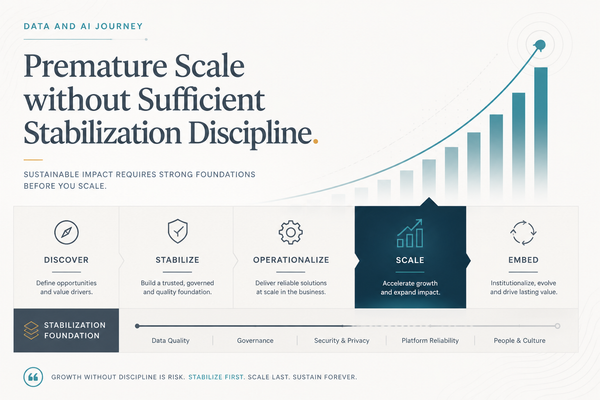
And I do not think this is only a Claude story. I think it is a signal about where the next part of the Data and AI journey starts to get more operational. Earlier on, the challenge was getting to reasonably governed access at all. Now the challenge is whether governance is active enough to catch meaningful changes before they disappear into routine use.
That is a different kind of maturity.
Not a giant new committee. Not bureaucracy for the sake of bureaucracy. Just a real internal motion for asking a few necessary questions before access expands.
Did retention change? Did traffic handling change? Did fallback behavior change? Did the vendor change the terms in a way that affects what users should or should not do? Did anything move enough that legal, privacy, security, procurement, or internal governance should take another look?
A lot of organizations are probably not fully set up for that yet, mostly because they have not had to be. If the working assumption was that enterprise access largely settled the issue unless you knowingly changed the settings yourself, then this kind of shift is easy to miss. Not because anyone is careless. Just because the mental model has not caught up yet.
That is why I keep coming back to this as a governance signal more than a model story.
Once outputs are shaped not only by the model, but also by fallback logic, safety controls, retention requirements, and vendor-side monitoring, you are not evaluating raw capability anymore. You are evaluating the whole operating environment around that capability.
That changes more than people think. It changes testing. It changes acceptable use. It changes what users should and should not enter. It changes what legal and privacy teams need visibility into. And it changes what it actually means to say a model is approved for use inside the organization.
To me, that is the real shift here. The next phase of the Data and AI journey is not just about governed access. It is about ongoing governance.
Does your organization have a real checkpoint for deciding when a model change is significant enough that the governance answer needs to be revisited?
When a vendor changes the model, the terms, or the fallback behavior, who in your organization is actually responsible for noticing before access expands?