The business value belongs to operations and finance, and they should define it before any model is built. The outcome is better margin and inventory efficiency: less capital tied up in safety stock, fewer stockouts, fewer overstock write-downs, all driven by forecasts the planning team can actually act on. The owner is a supply chain or operations leader, with finance as a stakeholder in the working-capital impact. The metrics are forecast accuracy where it matters, inventory turns, stockout rate, and write-downs. Naming those up front matters because forecasting is easy to declare a success on paper and hard to prove valuable unless you measure the business outcome, not just the model's error band.
Forecasting is one of the first use cases most operations-heavy organizations reach for, and one of the most frequently disappointing. The disappointment is almost never the algorithm. Forecasting methods are mature and largely commodity; a competent team can stand one up quickly. This use case sits toward the harder end of the delivery range, because it depends on your own historical data across multiple systems, and that data is usually messier than it looks.
What it actually takes to deliver
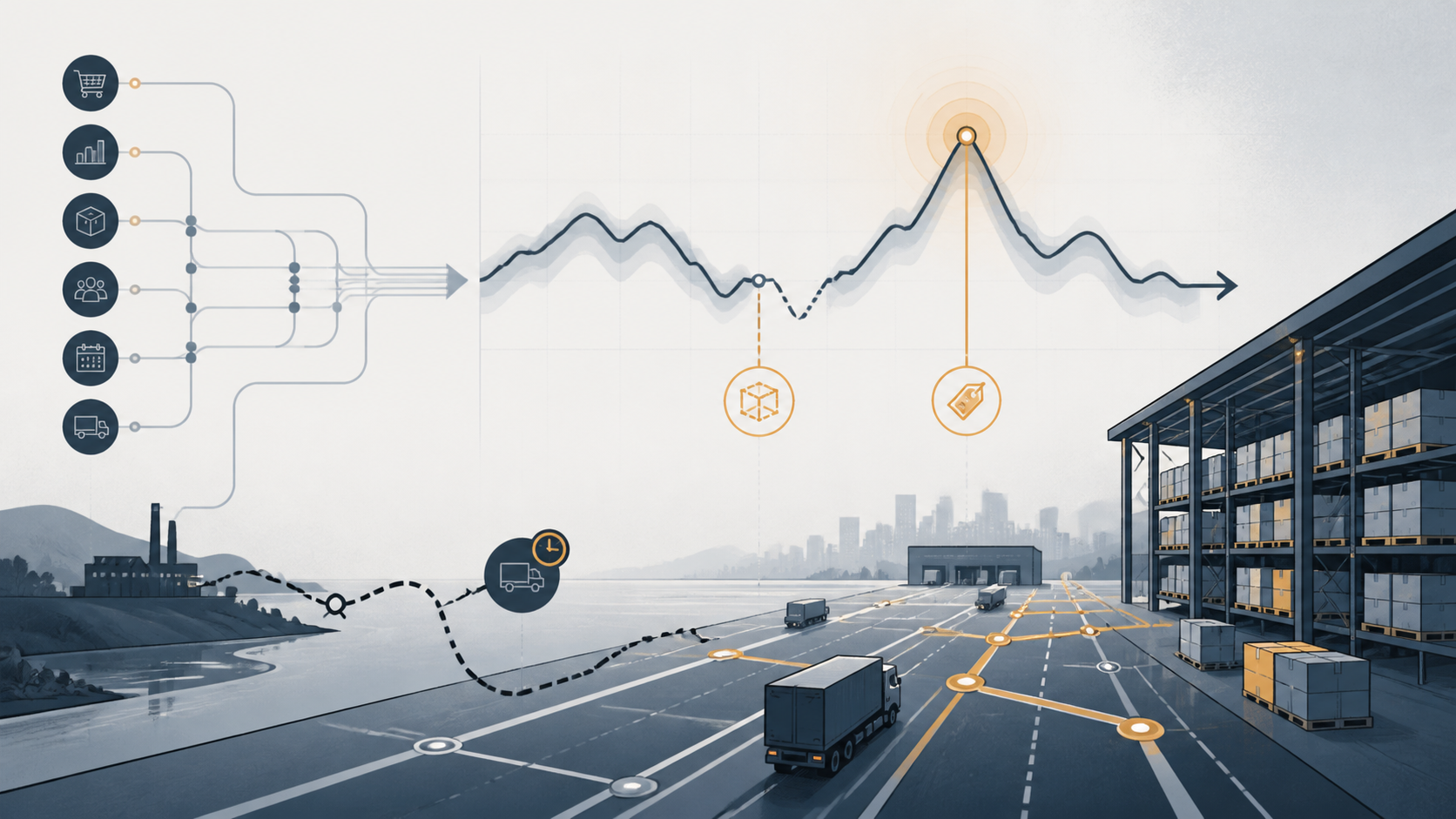
A forecasting model learns from history, so the quality of that history is the binding constraint. The trouble is that sales history routinely encodes events the model cannot interpret. A consumer goods manufacturer forecasting a seasonal product sees a sharp dip in the history and reads it as low demand, when the dip was actually a stockout caused by a supply disruption: demand that was real but never became a recorded sale. The model cannot tell suppressed sales from low demand, because the context that explains the difference, the stockout, the promotion that inflated a prior period, the supplier delay, lives in other systems or in no system at all.
So the real delivery requirements are about the data, not the model. The historical signal has to be trustworthy. Events have to be attributed, so the model can distinguish a stockout from a genuine demand shift. And there has to be lineage from the source system to the model input, so that when a forecast looks wrong, an analyst can trace the number back through every transformation to the originating record and understand why. Most organizations have the sales data and lack the attribution and the lineage. The model then trains on whatever the warehouse happens to contain, and the planners cannot answer the most important question about it: what did it actually learn from?
There is a second data problem that hides behind the first. Demand rarely depends on history alone; it responds to price changes, competitor moves, weather, and macro conditions that live entirely outside the sales record. A model trained only on internal history learns the shape of past demand but not the drivers that bent it, so when one of those drivers moves in a way the history never saw, the forecast misses and no one can say why. Bringing those external signals in is its own integration and reconciliation effort, matching outside data to your own periods and products and deciding which source is authoritative when they conflict, and it is rarely scoped at the start.
This is why forecasting matters most exactly when it is least reliable. In calm periods, an unexplained model stays inside its error band and planners adjust by feel. When several disruptions hit at once, planners need to know whether to trust the model or override it, and if they cannot trace what it is responding to, they override on instinct and the model goes unused in the scenario that justified it.
What to ask, prepare, and implement
Before building, ask whether you can attribute the major events in your demand history, distinguishing stockouts, promotions, and disruptions from real demand changes, and whether you can trace a model input back to its source. If not, that attribution and lineage work is the project, and it should be scoped before the modeling. Prepare a governed time-series data foundation rather than a one-time extract, because forecasting is a standing capability that decays without maintained inputs. Implement with explainability in mind from the start: planners will only act on forecasts they can interrogate, so build the ability to trace and explain a forecast as a first-class requirement, not an afterthought.
Resources to make it land
On people and roles, you need a business owner in supply chain who owns the outcome, a data steward for the demand and event data who is accountable for its quality and attribution, and a data engineer to build the lineage from source systems to model inputs. The modeling itself is the smaller role. On skills and external help, the scarce skill is not modeling but operational data governance, attributing events, reconciling sources, establishing lineage; this is often where outside help with supply chain data engineering pays off, while the forecasting model can frequently come from the planning platform you already run. On data work and tooling, expect to invest in cleaning and attributing historical demand data, integrating event metadata from promotion, supply, and inventory systems, and a time-series data store with governed lineage feeding the model.
The readiness questions are these. Can you attribute the significant events in your demand history rather than letting the model misread them? Can you trace a forecast back to its source data and explain it to a planner? Is there an owner for the demand data who keeps it trustworthy over time? If the answers are no, the question is not whether to buy a better forecasting model, but whether to do the attribution and lineage work first, because without it the model will look fine in calm quarters and fail the planners in the disrupted ones.