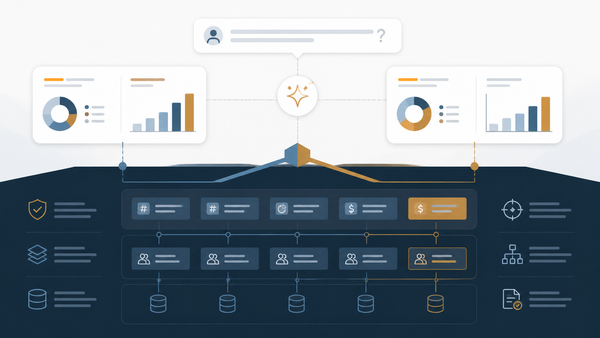
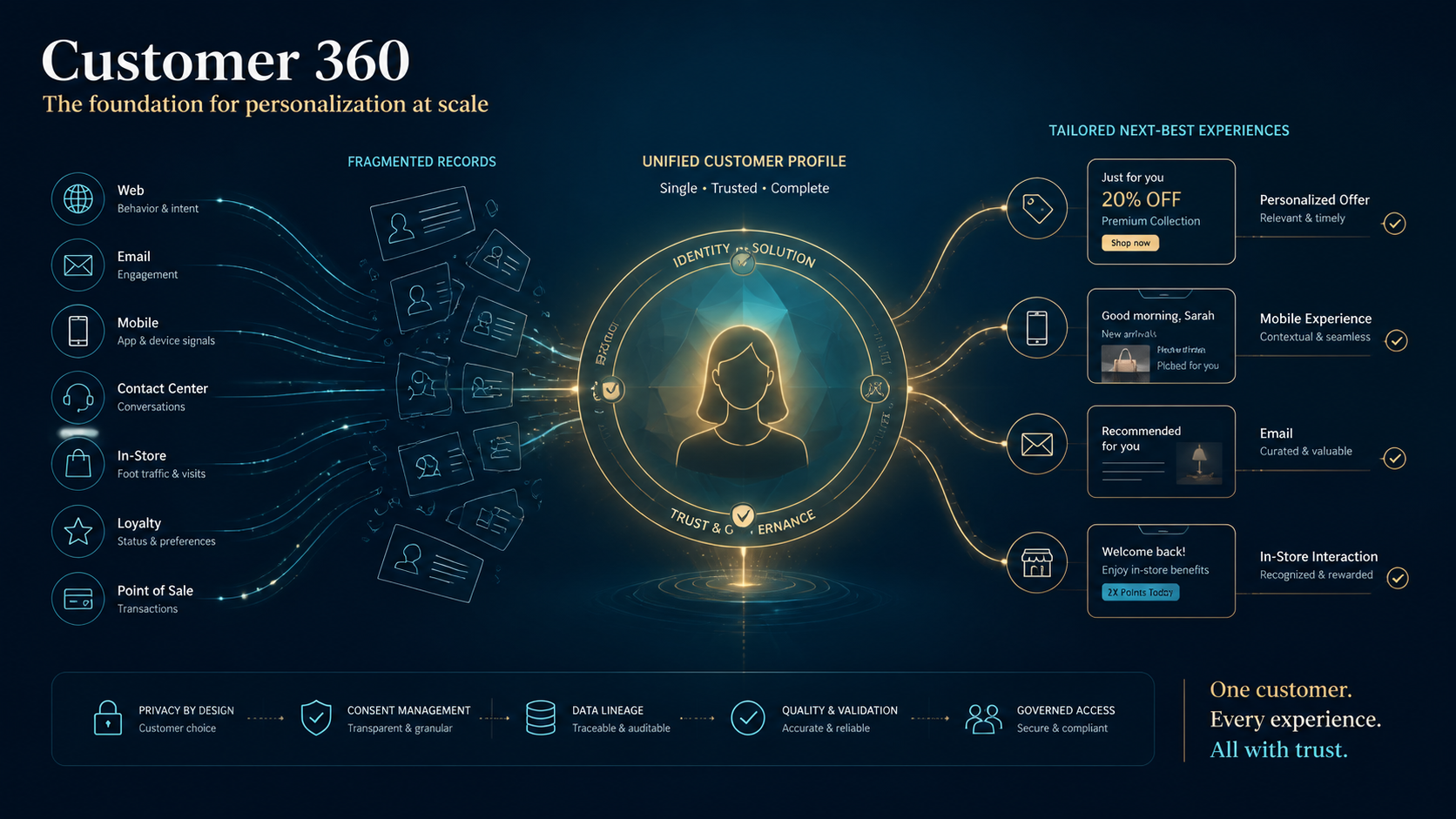
The business value belongs to the functions that own the customer relationship, marketing, digital, loyalty, and service, and they should define it before the technology conversation starts. The outcome is revenue growth and retention driven by experiences that reflect a single, coherent understanding of each customer across every channel: the email, the homepage, the app, and the contact center all acting as if the organization actually remembers the customer. The owner is a customer-facing executive, often a CMO or chief customer officer; the metrics are retention, revenue per customer, and cross-channel experience quality. The decision behind each interaction is, for this customer at this moment, what to present next.
This use case sits toward the harder end of the delivery range, and the reason is important: the difficulty is not the AI. Recommendation models, propensity scoring, and decisioning engines are mature and easy to acquire, and some are embedded in platforms you may already own. What the use case depends on is something no vendor can hand you, a trustworthy single view of the customer, and that is almost always the missing piece.
What it actually takes to deliver
Many organizations believe they have a customer view because a customer identifier appears across multiple systems. That is not a unified customer; it is a set of siloed profiles that agree on a key. The distinction becomes operational the moment you try to personalize. A customer browses a product on the website, buys a different product in-store, returns it, and opens a marketing email. A coherent next interaction has to reflect all of that, but the browse lives in the web platform, the purchase in point-of-sale, the return in order management, and the email engagement in the marketing tool. Each system knows its fragment; none knows the customer. A personalization engine on top can only act on the fragment it is wired into, which is how it recommends a product the customer just returned.
So the real delivery requirement is a customer data layer that is unified, so the fragments resolve into one coherent profile; attributed, so every signal can be traced to its source and trusted as a model input; and consented, so the use of each signal is defensible when a customer or regulator asks why a decision was made. Those last two are not bureaucratic. Personalization decisions get challenged, and when they do, the organization needs to trace a decision back through the profile to the source and basis for each signal. If the profile is an unattributed merge of fragments from systems with different consent histories, that trace is impossible, and the program has to be paused while someone reconstructs an answer it should have had by design.
Identity resolution is where this gets genuinely hard, and it is worth being honest that it is rarely a clean join. The same person appears as a guest checkout on the web, a loyalty number in store, an email address in the marketing tool, and a phone number in the contact center, with no shared key that reliably ties them together. Resolving them means probabilistic matching, rules for how confident a match has to be before two records are merged, and a way to unwind a merge when it turns out to be wrong, because a bad match attributes one customer's behavior to another and personalizes against a person who does not exist. None of that is provided by the recommendation engine sitting on top.
This is also where customer data ownership becomes real. Building a single view forces the question of who owns the customer entity across systems, with authority to decide whose definition wins when the web platform and the loyalty system disagree about the same person. That role often exists on paper. This use case reveals whether it was ever made operational, because without an empowered owner the unified view never gets unified, and the program stalls on organizational ambiguity rather than technology.
What to ask, prepare, and implement
Ask whether you can resolve one customer's activity across web, store, email, and service into a single attributed profile, whether there is a named owner of the customer entity with real authority, and whether you can defend a personalization decision with lineage and consent records. Prepare the governed customer data layer as the core of the effort, not a supporting task, and resolve the ownership question before, not during, the build. Implement consent and attribution into the profile from the start, because retrofitting them after personalization is live is far more expensive than building them in.
Resources to make it land
On people and roles, the pivotal one is an empowered owner of the customer entity, supported by data stewards for the contributing systems and a data engineering team to build identity resolution and the unified profile. The business owner holds the revenue and retention outcome. On skills and external help, the demanding skills are identity resolution, data integration, and consent governance rather than data science; outside help with customer data platform implementation and entity resolution frequently shortens a long and error-prone build, while the modeling can often come from tools you already have. On data work and tooling, this is substantial: integrating customer data from every channel, resolving identity across systems, capturing and governing consent, and standing up a customer data layer or platform that serves a trustworthy profile to the decisioning engine.
The readiness questions are these. Can you assemble a single, attributed, consented view of a customer across your channels today? Is there an owner of the customer entity with the authority to resolve cross-system conflicts? Can you defend why a given customer received a given experience? If the answers are no, you are not ready to personalize at scale, and the real question is whether to build the governed customer layer and establish ownership first, or to keep deploying channel-level personalization on a foundation you cannot defend when it is challenged.