The business value here is owned by sales, and it should be stated by sales before anyone touches a model. The outcome is a higher pipeline conversion rate and more productive reps, achieved by pointing each rep's limited selling time at the accounts most likely to close and recommending a sensible next action for each. The owner is a revenue leader; the metrics are conversion rate, win rate, and productivity per rep. If those metrics are not named and a baseline is not captured, you cannot tell later whether the capability worked, and lead scoring becomes a feature you turned on rather than a result you delivered.
This is one of the more attainable AI use cases, which is exactly why it is a good first example. Most modern CRM platforms embed lead scoring and next-best-action trained on the data the CRM already holds: opportunity records, win-loss outcomes, activity history, stage progression. You enable it, point it at your history, and within weeks reps work a ranked list that beats unaided judgment on a busy day. It tends to sit at the easy end of the delivery range, on data the vendor already governs. That is a real advantage, and it is also where the honest part of the conversation begins.
What it actually takes to deliver
Embedded does not mean effortless, and it does not guarantee good data. The vendor model is only as good as your CRM hygiene. If reps log opportunities inconsistently, leave stages stale, or record outcomes loosely, the model learns from a distorted picture of what winning looks like, and the scores quietly mislead. The first delivery requirement is unglamorous: the CRM data the model trains on has to actually reflect how deals progress and close. Many organizations discover their CRM is dirtier than they assumed only when the scores start disagreeing with what experienced reps know.
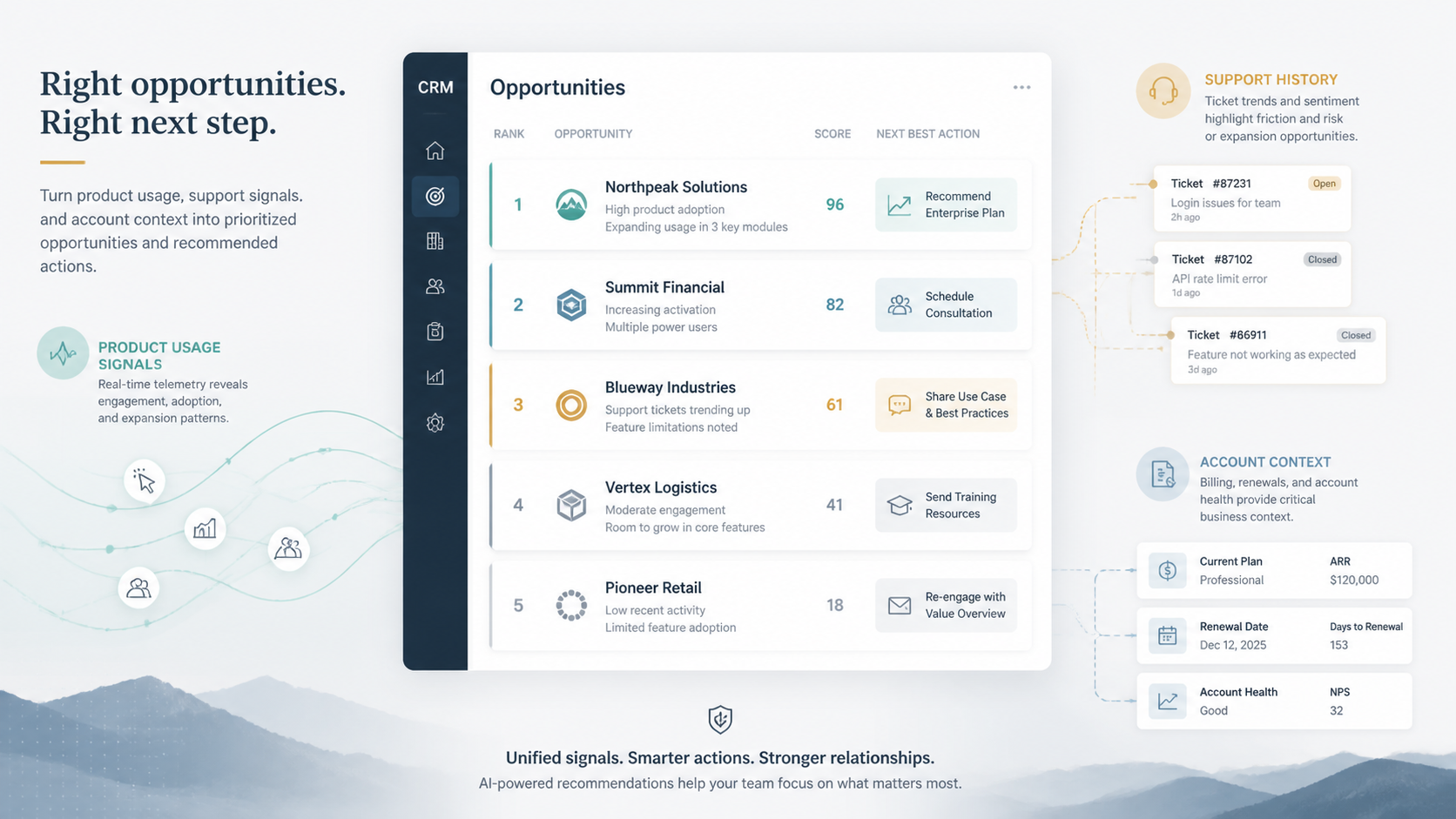
The second requirement appears when the business wants more than the vendor data can give. The model knows everything the CRM knows and nothing it does not. The strongest signals about whether an account will buy or expand often live elsewhere: product usage in the telemetry system, support history, billing and renewal data, marketing engagement that was never written back to the opportunity. The moment the business asks the score to reflect what a customer is actually doing across the relationship, the use case shifts from an embedded feature to an integration effort. Now someone has to pull those signals from other systems, resolve them to the right CRM account, decide which system is authoritative when they disagree, and keep that pipeline fresh. That is a different and larger undertaking, and whether you can do it depends on whether a unified customer data foundation exists.
The practical symptom of stopping at the vendor boundary is a plateau. The early lift is real, the next increment never arrives, and the score keeps surfacing accounts the reps already knew about, because the model has learned everything its data can teach it.
What to ask, prepare, and implement
Before enabling it, ask whether your CRM data is clean and consistent enough to train a trustworthy model, and if not, fix the hygiene and the rep behavior that drives it first, because no model overcomes bad inputs. Decide up front how reps will actually use the scores in their daily workflow, because a score nobody acts on changes nothing, and plan the change management to get reps trusting and working the list. Capture a conversion baseline so you can prove impact. And decide deliberately whether your ambition is prioritization within the CRM, which the embedded feature handles well, or scoring that reflects the whole customer relationship, which requires the integration work and should be scoped and funded as its own initiative.
Resources to make it land
On people and roles, the essential one is a sales operations owner who owns CRM data quality and the adoption of the scores, plus an executive sponsor in revenue who holds the outcome. For the embedded version you do not need a data science team. If you pursue enrichment from other systems, you add a data engineer to build and maintain the pipelines and someone accountable for resolving cross-system account definitions.
On skills and external help, the embedded capability is largely a configuration and adoption exercise, well within reach of an internal CRM admin and a sales-ops function; this is rarely where outside help is needed. External help earns its place if you go after the unified customer data layer, where data engineering and entity-resolution experience genuinely shortens the path. On data work and tooling, the embedded version needs CRM data hygiene and the platform's own scoring feature. The enriched version needs a customer data layer or warehouse, integration pipelines from product, support, and billing systems, and a governed answer to account identity across them.
The readiness questions are these. Is your CRM data clean and consistently maintained enough to train a model you would trust? Do you have a sales-ops owner who can drive both data quality and rep adoption? And is the value you actually want available within the CRM, or does it require signals from systems you have not yet connected? If the first two are yes and you want prioritization within the CRM, you are ready to deploy now. If the value depends on the full customer picture, the real question is whether to start with the quick embedded win while you build the customer data foundation the larger outcome requires.