February 24, 2026
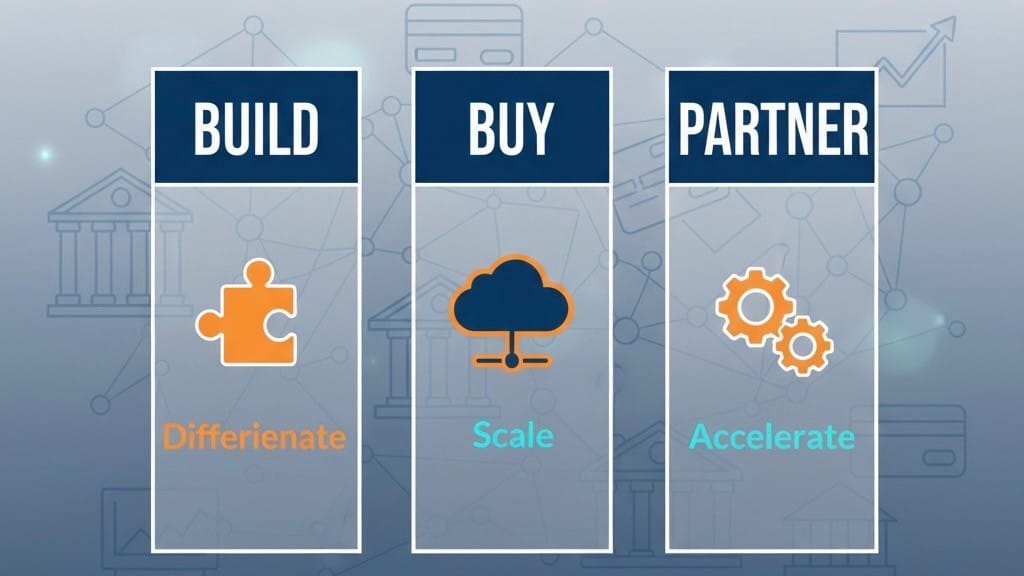
Build, Buy or Partner is a question all organizations wrestle with. Most credit unions will not build AI. They already have it. Embedded in their fraud tools, their LOS, their digital banking platform. The real decision is what to do next.
And that decision is not one decision. It is dozens. A credit union might partner with a vendor for fraud detection, buy a platform for its data warehouse, and build custom analytics on top. The sourcing answer changes depending on the capability, the business need, and the organizational context. There is no single right model - there is only the right model for each use case.
So how do you decide? Throughout this series, we have talked about right-sizing governance, data quality, team structure, and personalization to fit your maturity and your mission. The same principle applies to sourcing. Four lenses help cut through the noise.
Lens 1: Differentiation
Does this capability set you apart, or is it table stakes? Core fraud detection benefits from vendor scale - a partner processing transactions across thousands of institutions can spot patterns no single credit union could on its own. That is a clear case for partnership. But how you use member data to anticipate needs, personalize outreach, or identify members in financial stress? That might be where building on top of a platform creates real competitive separation.
The question to ask: if we execute this exceptionally well, will members notice?
Lens 2: Sustainability
Can the organization maintain it, not just launch it? This is where the best-of-suite versus best-of-breed conversation gets real. A best-of-breed point solution might offer a stronger capability on day one, but if the team cannot sustain the integrations, monitoring, and vendor management across a dozen different tools, it becomes a liability. A well-chosen suite from a strategic partner might offer “good enough” on individual features while dramatically reducing operational complexity.
Neither approach is universally right. The honest question is: what can we realistically support with the team and budget we actually have, not the one we hope to have next year?
Lens 3: Speed
What does delay cost? In some areas, taking time to build something tailored is fine. In others, member friction, staff burden, or competitive pressure makes speed a strategic factor. Buying or partnering for the foundational “plumbing” often frees internal energy for adoption and outcomes, which is usually where the real value lives anyway.
Lens 4: Governance
This is the lens that applies regardless of sourcing model. Whether AI is built, bought, or delivered through a partner, the institution is still accountable for how it is used and how it impacts members. The NCUA has emphasized that AI governance extends beyond traditional vendor management to include algorithmic decision-making, fair lending, and ongoing monitoring. The recently released Financial Services AI Risk Management Framework reinforces the same point: governance expectations scale with adoption, and they apply to community institutions and multinationals alike.
A practical starting point:
- Inventory every place AI is making or influencing decisions, including vendor-embedded tools. If you cannot list them, you cannot govern them.
- Document shared responsibility: what the vendor owns versus what you own.
- Review high-stakes decisions. Anywhere AI can materially impact a member - lending, fraud blocks, hardship scenarios - a human review step belongs in the process.
The build, buy, or partner decision is not a single fork in the road. It is a series of choices, each shaped by what you are trying to accomplish, what you can realistically sustain, and what governance the use case demands.
As you look across your AI and data capabilities, where have you landed on build, buy, or partner - and where are you still wrestling with it? What is making the call hard?