April 29, 2026
Most credit unions do not need to be convinced that AI should be used responsibly. I have never spoken to anyone who did not believe that whole heartedly. The harder question now is what responsible use actually requires once AI starts influencing real member outcomes in lending, fraud, service, marketing, or operations.
That is where an ethics statement stops being enough.
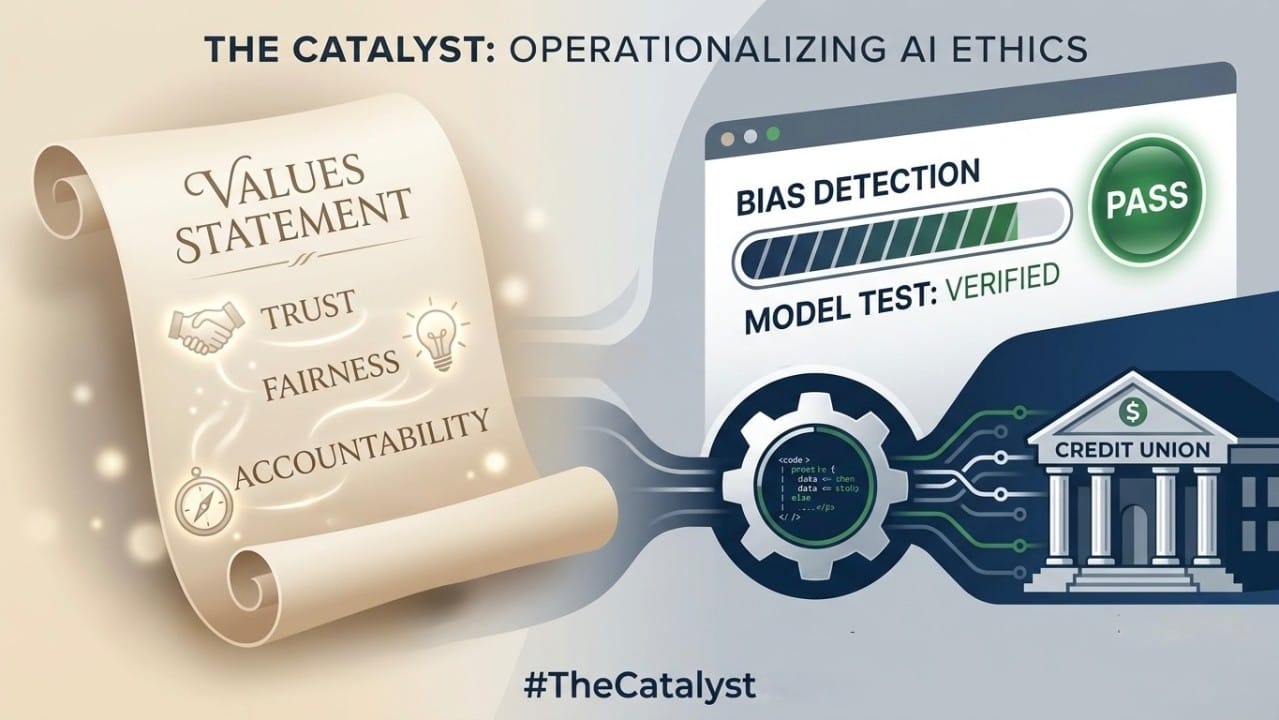
A commitment to fairness, transparency, and accountability matters. It gives the institution a clear point of view. It signals that member trust is still the north star. However, values only carry weight when they show up in operating practice.
If a member is denied credit and no one can clearly explain why, the ethics statement did not fail on paper. It failed in execution. If a fraud model creates a pattern of unnecessary holds for certain members and nobody is reviewing the outcomes closely enough to catch it, the problem is not that the institution lacked principles. The problem is that the principles never made it into the controls.
That distinction matters more now because the regulatory and compliance environment is not evaluating intentions in the abstract. In credit decisions, institutions still have to provide specific reasons for adverse actions, even when complex algorithms are involved, and NCUA’s AI resources point credit unions back to due diligence, ongoing monitoring, fair lending, privacy, model risk, and governance expectations rather than treating AI as outside the reach of existing oversight.
So what does operational AI ethics actually look like?
It starts with explainability, but not in the vague sense of being able to say a model is “generally understandable.” In lending, explainability means the institution can give a specific and accurate reason for a denial or other adverse action that reflects the factors actually used. If the model is too opaque for that, the issue is not only technical. It is legal, operational, and reputational.
It also requires fairness testing that continues after deployment. A model can look acceptable at implementation and still drift over time as data changes, member behavior shifts, or new inputs begin to function as proxies for protected characteristics. For high-impact use cases, especially credit, collections, fraud, and pricing, fairness is not a one-time validation exercise. It is an ongoing review discipline.
Then there is human oversight. This is one of the places where the conversation often becomes too generic to be useful. “Human in the loop” sounds reassuring, but it only matters if the institution has defined when that human steps in, what they are expected to assess, what authority they have to override the model, and how that intervention is documented. Otherwise, the phrase becomes more slogan than safeguard.
I think this is where many institutions feel the tension most clearly. An ethics statement is easy to agree with because it lives at the principle level. Operational ethics is harder because it forces role clarity, review cadence, documentation standards, escalation paths, and investment in monitoring. It asks who owns the issue after the policy is approved and the vendor is live.
That ownership question is more important than it may first appear.
Someone has to be accountable for reviewing whether outcomes remain aligned with what the institution says it stands for. Someone has to be able to see the data, understand the use case, raise concerns, and get those concerns in front of leadership before they become a member issue, an exam issue, or both. Institutions without that structure may still have good intentions. What they do not yet have is an operational ethics function.
For credit unions, this should feel familiar. We already understand that trust is built operationally. Members do not experience our values through a mission statement on a wall. They experience them through decisions, service moments, exceptions, and how we respond when something goes wrong. AI works the same way. The blueprint matters. The building matters more.
The institutions that will handle this well are not necessarily the ones with the most polished AI principles. They are the ones that can translate those principles into repeatable practices that fit their size, maturity, and risk profile. Clear use-case classification. Defined review ownership. Fairness monitoring. Documentation. Vendor challenge. Escalation paths. Evidence.
That is not bureaucracy for its own sake. It is how a member-first ethics commitment becomes credible.
Does your institution’s AI ethics commitment have an operational owner, or does it still live mostly at the policy level?