May 14, 2026
A lot of the excitement around AI is understandable.
A new tool shows up. It does in seconds what used to take much longer. Everyone can see the potential right away.
Then real life kicks in.
The workflow is still clunky. The approvals still take too long. The handoffs are still messy. People are still unclear on what they own, what good looks like, and when they should trust the output versus stop and challenge it.
That is where the real work usually starts.
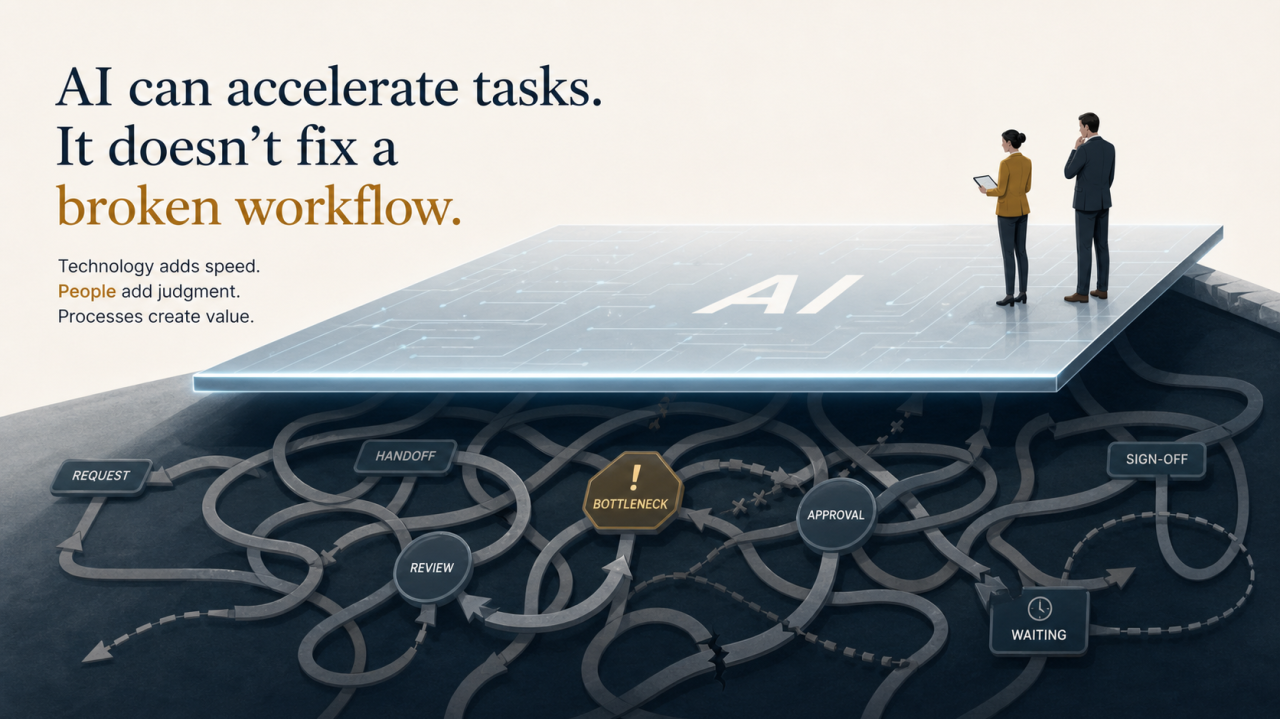
AI can help a lot. Technology can help a lot. But shiny new tools do not fix broken work on their own.
They usually just make the gaps easier to see.
A tool can save time and still not make the work feel much better. If the process around it is still clunky, people usually end up doing both. They use the new tool, then keep dragging the old workflow behind it because nothing else really changed.
That is why I keep coming back to people.
People are still the ones delivering the member experience. People are still the ones applying judgment when something looks off. People are still the ones deciding whether an answer from AI is useful, incomplete, or just wrong. People are still the ones a member remembers after the interaction is over.
That matters even more in credit unions.
The goal is not to remove the human element from the experience. It is to take friction, repetition, and low-value work off people’s plates so they can spend more time where they actually add value. Better conversations. Better judgment. Better follow-through. More attention on the moments that affect trust.
When that part is missing, AI adoption starts to look impressive without feeling especially helpful.
A team may be using the tool every day. But if nobody changed the workflow, clarified ownership, updated expectations, or made space for people to work differently, then the tool often becomes one more thing to manage. People use it, then work around it, then double-check it, then still carry the old process with them because nothing around the work really changed.
I think that is why some AI rollouts feel more successful in the demo than in the day-to-day reality.
The technology may be working exactly as designed.
The organization around it is not.
That is why this usually stops being about the tool pretty quickly. Once AI is part of the work, people need to know what they own, what they are supposed to question, and when “good enough” is not actually good enough. If that part stays fuzzy, the speed shows up before the understanding does.
The strongest AI environments are probably not the ones with the most tools.
They are the ones where people know what the tool is for, what it is not for, when to rely on it, when to question it, and how their own role is changing because of it.
That is a much more human kind of transformation.
And I think it is the only kind that lasts.
Because in the end, AI does not deliver the culture. It does not deliver the trust. It does not deliver the experience.
Your people do.
Where have you seen AI genuinely improve the work, and where has it mostly exposed the fact that the workflow around the work still needs to change?