March 17, 2026
Innovation moves fast. In our world, though, trust moves everything.
As the CULytics Summit gets underway here in Atlanta, I’m already hearing a familiar tension in the hallway conversations. Everyone wants to use AI to improve member experience, simplify work, and move faster. At the same time, nobody wants to create new risk, erode confidence, or introduce something we can’t fully explain.
That tension is real, and I don’t think it goes away.
If anything, it becomes the leadership challenge. How do we create enough room to experiment and learn without making trust the thing we accidentally trade away in the process?
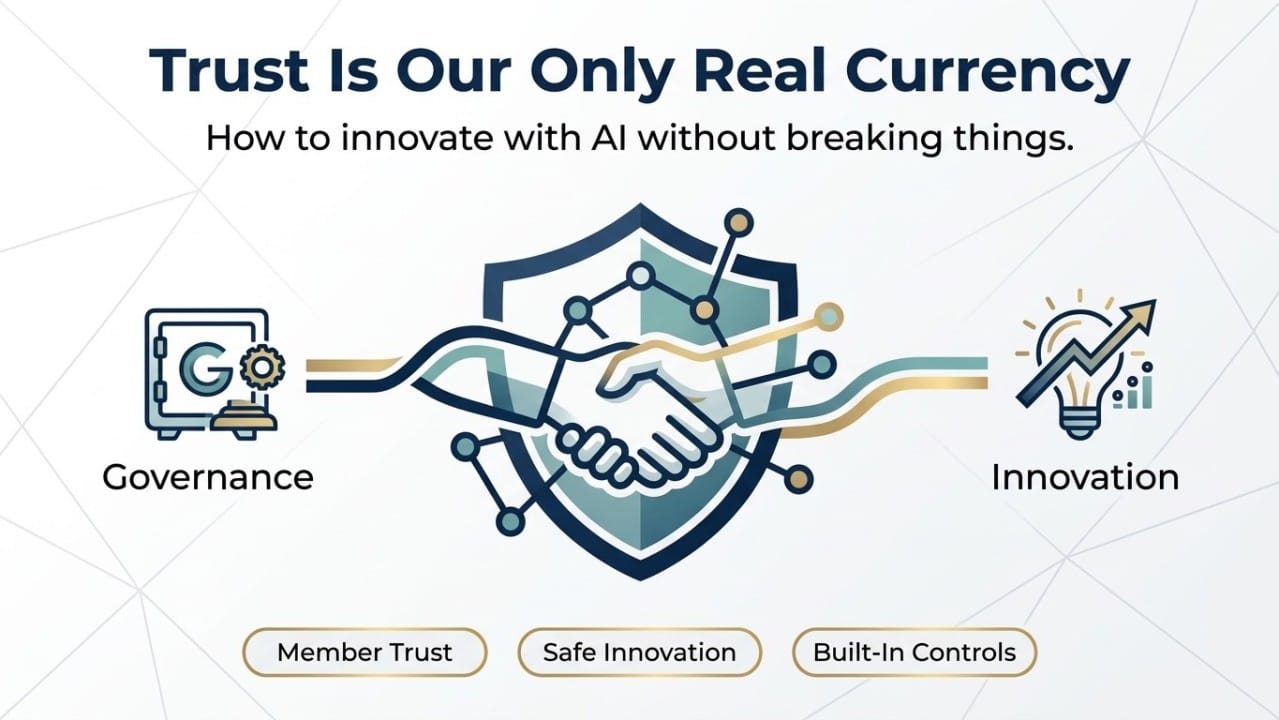
One of the more useful ideas I took from Gartner was this: governance cannot stay documentation-led and manual if we expect AI to scale. Sarah Turkaly’s research points toward more integrated governance models and more technology-enforced controls, so governance becomes part of how innovation happens safely, not a checkpoint bolted on at the end.
That framing matters, because too often governance gets cast as the department of no. In practice, the best governance does the opposite. It gives teams clarity. It sets boundaries people can understand. It creates confidence that we can move forward without guessing where the guardrails are.
For credit unions, that is not a side issue. It is the issue.
Our members trust us with the most personal parts of their financial lives. That trust is hard won, easy to lose, and almost impossible to recover once it is broken. So when we talk about AI in areas like lending, fraud, service, or marketing, we are not just talking about efficiency. We are talking about whether the member experience still feels fair, understandable, and worthy of confidence.
That is why I think governance has to be reframed. Not as a brake pedal, but as a steering system.
A good governance model should help us answer practical questions early. What data should this model use? Where does human review need to stay in the loop? What decisions need explainability? What policies should be enforced automatically instead of relying on everyone to remember them? Gartner’s research argues that future-ready governance is built around integrated operating models, adaptive trust-based controls, and policy enforcement in technology rather than in binders and static documentation.
You can see a version of that thinking in the market. Apple has made privacy a central part of its AI story by emphasizing on-device processing where possible and using Private Cloud Compute for more complex requests, with the company stating that relevant data is used only to fulfill the request and is not stored or made accessible to Apple.
Whether or not that model translates directly to financial services is not really the point. The bigger point is that governance and trust do not have to sit on the other side of innovation. They can be part of the value proposition.
I think that is where a lot of us need to push the conversation next.
Because the goal is not just to launch AI responsibly. The goal is to make responsible innovation a repeatable capability. Something the business can trust. Something risk leaders can trust. And most importantly, something members can trust even though they may never see the model, the control framework, or the policy logic sitting underneath it.
That kind of trust does not come from a slide that says we take AI seriously. It comes from doing the hard work to build governance into the operating model from the beginning.
For the leaders here at CULytics, and for those following from home, that feels like the real challenge in front of us. How do we create governance that is strong enough to protect trust and flexible enough to let good innovation move?
That is the conversation I’m hoping we have more openly this week.
How is your credit union balancing the pressure to move faster with AI and the responsibility to protect the trust members already placed in you?