February 14, 2026
There’s an uncomfortable truth the AI hype cycle tends to skip: the fastest way to lose member trust isn’t a data breach. It’s a member discovering that a decision that changed their financial life—a loan denial, a fraud hold on their paycheck, a product recommendation that wasn’t in their interest—was made by an algorithm they never knew existed.
Credit unions exist because people trusted other people to look out for them. If we deploy AI that undermines that trust, we haven’t innovated. We’ve contradicted our mission.
The Stakes Are Higher Than They Appear
AI adoption across credit unions is accelerating. Sixty-five percent of credit unions plan to increase AI investments over the next two years, and 83% of financial institutions overall are growing AI budgets in 2026. That investment is flowing into lending, fraud detection, member service, and marketing—areas that directly touch members’ financial lives.
At the same time, consumer trust in AI for financial decisions remains strikingly low. Only 29% of banking consumers report high trust in AI output when making banking decisions. Forty-three percent actively distrust AI chatbots for financial advice. Members aren’t opposed to technology—they’re wary of technology that operates without transparency, accountability, or their interests at the center.
For credit unions, this gap between AI capability and member trust isn’t just a marketing challenge. It’s an existential one. Our entire model is built on the promise that we serve members, not shareholders. If AI erodes that distinction, we lose the one thing that differentiates us.
A Framework for Member-First AI Ethics
When evaluating any AI use case—whether you’re building it, buying it, or it’s embedded in a vendor platform—run it through four questions:
- Does this serve the member’s interest, or just our efficiency? Automation that reduces cost is valuable. But if the primary beneficiary is the institution and the member experience stays the same—or gets worse—that’s optimization, not service. The goal is AI that makes members’ financial lives better.
- Can we explain this decision to the member it affects? The CFPB has been clear: there is no special exemption for artificial intelligence when it comes to explaining adverse actions. But beyond regulatory compliance, explainability is a trust issue. If a member is denied a loan, flagged for fraud, or offered a specific product, they deserve to understand why. If your AI can’t support that explanation, it’s not ready for that use case.
- Have we tested for fairness—not just accuracy? AI models trained on historical data can replicate historical biases. Research shows that AI lending models trained on historical data consistently replicate patterns of discrimination in mortgage lending. Accuracy and fairness are not the same thing. A model can be highly accurate in predicting default and systematically disadvantage certain populations. Testing for both is non-negotiable.
- Is member data protected as if our reputation depends on it—because it does? The NCUA’s AI compliance framework makes it clear: any AI touching member data needs inventory, classification, and controls. But beyond compliance, credit unions should be asking vendor partners pointed questions: Is member data used to train models? Under what terms? What happens to that data if the vendor relationship ends?
The Cooperative Advantage
Here’s what often gets lost in the ethics conversation: member-first AI ethics isn’t a constraint on innovation—it’s a competitive advantage. The World Council of Credit Unions put it well in their recent ethical AI whitepaper: “Ethical use of AI can’t be assumed. It must be designed”.
Credit unions that lead with transparency, fairness, and member protection aren’t just mitigating risk. They’re building the kind of trust that megabanks and fintechs struggle to earn. When only 29% of consumers highly trust AI in banking decisions, the institution that can say “we designed this for you, and here’s how it works” will stand apart.
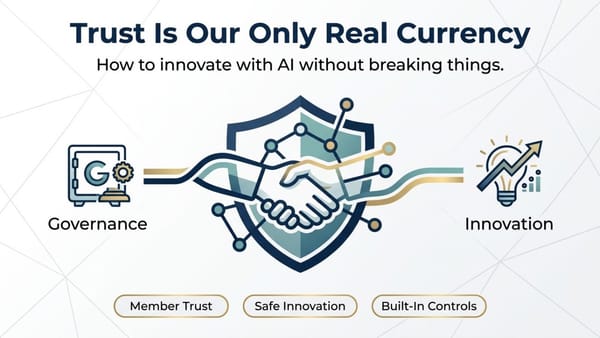
Think of it this way: we don’t adopt AI despite our cooperative values. We adopt AI through them. The mission doesn’t slow us down. It tells us where the guardrails belong.
What most credit unions will recognize: the pressure to move fast on AI is real. Boards are asking about it. Vendors are selling it. Members expect digital experiences that compete with the largest banks. The temptation is to adopt first and govern later. But in financial services—especially in a member-owned model—that sequence is backwards.
Ethics isn’t the last mile of an AI deployment. It’s the first conversation.
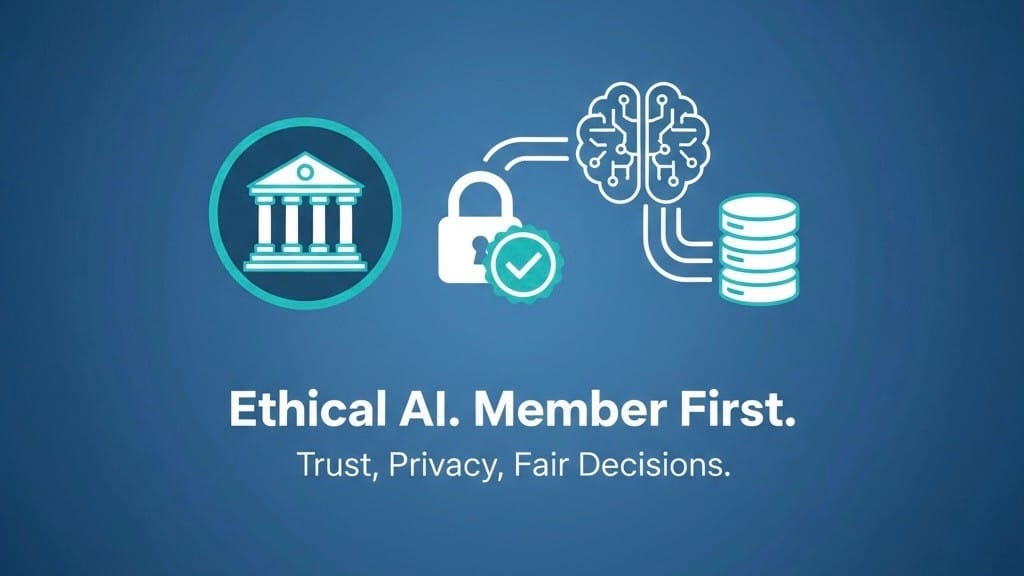
Whether we build AI in-house or bring it in through partners, the ethical bar cannot move. If we build, ethics has to sit at the center of every design choice—what data we use, which outcomes we optimize for, how we handle exceptions, and how we explain results to members. If we buy or partner, we should only work with organizations that are as serious about ethics, transparency, and member protection as we are, not just the ones with the flashiest features. That’s one reason CUSOs can be especially strong partners here: they share our cooperative DNA and our mission to put member trust, privacy, and fair decisions first.
What’s one AI use case at your organization where you’ve wrestled with the tension between speed and doing it right? I’d love to hear how you navigated it.