March 18, 2026
One of the more interesting conversations I keep hearing this week is not really about models or vendors. It is about ownership.
Who actually owns AI in a credit union?
Not on the org chart. Not in the steering committee. I mean in the real, practical sense of who is accountable when an AI use case moves from idea to implementation to outcome.
That feels like a simple question, but I don’t think it is.
If AI sits only with IT, it usually turns into a technology project. If it sits only with the data team, it can turn into an impressive demo. And if it sits nowhere in particular, it tends to get stuck in that middle ground where everyone is interested, but nobody is truly accountable for the result.
That was one reason Frank Buytendijk’s Gartner session stayed with me. He made the point that “who owns AI?” may actually be the wrong question, and that AI needs orchestration and stewardship more than traditional ownership.
That rang true.
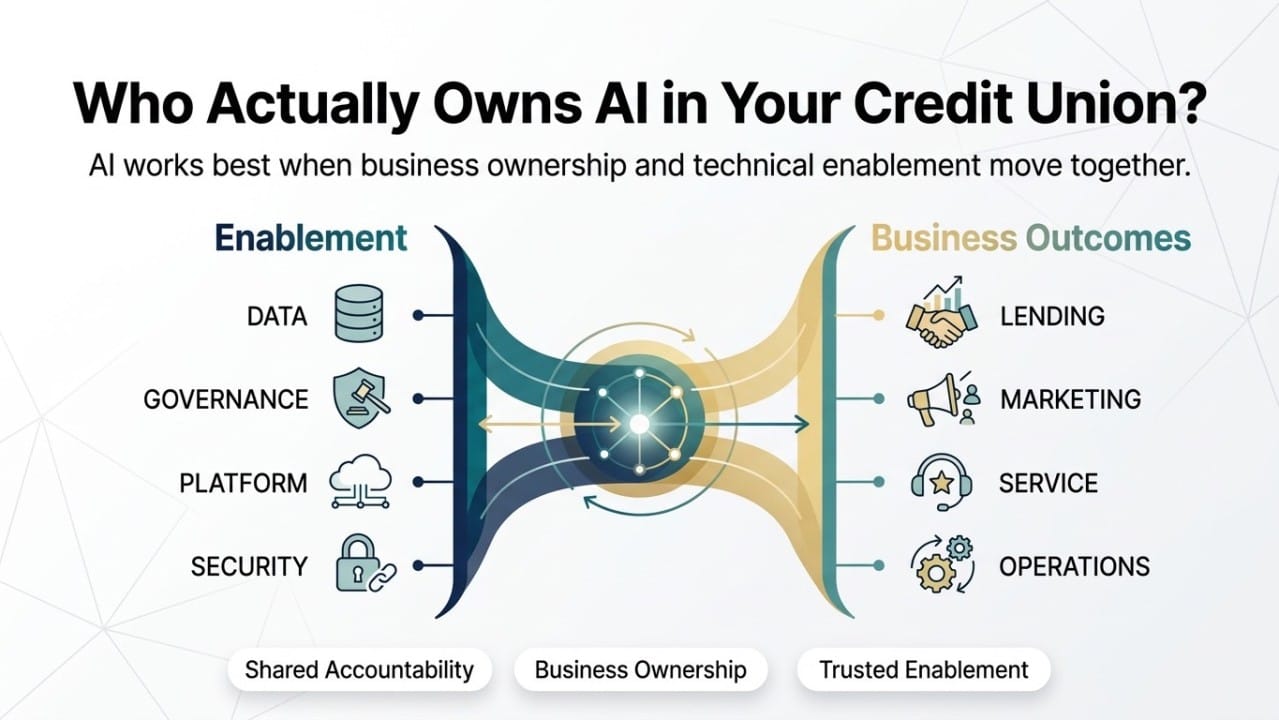
Because in our world, the data and technology teams absolutely have to build the foundation. They help create the infrastructure, governance, security, and standards. But if the lending team is using AI to improve credit decisions, then the lending team has to own that outcome. If marketing is using AI to improve outreach, then marketing has to own that outcome. If operations is using AI to remove friction, then operations has to own that outcome.
Otherwise, we end up treating AI like something the technical teams are doing on behalf of the business instead of with the business.
And I think that is where a lot of organizations get sideways. We keep asking who owns AI as if it should belong to one executive, one function, or one team. But maybe the better question is who owns the business problem, and do they have the right technical partners around them to solve it well?
That feels a lot more useful to me.
Because the credit unions that get this right probably will not be the ones with the flashiest tools. They will be the ones where business leaders and technical leaders are genuinely working in lockstep, with clear accountability on both sides.
Maybe that is the real shift in front of us.
Not moving AI out of IT. Not handing it all to data. But building an operating model where the center enables, the business owns outcomes, and nobody is confused about what success is supposed to look like.
That is the conversation I find myself wanting to have more often.
At your credit union, is AI still mostly viewed as a technology initiative, or has it become part of how business leaders think about owning results?