May 21, 2026
Wow, the developments keep coming, and what is starting to matter is not any one announcement by itself. It is how they are starting to stack on top of each other. AI is moving further into people’s financial lives, policy signals are getting more active, and the question of what institutions are actually ready to support, govern, and explain feels a lot more immediate than it did even a short time ago.
OpenAI’s Financial Offering
The OpenAI announcement is more important than it looks. If members start connecting accounts across institutions, ChatGPT may end up seeing more of their financial life than the credit union can. I do not think the point here is that credit unions now need to compete head-to-head with ChatGPT. The more practical question is whether our staff are ready for the moment a member says, “ChatGPT helped me come up with this plan. What do you think?”
That may not stay hypothetical for very long.
And it is a hard conversation if the employee only has a partial view of the relationship in front of them while the member may have already handed an external AI tool a much fuller picture of their finances. At that point the data question, the staff readiness question, and the trust question are all sitting in the same conversation.
The policy environment may be shifting too
The White House executive order on fintech innovation matters because it suggests some of the friction around innovation, partnerships, and access may be getting another look. It is not just a broad statement about innovation. It directs federal financial regulators, including the NCUA, to review rules, guidance, supervisory practices, and application processes that may be slowing innovation, competition, and collaboration between fintech firms and regulated institutions.
That is worth paying attention to, especially because the timing is short. A 90-day review window for regulators and a 120-day Federal Reserve report on payment access is soon enough to start showing up inside real planning cycles.
I do not read that as a signal that every credit union should suddenly become a fintech chaser. I read it more as a reminder that the environment around innovation may start moving faster than some institutions are used to. Once that happens, the question is not whether innovation keeps coming. It is whether we are clear enough in our own strategy, data, governance, and staffing to know where to engage, where to partner, and where to hold the line.
The oversight side may be moving too
Then there is the separate reporting around a possible White House executive order on frontier models. Even if it stays in draft form or changes materially, it points to something worth watching. The conversation is not moving in only one direction. It is not just about faster adoption. It may also be moving toward more direct scrutiny of the most advanced models, especially where cyber risk and broader systemic risk start to overlap.
That matters for credit unions even if they are not building frontier models themselves. If AI capability, cybersecurity, and governance keep getting tied together more tightly, then AI stops being just a tool conversation. It becomes an operating model conversation, and eventually an oversight conversation too.
This is where the journey comes back in
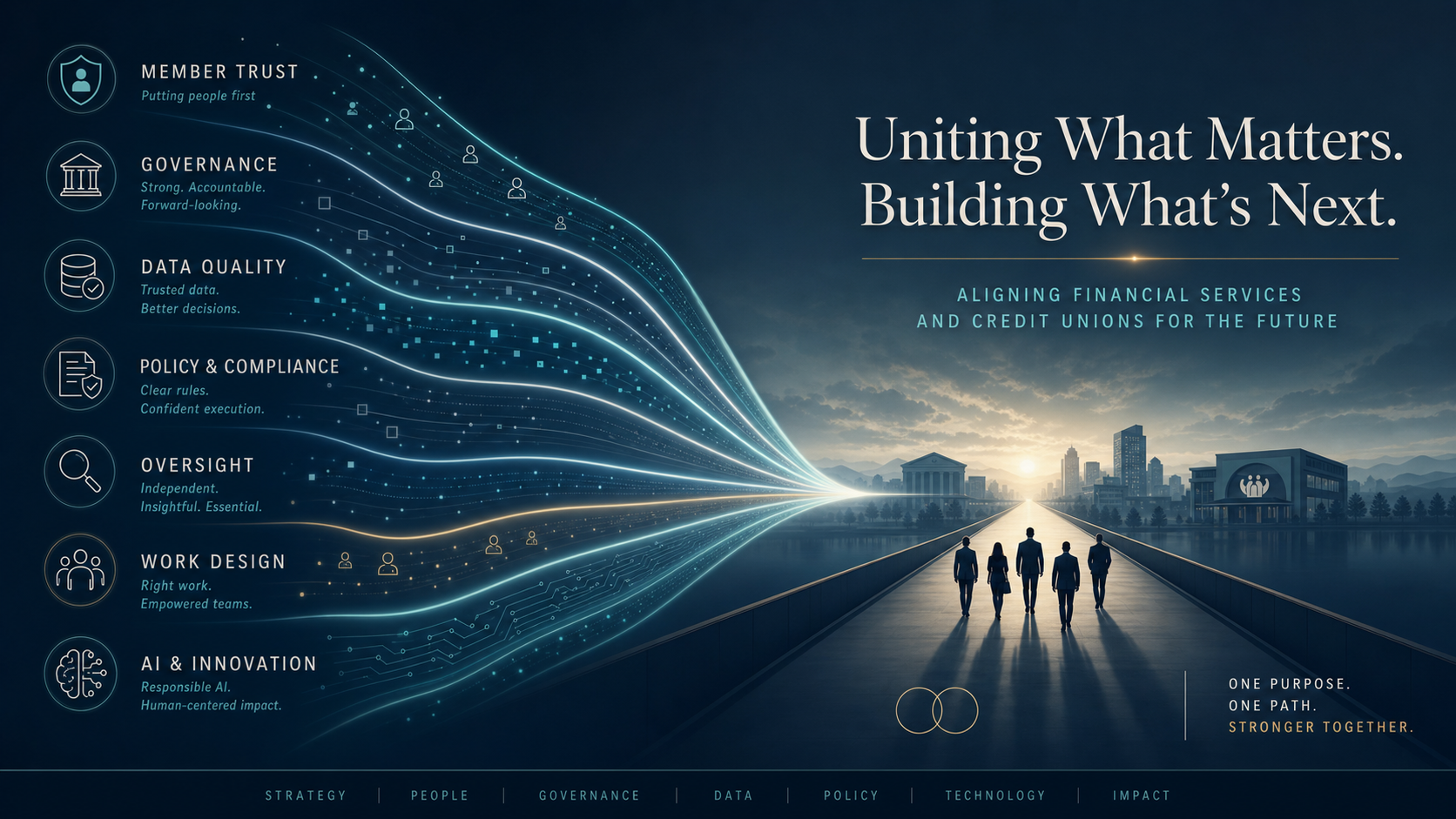
This is probably why I keep coming back to the idea that data and AI work has to be one coherent journey.
On the surface, these look like separate signals. But they all press on the same underlying issue. If a member walks in with a plan shaped by ChatGPT, that is partly a member experience issue. It is also a data issue if the institution only has a partial picture, a staff readiness issue if the employee has to respond with judgment and confidence, and a governance issue if the organization has not really worked through where AI fits and where it does not.
That is why the journey framing still helps me. It keeps the work from splitting into a handful of adjacent conversations that never quite connect. Data quality over here. AI over there. Governance in another meeting. Workforce readiness somewhere else. Strategy sitting above all of it in a slide deck.
In a lot of credit unions, I do not think those pieces come together later unless someone is very deliberate about making them come together now.
That feels closer to the real work. Not whether we can point to an AI strategy, but whether the institution is getting more coherent as these signals start arriving closer together. Better data. Clearer governance. Staff who are more prepared for the next kind of member conversation, not just the last one. A clearer sense of where to lean in and where to be careful.