March 19, 2026
One thing I always appreciate about events like Gartner and CULytics is that they can stretch your thinking a little. You leave with new language, new ideas, and usually a few conversations that stay with you longer than the slides do.
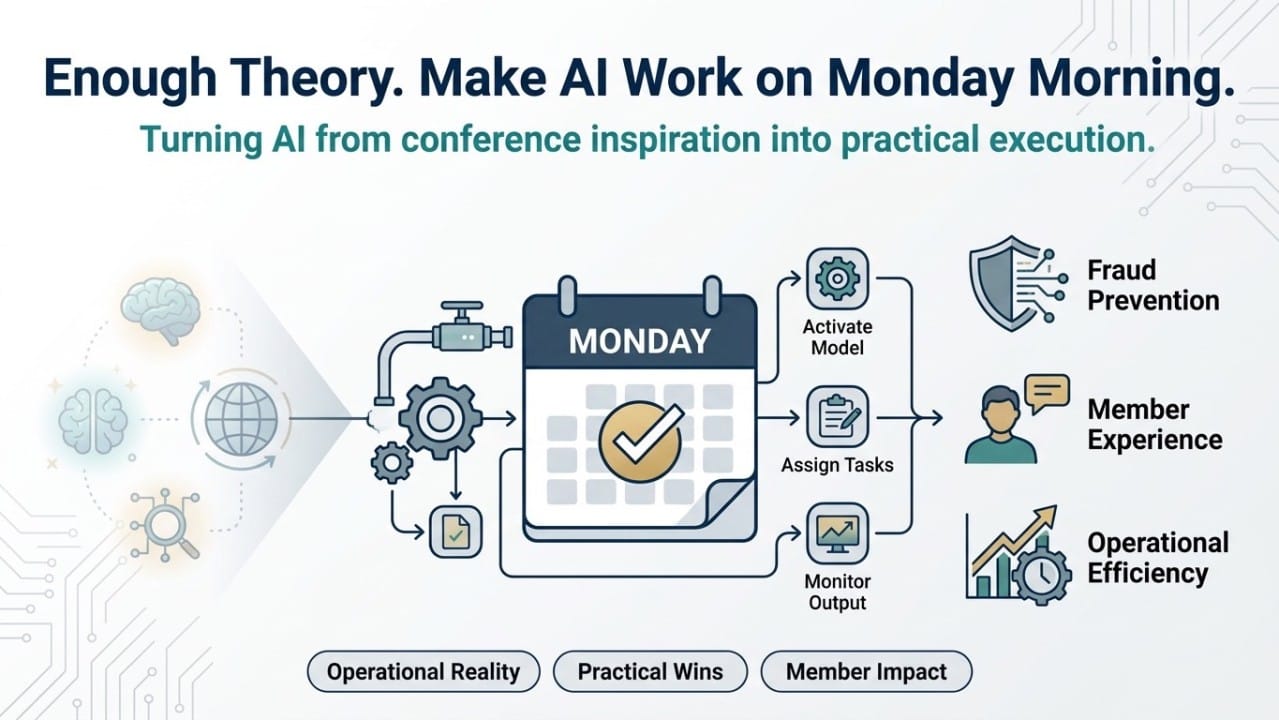
But then Monday morning shows up.
And that is where all of this gets real. Not in a keynote. Not in a demo. In the middle of legacy systems, limited capacity, budget tradeoffs, and a business that still needs to deliver for members today.
That is probably my biggest takeaway from the last two weeks. We are past the point where AI can just be interesting. It has to be useful.
We have talked a lot lately about agentic analytics, modern governance, and the organizational realities that can either accelerate AI or quietly stall it out. All of that matters. But eventually every one of those conversations runs into the same question: what are we actually going to do with it when we get back to work?
That is why Gartner’s latest State of Data & Analytics session felt grounded to me. The message was not that leaders need more ambition. It was that the real pressure points are practical ones: how to use budgets well, how to architect for scale, and how to drive adoption of AI in ways that actually stick across the business. Gartner’s survey also found that budget reductions or funding reallocations, limited workforce data and AI literacy, and talent shortages were among the biggest threats to success, while most organizations still have not integrated a full suite of AI techniques into their delivery models.
That sounds a lot more like the world most of us actually live in.
And to me, that is where the conversation gets better. Because once you accept that execution is the issue, the question changes. It is no longer “Do we believe AI matters?” It becomes “Where can we apply it in a way that solves a real problem, fits the way we operate, and earns the right to scale?”
You can see that kind of thinking in areas like fraud. Rippleshot says its network uses consortium data from more than 5,000 financial institutions and analyzes more than 50 million daily transactions to help banks and credit unions identify high-risk merchants, compromised cards, and emerging fraud patterns earlier. In one case study the company says a financial institution reduced false positives by 46 percent and achieved 7x ROI in the first year, and in another it reported a 58 percent drop in fraud rate and a 45 percent decrease in fraud dollars lost.
That is a good reminder that the most valuable AI stories are usually not the flashiest ones. They are the ones that help a member avoid friction, help a team act earlier, or help the organization make a better decision with more confidence.
For credit unions, I think that is the lens that matters most.
Our job is not to chase every trend. It is to translate what we are seeing in the broader market into something practical and trustworthy for our own institutions. Gartner gave us a useful macro view. CULytics added the grounded conversations with peers who are trying to solve similar problems in real environments. Now the next move is ours.
Not to build everything at once. Just to pick the next meaningful thing and operationalize it.
So that is probably the question I would leave on the table after the last couple of weeks:
What is the first thing you are actually going to change on Monday morning so your AI strategy starts looking more like execution and less like theory?