March 5, 2026
Mergers get evaluated like math, and I get why. Assets, market reach, balance sheet strength, all the things we can model.
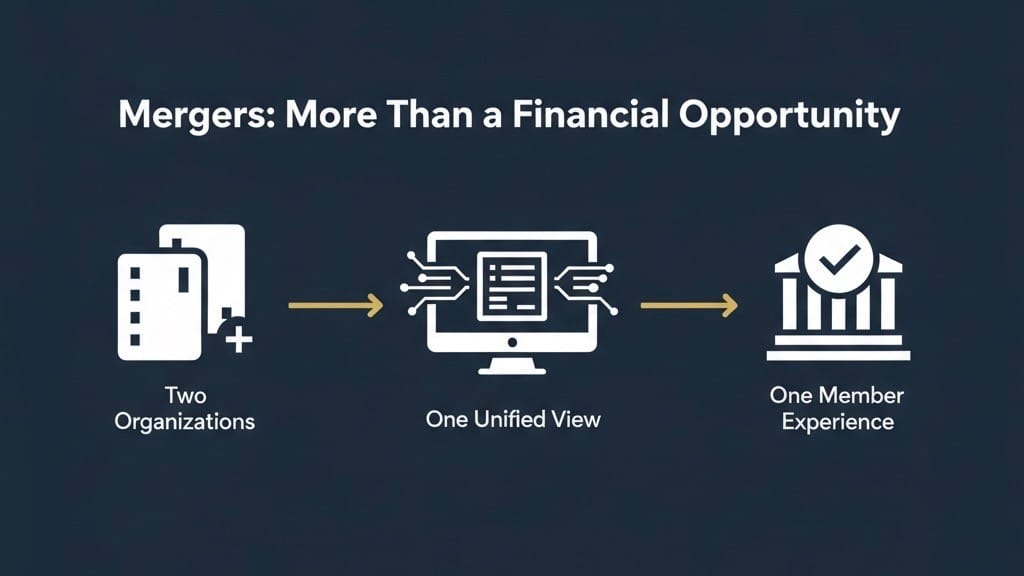
But the part I find most energizing is what it unlocks for members. When two credit unions come together, you suddenly have two sets of capabilities, two sets of lessons learned, and usually two different ways of serving members really well. If you take a “best of both” mindset, a merger becomes more than consolidation. It becomes a real opportunity to expand the ecosystem of services available to every member.
That mindset shows up in a simple question: what do we want the combined member experience to feel like, especially during the transition? Then you work backward from that.
A few questions I like because they keep it practical and keep the focus on members:
- What are the member moments we cannot afford to disrupt, even while systems are changing?
- Where does either organization already deliver a great experience that we can extend to the combined membership quickly?
- What needs to be standardized early to keep service consistent, and what can be sequenced over time without harming the member experience?
That last point matters because, in real life, the cores are almost never the same. Historically, the core conversion and the data migration are some of the most intensive and stressful parts of a merger integration. And when there is a multi-core transition period, members and staff are living in that in-between the whole time, so it is worth being deliberate about how you keep service consistent.
The tricky part is that transition period takes time, but members still expect a “one credit union” experience in the meantime. A solution I have seen is putting a shared data view on top of both environments so staff are not constantly bouncing between systems, and service stays consistent. On the connectivity side, having “one connection, multiple cores” capability can take pressure off the transition period and give you more flexibility in how you sequence the work. A unique solution I have worked with that brings those pieces together is Kinective, specifically their Data Intelligence platform and their Data Connectivity capabilities, and it can make the transition feel smoother because continuity stays front and center.
A well-executed integration does not just avoid disruption. It can leave members with a broader ecosystem of services, and it can feel more unified earlier than the core convergence date on the project plan.
If you are heading into a merger, what would you anchor on first to protect continuity: the member moments that matter most, the data view your teams operate from, or the connectivity that keeps day-to-day service moving?